Find the Cause. Prove the Fix.
A finding from an audit or a round arrives with its standard, its evidence and its location already attached. Open the root cause analysis on top of it, assign the corrective action to the department that owns the work, and track the clock from the first day.
Investigation That Proves, Not Assumes
A corrective action plan is only worth the analysis under it. Medlaunch keeps the finding, the analysis, the action, the owner and the evidence in one record, so the plan you hand a surveyor shows its own reasoning.
It Starts From the Finding
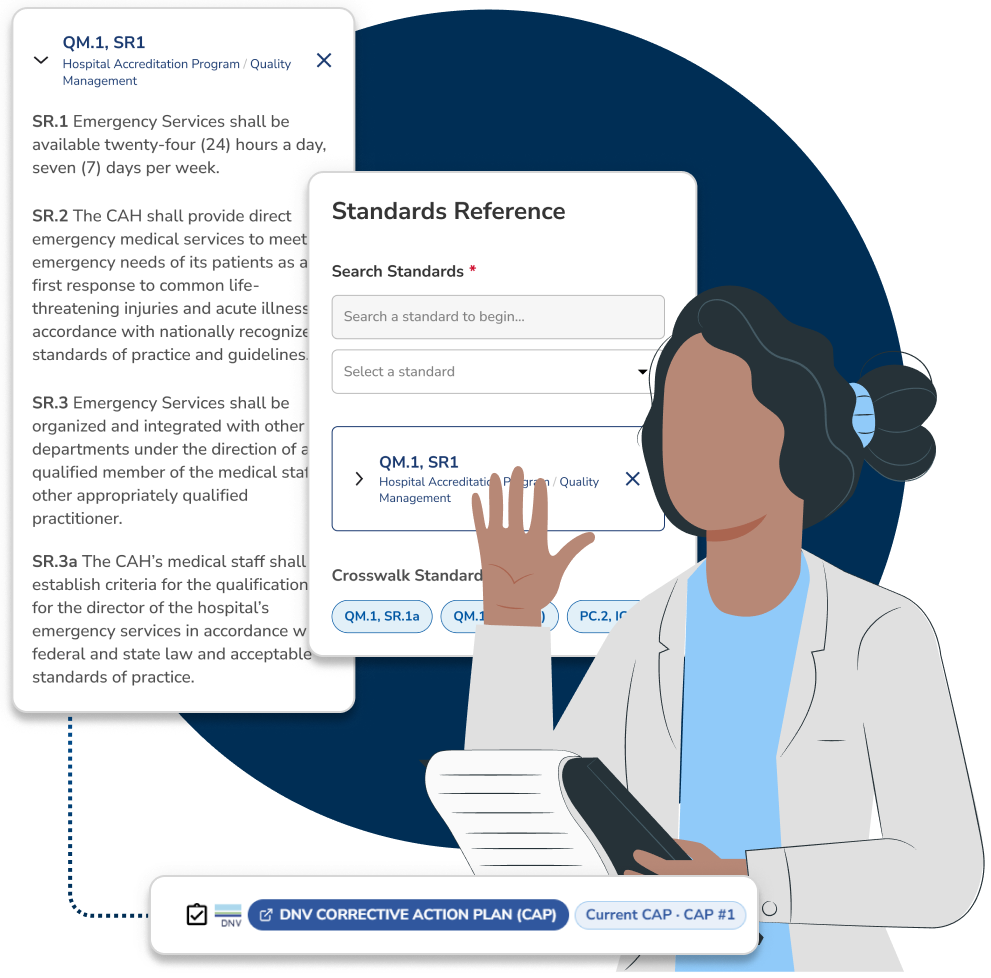
The RCA opens on top of the finding, not next to it. The cited standard, the evidence, the location, the department and the auditor's notes carry across. Nobody re-types the problem statement, and nothing is lost between the unit and the investigation.
Pick the Method That Fits
Structured RCA workflows, 5 Whys, fishbone, Failure Mode and Effects Analysis, with templates you build against your own standards, risk categories and accreditor requirements. Adapt the form by department, finding type or severity without maintaining five different documents.
Assign It Outside Your Department
Most corrective actions belong to someone who does not live in the quality module, facilities, pharmacy, EVS, nursing education. Assign the CAP to them directly, with the finding attached and the due date set. They get a task, not a login problem.
Let Rules Do the Routing
Write the rule once: this finding type, at this severity, opens a CAP, assigns this department and sets this deadline. Escalation, reminders and reassignment run without anyone remembering to chase.
Track the Clock
Response time from finding to RCA, RCA to CAP, CAP to closure. On-time completion rate. Overdue by department. The numbers exist because the platform timestamps the workflow, not because somebody maintained a tracker. Reporting and trending live in Relevance BI.
Closure Is Not the End
A CAP closes into a monitoring window, not an archive. Effectiveness criteria you defined are checked against real activity, and a recurrence reopens the plan.
One Finding, End to End
A worked example of the audit-origin story: a physical-environment nonconformity, from the round that found it to the proof that the fix held.
- The finding, during a quarterly Life Safety round on 4 West, a soiled utility room's rated door fails to self-close. Recorded as a nonconformity, cited to the Life Safety Code hazardous-area requirement (CMS tag K-0321), photographed, location and department attached.
- The analysis, the RCA opens from the finding. The team works 5 Whys to a systemic cause: the closer was swapped during a unit renovation for a non-rated unit, and the renovation change was never routed through Life Safety drawing review.
- The corrective action, three actions, three owners: Facilities replaces the closer and re-inspects every rated door on the campus; the Safety Officer amends the renovation change-control procedure; Education retrains the project coordinators. Each has a due date and a required piece of evidence.
- The policy it cited, because the finding cited a procedure, a rule pushes that procedure into review and starts its approval workflow. Nobody had to remember it.
- The proof, the CAP closes into a monitoring window. The effectiveness criterion your team set: zero rated-door failures across two consecutive quarterly Life Safety rounds, and no repeat citation at the next survey.
Related
- RCAs & CAPs in Risk ManagementThe same RCA and CAP engine handles safety events and incidents, where harm scoring, reportability and claims exposure change what the investigation has to prove.
- Effectiveness MonitoringA CAP closes into a monitoring window, not an archive.
- AuditsMost findings that open a CAP come from an internal audit.
- RoundsOthers come from a failed field on a routine round.
- AutomationsThe routing that opens a CAP is a rule you write once.
- Approval WorkflowsA finding that cites a procedure can push it into review and approval in MyPolicy.
- Vendor CAPsThe same corrective action engine runs when a vendor fails a contract evaluation.
- Reporting & DashboardsReport and trend these KPIs in Relevance BI.
Catch a Fix That Misses the Cause
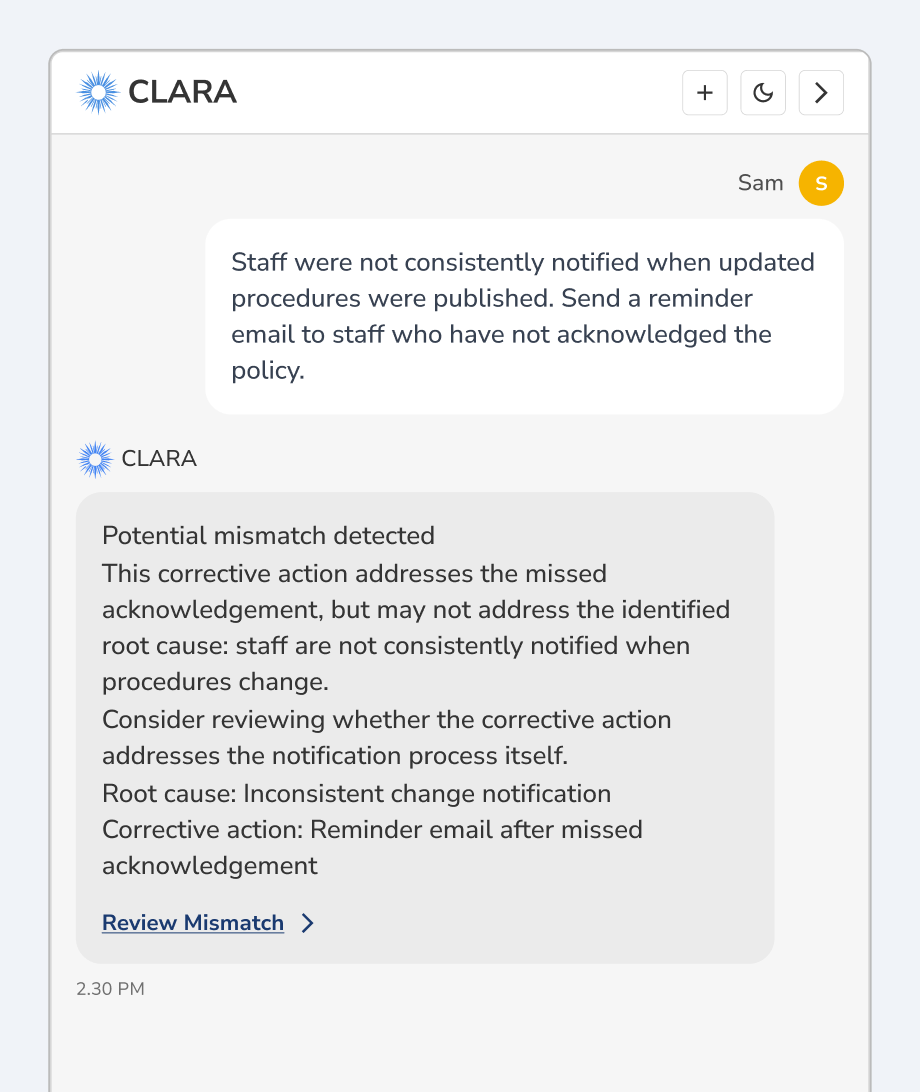
A corrective action that treats the symptom closes on time and comes back at the next survey. Clara reads the root cause your team named, reads the action written against it, and says so when the two do not line up. You decide whether she is right before the plan leaves your desk.
Keep the Clock in Plain Sight
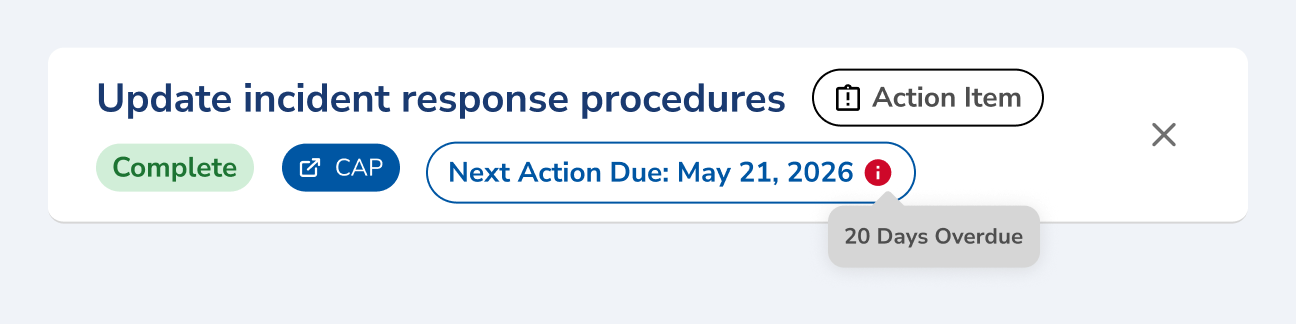
An action that slipped its date is invisible inside an email thread. Every CAP action carries its owner, its next due date and how far past that date it has run, with a link back to the plan it belongs to. Your team chases the one that is late instead of reading the whole list.
How Clara AI Enhances RCA & CAPs
Clara reads the finding, the standard it cited, and every prior analysis on that standard, then drafts the parts of the investigation that are already knowable. Your team owns the root cause. Clara owns the paperwork around it.

CLARA
Clarity in complianceClara reads
Clara proposes
Your team names the root cause and edits every drafted field. Clara flags a mismatch; she never closes an action.