The Vendor Owns the Fix. You Own the Record.
A vendor's corrective action has a problem your internal CAPs don't: the person who has to fix it doesn't work for you. Document what you asked for, track it to closure while the vendor owns the work, and escalate on terms your contract already gives you.
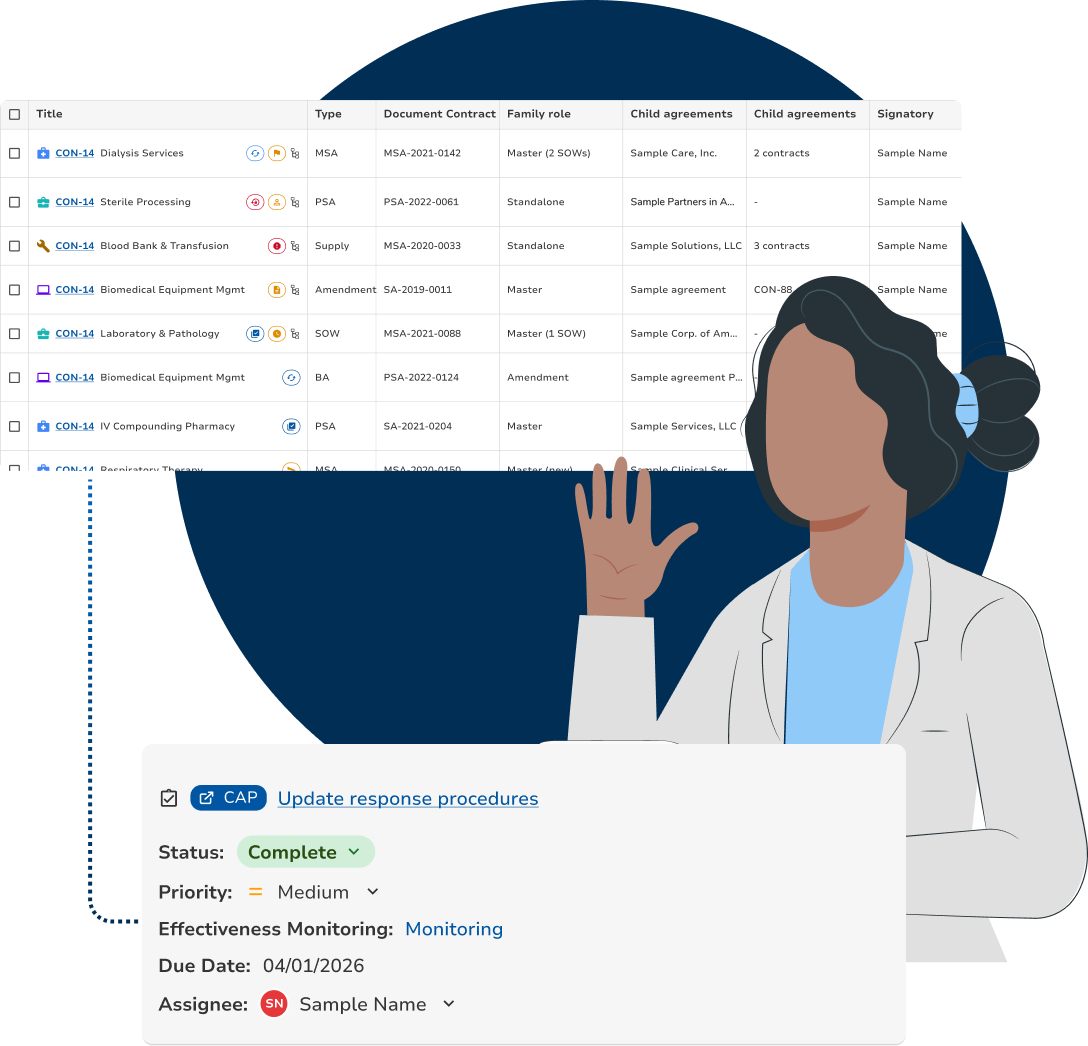
The safety events, patient complaints and findings that already name this vendor are what turn “we think this vendor is a problem” into evidence.
Two Owners, One Corrective Action
You cannot assign a task to someone else's employee. So a vendor corrective action carries an internal owner who is accountable for pursuing it and a vendor-side owner who is accountable for doing it.
Two Named Owners
Every vendor CAP has an internal owner and a vendor-side contact, both named. The internal owner gets the task, the reminders and the accountability for chasing. The vendor gets the request in writing. Nobody gets to be vaguely responsible.
The Clause Is Attached
Open the corrective action and the contract language it rests on is right there, the service level, the turnaround commitment, the quality standard. The person making the phone call knows exactly what was promised before they make it.
Evidence Arrives From Outside
The vendor sends a retraining roster, a corrected process document, a batch record. You attach it, and a named person marks it verified or not. Accepting a vendor’s word is a decision someone makes on the record, not a default.
A Dated Escalation Ladder
Rep, account manager, contract owner, executive sponsor, formal notice. Each rung has an owner and a date, and the ladder advances on the calendar rather than on somebody’s patience. What you tried and when is never in dispute.
Recurrence Is Visible
The fourth short-shipped tray does not look like the first. Prior corrective actions against the same vendor, the same service line and the same failure mode sit on the record, so a pattern gets treated as a pattern.
Closure Is Verified
A vendor CAP closes when the measurement moves, not when the vendor says it is fixed. You set what closure looks like when you open it, a clean month, a re-audit, three consecutive on-time deliveries, and closure waits for it.
What Your Contract Lets You Do
Your Leverage Is Already Written Down
Somewhere in the agreement you signed there is a cure period, a remedy and a termination right. Most organizations never use them because nobody chasing the problem has read them. Put the remedy terms on the corrective action itself, and the person making the call knows what they can actually say.
Cure Periods
Most agreements give a vendor a defined window to fix a breach before anything else is available to you. That window starts on a date, and the date belongs on the corrective action, not in a lawyer’s memory.
Service Credits and Remedies
Where the contract prices failure, the corrective action carries the entitlement. Missed turnaround targets and missed delivery windows are counted as they happen, so the credit is calculated from a record rather than reconstructed at renewal.
Escalation and Formal Notice
When informal escalation is exhausted, formal notice is the next rung, not a new project. The dates, the attempts and the vendor’s responses are already assembled, because they were captured while they happened.
Non-Renewal and Termination
A failed corrective action is the single most useful input to a renewal decision, and it should be sitting in front of the person making it. Open and failed CAPs surface on the vendor’s record when the renewal window opens.
Related
- RCA & CAPsWhen the finding is against your own process and staff, the corrective action lives in Quality Core.
- RCAs & CAPs in Risk ManagementWhen the trigger is a safety event or an incident with harm in play.
- Vendor OversightA vendor CAP usually starts as a number that moved the wrong way on a scorecard.
- Renewal TrackingAn open or failed corrective action is on the vendor's record when the renewal window opens.
- Ontology LayerVendors sit in the same connected model as the findings, events and contracts that touch them.
- Reporting & DashboardsExtract open corrective actions by vendor, by age and by service line.
- Policy-Driven AutomationA missed cure date can open a task or advance an escalation on its own.
How Clara AI Enhances
Vendor Corrective Actions
Clara does the reading and the remembering on this surface, finding the clause the failure breaches, drafting the request in language the vendor can act on, and noticing when a problem is not new. She never contacts a vendor and never closes a corrective action. You send it, you verify it, you close it.

CLARA
Clarity in complianceClara reads
Clara proposes
Clara drafts and flags. You edit the request, you send it, and you are the one who verifies and closes it.