Learn
What Are CMS Tags?
Anyone who has been through a CMS or state survey, or read a hospital's Statement of Deficiencies, has run into "tags": short alphanumeric codes like A-0057 or K-0321 attached to every citation. This page is a reference for what CMS tags actually are, where they come from, the main tag families relevant to hospitals, and what happens once one is cited.

Key takeaways
- A CMS tag is the code a surveyor cites a deficiency under. Each one maps to a specific requirement in the State Operations Manual.
- Hospitals meet three families most often: A-tags (hospital Conditions of Participation), K-tags (Life Safety Code), and E-tags (emergency preparedness).
- Condition-level deficiencies put Medicare participation at risk. Standard-level deficiencies require correction but generally do not.
- Every cited tag needs a plan of correction, and surveyors expect the correction to still hold at the next survey.
- Tracking policies, audits, and CAPAs at tag-level granularity is what makes readiness answerable tag by tag.
The Main Tag Families Relevant to Hospitals
Different SOM appendices use different tag prefixes. The three families hospitals encounter most often are:
A-tags, hospital Conditions of Participation (Appendix A). A-tags come from SOM Appendix A, "Survey Protocol, Regulations and Interpretive Guidelines for Hospitals," which interprets the hospital Conditions of Participation at 42 CFR Part 482 (CMS: SOM Appendix A, Hospitals). Each four-digit A-tag maps to a specific regulatory citation: Tag A-0020, for example, maps to 42 CFR §482.11 (Compliance with Federal, State, and Local Laws), while tags in the A-0700 range address the physical environment. A-tags span the full breadth of hospital operations: governing body, patient rights, QAPI, nursing services, medical staff, and infection control. CMS periodically revises Appendix A through numbered transmittals, so interpretive guidance under a given tag can change even when the underlying regulation doesn't.
K-tags, Life Safety Code (Appendix I). K-tags come from SOM Appendix I, "Survey Procedures for Life Safety Code Surveys," and are the data tags on the Fire Safety Survey Report (Form CMS-2786) used to assess compliance with the Life Safety Code and Health Care Facilities Code CMS has adopted (based on NFPA 101 and NFPA 99) (CMS: SOM Appendix I). K-tags cover the physical building and fire-safety systems, means of egress, fire and smoke barriers, corridor widths, hazardous area protection, fire alarm and sprinkler systems, and are frequently the responsibility of facilities/engineering teams working alongside quality staff.
E-tags, emergency preparedness (Appendix Z). E-tags come from SOM Appendix Z, "Emergency Preparedness for All Provider and Certified Supplier Types," covering the emergency preparedness Condition of Participation across 17 provider and supplier types, including hospitals (CMS: SOM Appendix Z). E-tags address the four core elements of the CMS Emergency Preparedness Rule: the emergency plan itself (risk assessment and all-hazards approach), policies and procedures, a communication plan, and a training and testing program. Tag E-0001 addresses the foundational requirement to develop and maintain an emergency preparedness program at all.
Other SOM appendices exist for other provider types and survey purposes, for example, separate appendices apply to psychiatric hospitals and critical access hospitals, each with its own tag numbering.
Condition-Level vs. Standard-Level Citations
Not every citation carries the same weight. CMS distinguishes between two levels of deficiency:
- Standard-level deficiency, noncompliance with one or more individual requirements ("standards") that make up a broader Condition of Participation, where the noncompliance is not, by itself, severe enough to substantially limit the hospital's capacity to furnish adequate care or to jeopardize patient health and safety.
- Condition-level deficiency, noncompliance serious or extensive enough, whether from a single severe finding or an accumulation of standard-level findings within the same condition, that it calls into question the hospital's overall compliance with an entire Condition of Participation.
CMS determines the level based on the nature (severity and potential for harm) and extent (how widespread or frequent) of the noncompliance found. This distinction matters because a condition-level deficiency puts a hospital's Medicare participation at risk, it can trigger a more serious enforcement track, including termination proceedings, whereas standard-level deficiencies generally require correction but don't independently threaten deemed status.
See it on your open findings.
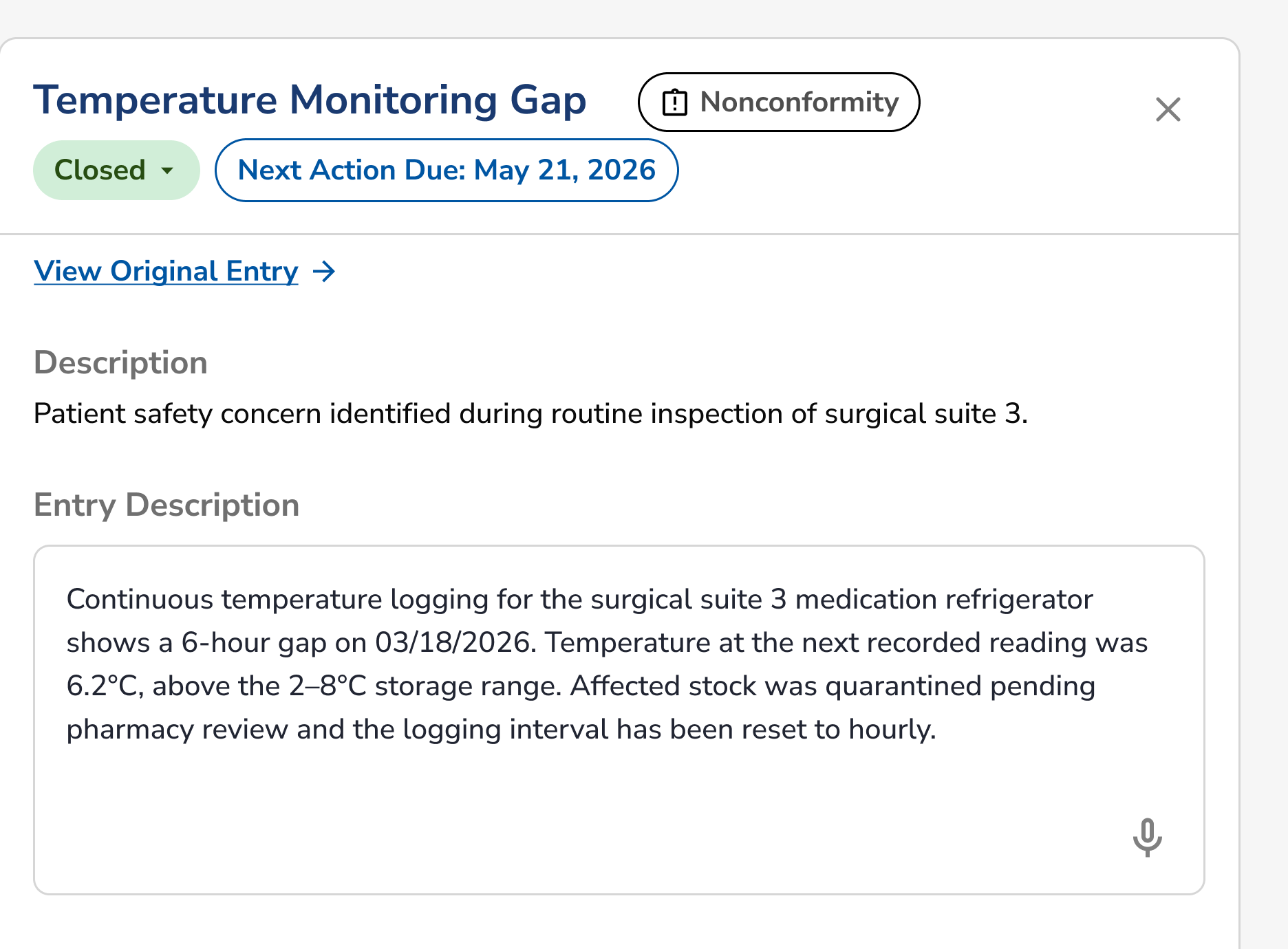
A demo takes a nonconformity you have open right now and walks it through to a closed corrective action, the entry it came from, the similar findings it matches, and the effectiveness check that closes it.
What Happens After a Citation
Once a survey concludes, findings are documented on the Statement of Deficiencies (Form CMS-2567), listing each cited tag with the regulatory language and the surveyor's factual findings. From there: the hospital submits a plan of correction (POC) responding to each cited tag, what will be done, who's responsible, and by when. Ten calendar days from receipt is a commonly cited submission window across CMS provider types, though hospitals should confirm the exact deadline in their survey exit documents, since it can vary by circumstance and state survey agency. Immediate jeopardy findings move faster: the hospital must implement an immediate removal plan and typically undergo an onsite revisit, with CMS setting a maximum processing window of 23 calendar days, measured from the last day of the survey through completion of termination procedures if it isn't resolved. For standard-track deficiencies, the state survey agency reviews the POC and may conduct a revisit to confirm corrective actions were actually implemented, not just documented, and cited tags don't disappear once a POC is accepted; surveyors expect sustained compliance at the next survey, not a one-time fix.
How Organizations Track Tag-Level Compliance
Because tags map directly to specific, citable regulatory requirements, the most effective compliance programs track internal audits, policies, and corrective actions at that same tag-level granularity, able to answer, for any given tag, which policy addresses it, when it was last audited, what open corrective actions relate to it, and how confident the organization is heading into its next survey.
Doing this consistently across hundreds of A-tags, dozens of K-tags, and the E-tag emergency preparedness requirements, across multiple accreditors and CMS itself, is difficult to sustain manually. In the Medlaunch platform, MyPolicy lets organizations tag individual policies to the specific CMS (and accreditor) standards they satisfy, Quality Core ties audit findings and CAPA items back to those same tags so gaps are visible before a surveyor finds them, and Relevance BI rolls that data up into ongoing readiness views by tag family, department, or condition.
Frequently asked questions
References
- CMS: State Operations Manual Appendix A, Hospitals
- CMS: State Operations Manual Appendix I, Survey Procedures for Life Safety Code
- CMS: State Operations Manual Appendix Z, Emergency Preparedness for All Provider and Certified Supplier Types
- CMS: State Operations Manual Chapter 2, The Certification Process (§2012, plan of correction submission)
- CMS: State Operations Manual Chapter 3, Additional Program Activities (§3010B, processing of immediate jeopardy terminations)
- CMS: Hospitals, Conditions for Coverage & Conditions of Participation
- CMS: Statement of Deficiencies and Plan of Correction (Form CMS-2567)
Keep reading
Related from Medlaunch
CMS Tags
How Medlaunch turns tag-level citations into tracked corrective action plans instead of a spreadsheet.
Read more →Conditions of Participation
The federal baseline at 42 CFR Part 482 that A-tags interpret, section by section.
Read more →What Is a Quality Management System?
The components a hospital needs in place before tag-level readiness is answerable at all.
Read more →