Blog
AI in Hospital Compliance: Why Governance Matters More Than Speed
Every hospital administrator has seen the demos by now. AI drafts a policy summary in seconds. AI pulls a CAPA history together before you've finished your coffee. AI turns a stack of survey evidence into a report a human would have spent a day building. None of that is the hard part anymore.

Key takeaways
- Shadow AI is already inside most health systems: 57% of healthcare professionals have encountered or used unauthorized AI tools at work, and 17% have used one themselves.
- Ungoverned AI creates three exposures a quality leader already owns, PHI leaving your controls, unreviewed output entering the record, and no audit trail behind either.
- Banning AI does not work. Staff reach for it because the documentation load is real, so the fix is a sanctioned alternative, not a policy memo.
- The standard is human-in-the-loop: AI drafts, a qualified human approves, every action is logged, and permissions govern what the AI can see.
- Clara runs inside the Medlaunch environment, role-based permissions, approval workflows, logged actions, so the speed arrives with the audit trail attached.
The Governance Gap: Shadow AI Is Already Inside Your Walls
The hard part is what happens when your compliance officer, your unit manager, or a new nurse educator pastes a patient safety event summary into a public chatbot to "help write it up faster", and nobody in the building knows it happened.
That's the real AI question hospitals need to be answering in 2026. Not "can AI make us faster," but "do we have governance over how AI touches our operations, our documentation, and our data." Speed without governance isn't a productivity win. It's exposure.
"Shadow AI", employees using AI tools that IT and compliance never vetted, approved, or even know about, is no longer a hypothetical risk for health systems. It's a documented, measurable one.
A December 2025 survey of 518 healthcare professionals, conducted on behalf of Wolters Kluwer Health, found that 40% had encountered an unauthorized AI tool in their organization but did not use it, and a further 17% admitted to using one themselves. That is 57%, a clear majority of the workforce, who have already met shadow AI inside their own organization (Wolters Kluwer Health, "Shadow AI" survey, published January 2026).
Sit with that for a second. This isn't a fringe behavior at the edges of the organization. More than one in six frontline healthcare professionals are running workplace tasks through tools that never went through a security review, a Business Associate Agreement, or a privacy assessment, because the tools weren't sanctioned to begin with, so there was nothing to review.
For a hospital quality or compliance leader, that statistic maps directly onto three risks you're already accountable for:
1. PHI exposure through tools you never vetted
Free or consumer-grade AI tools generally aren't built to HIPAA's standards, and many retain, train on, or otherwise process whatever gets pasted into them. If a staff member drops patient details, an incident narrative, or even de-identified-but-reconstructable data into an unapproved tool, that's a potential HIPAA exposure your compliance program had no visibility into, and no way to prevent, because it never went through your controls.
2. Unvetted outputs entering clinical and compliance documentation
AI-generated language finding its way into policy drafts, audit findings, or incident reports isn't inherently bad, but AI output that nobody reviewed, fact-checked, or approved absolutely is. An AI-drafted CAPA plan with a hallucinated regulatory citation, or a policy summary that quietly drops a required control, can sit in your record until a surveyor, or a plaintiff's attorney, finds it.
3. Accountability with no audit trail
When AI use happens outside sanctioned systems, there's no log of what was asked, what was generated, or who approved it before it became part of the official record. If a surveyor or investigator asks "who wrote this, and how was it verified," "an AI tool, and nobody checked" is not an answer a quality director wants to give.
None of this means hospitals should try to ban AI outright. Employees are reaching for these tools because the underlying problem, too much documentation, too little time, is real, and the demand for speed isn't going away. Banning shadow AI without giving staff a sanctioned alternative just pushes the behavior further underground. The fix isn't less AI. It's governed AI.
See it on your open findings.
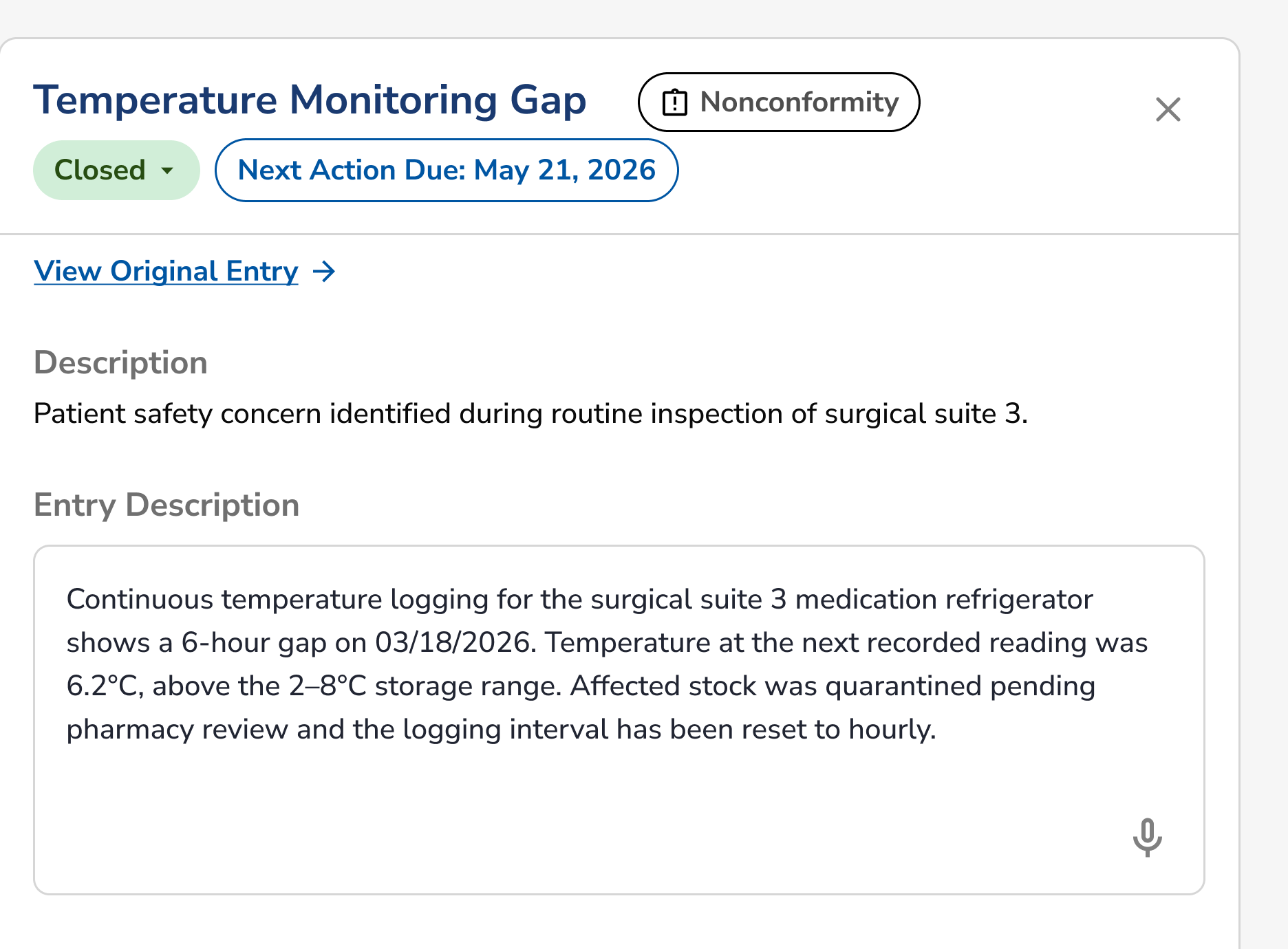
A demo takes a nonconformity you have open right now and walks it through to a closed corrective action, the entry it came from, the similar findings it matches, and the effectiveness check that closes it.
Human-in-the-Loop Isn't a Nice-to-Have, It's the Standard
The organizations getting AI right in healthcare aren't the ones with the flashiest automation. They're the ones that have made a simple principle non-negotiable: AI drafts, humans approve.
In practice, that means:
- AI accelerates the first draft, of a policy, an audit finding, a CAPA plan, an incident summary, but a qualified human reviews it before it becomes part of the compliance record.
- Every AI-assisted action is logged, not just the output. Who requested it, what data it touched, what changed, and who signed off.
- Approval workflows sit between AI output and anything binding, a policy going live, a CAPA being closed, a risk being downgraded. AI can recommend; it shouldn't get to decide unilaterally.
- Permissions govern what AI can see and touch, the same way they govern what a new hire or a contractor can see and touch. AI shouldn't have broader access to PHI or sensitive records than the least-privileged human on your team would.
This is what separates "we use AI" from "we govern AI", and increasingly, it's what surveyors, cyber insurers, and your own board are going to start asking about directly.
How Clara Gives You the Speed Without the Shadow AI Risk
This is exactly the gap Clara was built to close.
Clara is Medlaunch's AI agent, and it's built to work across your entire quality management stack end-to-end, Quality Core, Risk Management, MyPolicy, Vendor Management, and Relevance BI, rather than as a bolt-on chatbot that only knows what you paste into it. Because Clara operates inside the Medlaunch environment your team already uses for policies, audits, incidents, and CAPAs, it has real context: it knows your current policies, your standards mapping, your open findings, and your CAPA history, because that data already lives in the platform. There's nothing to copy and paste into a separate tool, and nothing leaves the environment to get there.
That context is what makes Clara useful in a way a generic AI tool can't be. And the governance built around it is what makes it safe to rely on:
- It stays inside the environment hospitals already trust. Clara operates within Medlaunch's SOC 2 Type 2-audited, HIPAA-compliant ecosystem. Patient and compliance data doesn't get exported to a third-party model outside your controls to get an AI-assisted answer.
- It respects role-based permissions. Clara can only see and act on what the requesting user is already authorized to see and act on, the same access boundaries your organization has already defined for that role.
- It works inside approval workflows, not around them. Clara can draft a policy update, surface a risk trend, or propose a CAPA, but the humans who are accountable for that content still review and approve it before it's final. Clara speeds up the work; it doesn't replace the sign-off.
- Every action is logged. What Clara was asked to do, what it touched, and what it produced is captured, giving compliance leaders the audit trail that shadow AI use, by definition, never has.
In other words, Clara solves the problem the Wolters Kluwer survey surfaces. Staff want AI-assisted speed, and they'll go find it somewhere if you don't provide it. Clara gives them that speed, but keeps it inside role-based permissions, logged actions, and a human-in-the-loop approval process, in an environment already built for HIPAA and audited to SOC 2 Type 2. Nothing leaves the platform to get the benefit.
Governance Is the Differentiator, Not the Constraint
Every quality management vendor is going to tell you their AI is fast. That's table stakes now. The question worth asking a vendor, or asking of your own internal shadow AI usage, is narrower and more important: where does the data go, who approved the output, and can you produce a log of it six months from now when a surveyor asks?
If you can't answer that today, that's the gap to close first, before adding more AI, not after.
Want to see how Clara and the Medlaunch stack keep AI-assisted speed inside a governed, auditable environment? Book a demo with our team.
Keep reading
Related from Medlaunch
How to Build a Hospital Quality Management System on the Medlaunch Stack
The build order, documents, audits, risk, KPIs, vendors, CAPA, that Clara reads across.
Read more →How My Policy Keeps Every Policy Audit-Ready
Version history, approvals, and attestation: the human sign-off an AI draft has to pass through.
Read more →What Is a Quality Management System?
The components AI has to operate inside before speed counts as an improvement.
Read more →