Blog
How Quality Core Closes the Loop: From Finding to Proven Fix
Most quality management systems are good at one thing: recording that a problem was found and that "something" was done about it. Very few actually close the loop, verifying the fix worked, and remembering whether it worked the last time you tried it. Quality Core is built around the entire lifecycle, not just the paperwork trail, from the moment a surveyor or an internal auditor spots an issue through the point where you can prove, with data, that the fix held.

Key takeaways
- Closing the loop takes three phases, the survey that finds the issue, the triage that assigns it, and the effectiveness monitoring that proves the fix held. Most QMS tools stop after the second.
- Findings enter through custom forms built against the standard you are actually surveyed on, NIAHO, CMS, OSHA, ISO, NFPA, or by voice through Clara, on your phone, mid-round.
- Every finding becomes a ticket with full lifecycle tracking, routed and dated by rules you define rather than by someone remembering to forward an email.
- Effectiveness determination is built into the ticket lifecycle and paired with AI-powered recurrence tracking, so "did this corrective action plan work?" has a data-backed answer instead of an assumption.
- When something does recur, Quality Core shows whether it came back at your site or across the system, a local process breakdown reads differently from a systemic gap.
Phase 1: It Starts With a Survey
Here's what that looks like in practice, broken into the three phases every finding moves through.
Every closed loop starts with an open finding. That finding usually comes from one of two places: a formal internal audit, or a round, someone walking the floor checking against a standard.
Custom Forms as Audit Tools
Quality Core lets you build custom forms to use as your audit instruments, structured, standard-specific checklists your team fills out during an audit or round. Because audit content in a hospital spans everything from NIAHO to CMS to OSHA to ISO to NFPA, your forms aren't generic checklists; they can be built to match whatever standard or framework you're actually being surveyed against.
Or Capture Findings by Voice, Mid-Round
Rounding doesn't stop for paperwork, so Quality Core doesn't require you to stop rounding to document. The Clara agent lets you fill out findings by voice, directly on your phone, while you're walking your rounds. Spot an issue, say it, and the finding gets captured without breaking stride to tap through a form on a clipboard or tablet.
Phase 2: The Triage Phase
A finding by itself doesn't fix anything. It has to become an assigned, tracked piece of work, and that's where a lot of manual processes, and a lot of QMS software, fall apart, because tickets get created but not routed, or routed but never followed up on.
Full Ticket Lifecycle Management
Every finding in Quality Core becomes a ticket with full lifecycle tracking, governed by rules that are built in but customizable to your organization's own policies. You define how findings route, who owns which categories of issue, and what due dates apply, and Quality Core applies that logic automatically rather than relying on someone remembering to forward an email or flag a spreadsheet row.
A Library Built for the Real Work of Getting to Root Cause
Fixing the underlying problem, not just the symptom, needs the right analytical tools on hand. Quality Core ships with more than 5,000 custom forms and templates covering things like CAHPS-related issues and formal root cause analysis (RCA), plus other frameworks teams use to work through a finding methodically. Ticket owners aren't starting from a blank page every time a new item lands in their queue.
See it on your open findings.
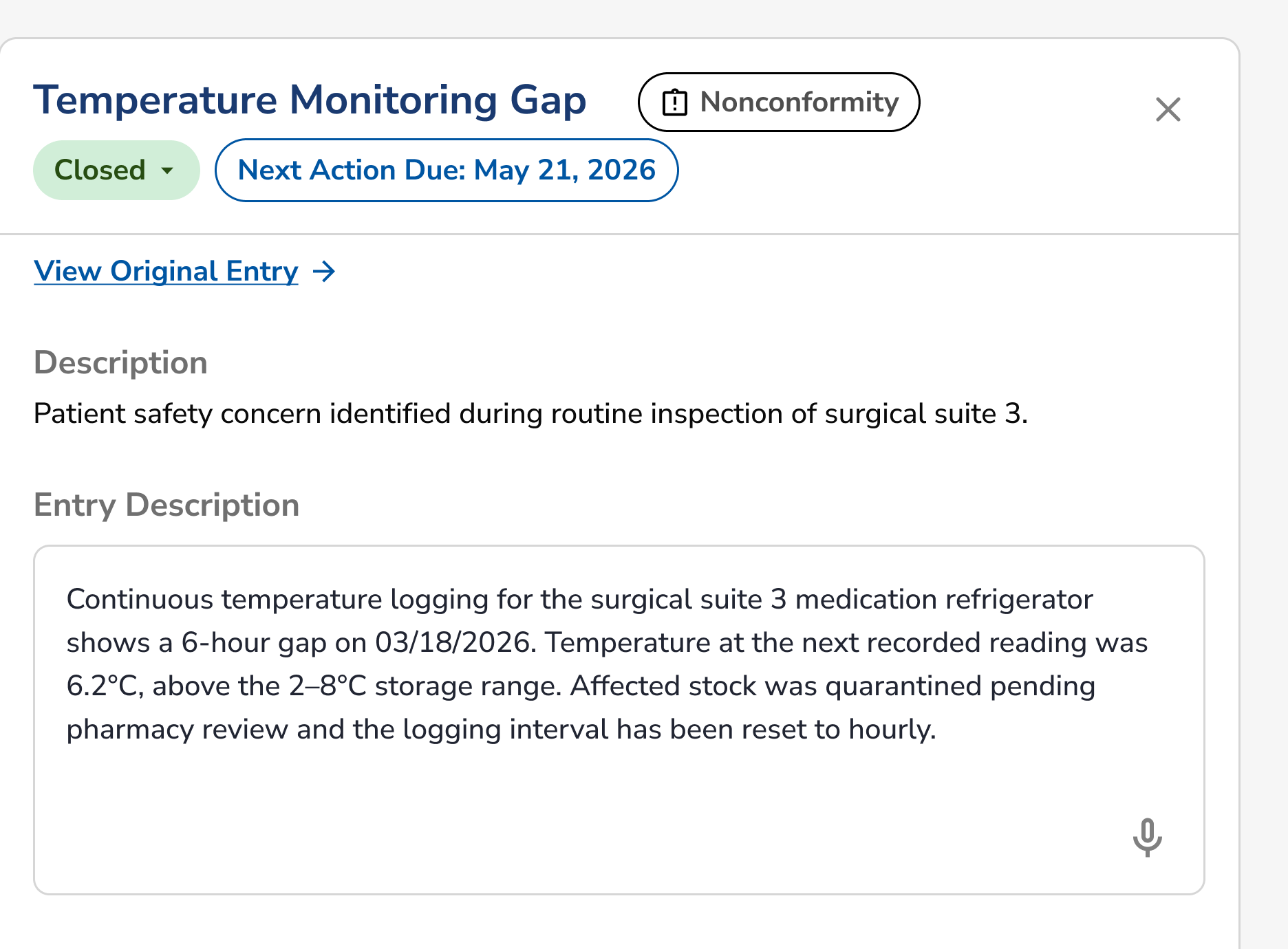
A demo takes a nonconformity you have open right now and walks it through to a closed corrective action, the entry it came from, the similar findings it matches, and the effectiveness check that closes it.
Phase 3: Effectiveness Monitoring, The Part Most QMS Tools Skip
This is where Quality Core actually diverges from most audit and ticketing software. A corrective action plan (CAP) getting marked "complete" tells you a task was done. It doesn't tell you whether the underlying problem is actually gone.
Effectiveness Determinations, Backed by Automated Recurrence Tracking
Quality Core builds effectiveness determination directly into the ticket lifecycle, paired with automated recurrence tracking powered by AI. Instead of closing a CAP and hoping, the system keeps watching for the same or a related finding to resurface, so you have an actual, data-backed answer to "did this corrective action plan work?" rather than an assumption made at the moment the ticket was closed.
Site-Level or System-Wide, You See Where It Recurred
If a recurrence does show up, Quality Core shows whether it happened again at your site or somewhere else across your system. That distinction matters. An issue that keeps resurfacing at one location might point to a local process breakdown; the same finding popping up at multiple sites points to a systemic gap. Quality Core surfaces that finding system-wide so other sites aren't caught flat-footed by a problem you already know about.
Learning From What Worked (and What Didn't)
Because Quality Core tracks effectiveness over time, you build a record of which corrective action plans actually held up historically and which didn't. That history is what you draw on for the next CAP dealing with a similar issue, you're not reinventing an approach that's already failed twice; you're adapting your next corrective action plan based on what's actually worked before, and continuously improving as a result.
Closing the Loop Is the Whole Point
Most organizations' quality programs stop at "CAP filed." The finding was documented, a plan was written, a box was checked, and the file gets closed. Quality Core treats that as the middle of the process, not the end of it. It keeps watching after the CAP is implemented, checks for recurrence, and tells you, definitively, whether the fix actually worked.
That's the difference between a system that manages paperwork and a system that manages quality. Surveys, tickets, and CAPs are how you find and respond to problems. Effectiveness monitoring is how you know you actually solved them.
See Quality Core close the loop on your own findings. Book a demo with Medlaunch Concepts and we'll walk through the full lifecycle, from a round captured by voice to an effectiveness determination made months later.
Keep reading
Related from Medlaunch
How My Policy Keeps Every Policy Audit-Ready
The controlled document a finding is written against, and the approval history behind it.
Read more →How to Build a Hospital Quality Management System on the Medlaunch Stack
Where the evidence engine and the CAPA loop sit in the build order, module by module.
Read more →What Is a Quality Management System?
The plain-language version of the loop this post runs end to end.
Read more →