All organization sizes

Healthcare Organization Size

Enterprise Compliance and Quality Management for Integrated Delivery Networks

Hospitals, ambulatory, post-acute, physician practices: one enterprise, one board, one regulatory story that has to hold together across every region and every entity. Medlaunch is built for that scale.

What breaks first

At this scale, the work outruns the tools

The work gets done; proving it is the problem

At this scale, the pain isn't whether compliance work is getting done at any given facility, it almost always is.

Governance is the real challenge

The pain is governance: can the enterprise prove consistent standards, evidence, and corrective action across a sprawling, heterogeneous organization, in real time, to a board quality committee and to regulators, without every quarterly report being a weeks-long reconciliation project pulled together from dozens of disconnected local systems.

What an IDN / Enterprise Organization Looks Like

An integrated delivery network spans the full continuum of care: acute hospitals, ambulatory surgery centers, physician practices, post-acute and home health, sometimes a payer arm, often across multiple regions or a national footprint, and often growing through M&A that brings new entities with their own legacy systems, taxonomies, and cultures.

Hundredsof entities feeding one ontology, across every region and every line of business.

ISO-Aligned Quality Management as Enterprise Governance

At enterprise scale, ISO alignment stops being a facility-level tool and becomes the operating language of the organization, a common management-system framework spoken the same way in a hospital, an ambulatory center, and a physician practice, with quality objectives tied directly to enterprise risk appetite. Audit programs stay standardized at the core while flexing for local regulatory nuance, and continuous improvement runs as an embedded discipline from the frontline all the way to the board, not a periodic initiative.

Survey Readiness Across the Enterprise

With unannounced survey cycles hitting different entities across the network continuously, survey readiness has to be a permanent enterprise state rather than a project anywhere. Reporting is run on demand, by entity, by region, or enterprise-wide, and consistent survey performance across the network becomes a real asset: for payer contracts, for referral relationships, and for M&A due diligence when the next entity joins.

Built for the Enterprise

Talk to Medlaunch about a network-wide rollout, FDE-led, integration-first, and built around the same ontology and network effect that make the whole enterprise smarter every time one entity learns something.

In the platform

What you run it with

Every claim below is a screen you can open in a demo.

01

The Medlaunch Stack at Enterprise Scale

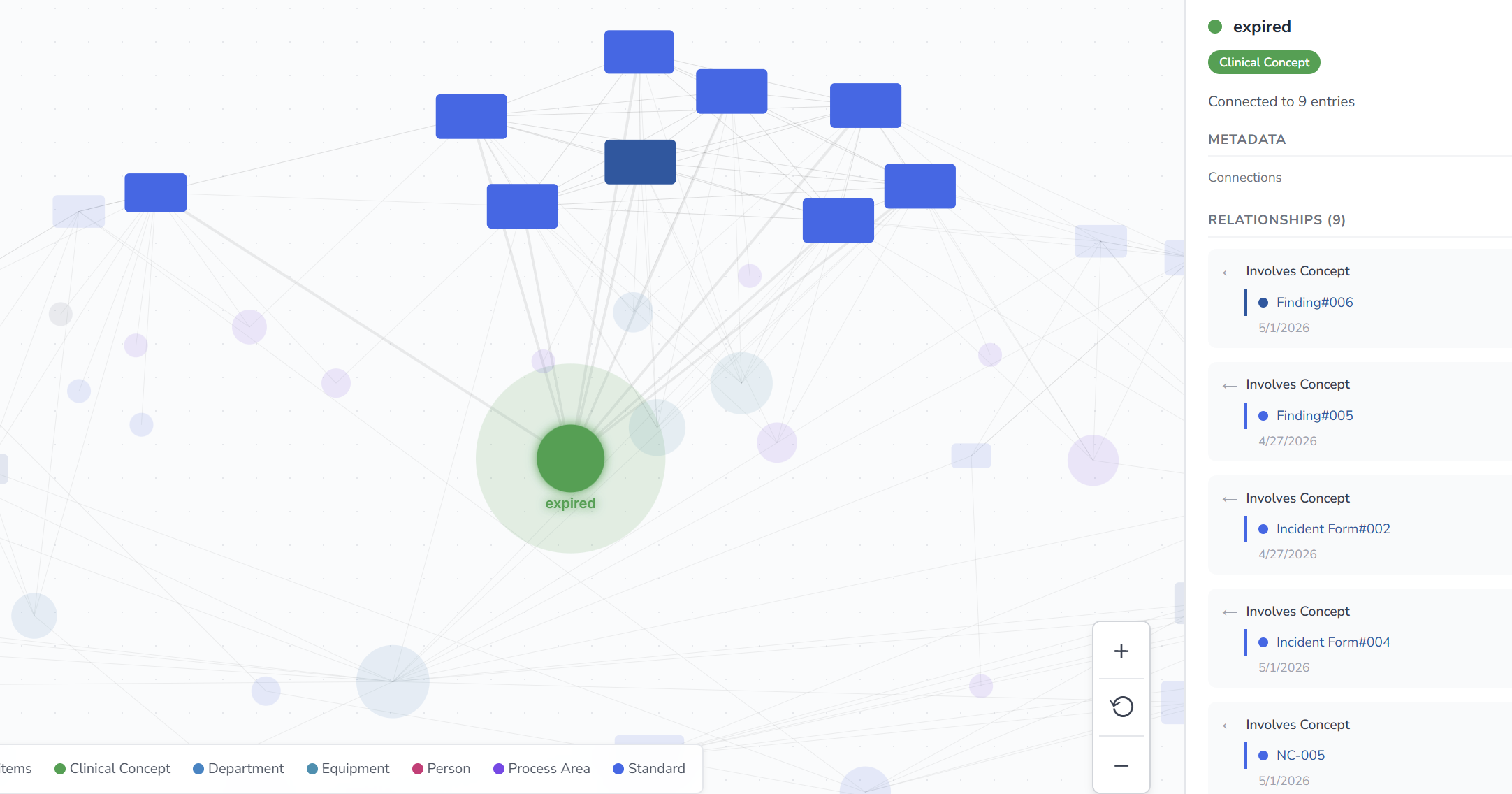
The ontology layer carries the most weight at this scale: every standard, every policy, every audit, every finding, every CAPA, and every incident or safety event, across every region and every line of business, lives in one connected data model. When a regulation changes, that change traces automatically to every affected policy and every affected entity, instead of relying on a memo campaign and hoping every facility updates in time.

Ontology graph centered on an "expired" Clinical Concept node, fanned out to its 9 downstream relationships across findings, incident forms, and nonconformance records.

02

The network effect as enterprise risk intelligence

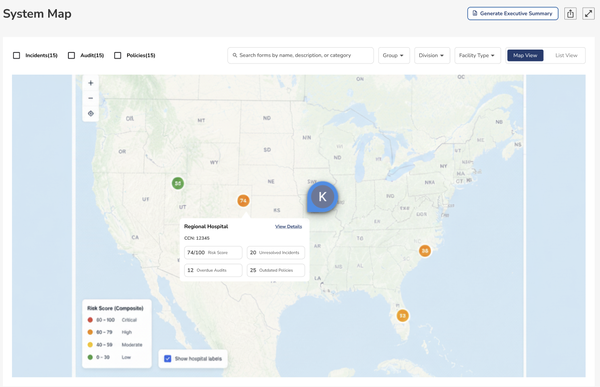
The network effect is where enterprise scale becomes a genuine advantage rather than just a management burden. With hundreds of entities feeding the same ontology, Relevance BI functions as real enterprise risk intelligence, a pattern identified in one region's incident data predicts and helps prevent recurrence across the entire network, and portfolio-level risk heat-mapping gives the board a real-time view instead of a quarterly snapshot. Institutional learning compounds across the enterprise instead of resetting every time a new entity is acquired.

System Map view scoring every facility by risk across the network, with a facility panel open showing its risk score, unresolved incidents, overdue audits, and outdated policies.

03

Thousands of users, and Clara making the scale sustainable

With thousands of users spanning entities, disciplines, and inherited system cultures, a platform genuinely built for usability, not a bolted-together enterprise GRC tool, is what determines whether adoption holds or the system becomes shelfware in half your entities. And Clara is what makes the scale sustainable at all: drafting findings across thousands of monthly rounds and audits, routing CAPAs by ontology-mapped ownership across hundreds of entities, managing reminders at a volume no team could handle manually, and surfacing systemic risk to leadership before it becomes a surprise at the board table.

Deployment

Forward-deployed engineers, embedded for the network rollout

At enterprise scale, forward-deployed engineers function as an embedded extension of your quality and IT teams for the full network rollout, phased onboarding entity by entity, mapping heterogeneous facility types and legacy taxonomies inherited through M&A into the shared ontology, migrating data out of legacy GRC tools and spreadsheets, and configuring workflows by line of business and region.

Integrations

Integration that runs as deep as the network

Integration runs deep to match: multiple EHR platforms, ERP, HRIS across tens of thousands of employees, enterprise SSO and identity, existing incident and event systems bridged or consolidated, and data warehouse feeds so Relevance BI output lands directly in the reporting fabric your board already uses.

  • Multiple EHR platforms
  • ERP
  • HRIS
  • Enterprise SSO and identity
  • Incident and event systems
  • Data warehouse feeds

See it running at your size.

Book a demo and we will walk through Medlaunch across the facilities you actually run.

Book a Demo