
Patient Rights

Patient Complaint and Grievance Management

Medlaunch turns every patient complaint into a tracked grievance ticket with a running deadline clock, so nothing goes past due.

What the grievance process requires

Hospitals that participate in Medicare and Medicaid must maintain a patient grievance process under the Patient Rights Condition of Participation (42 CFR §482.13), with CMS's expectations for how that process runs spelled out further in its interpretive guidance (State Operations Manual, Appendix A).
The regulation itself does not set a fixed number of days for resolving a grievance. CMS guidance calls for grievances to be resolved within a reasonable time frame and has referenced roughly 7 days as generally appropriate; when a grievance needs longer, the hospital has to tell the complainant it is still working on it and provide a written response by a stated date.

Whatever specific acknowledgment and resolution windows a hospital commits to, drawn from CMS guidance, a state requirement, or its own grievance policy, are deadlines that have to be tracked on every open complaint at once, which is exactly what breaks down in a shared spreadsheet or an inbox full of reminders.

In the platform

How Medlaunch keeps every deadline on track

Every claim below is a screen you can open in a demo.

01

Every complaint becomes a tracked grievance ticket

When a patient complaint logged in Risk Management is classified as a grievance, Medlaunch opens a ticket that carries the complaint description and the follow-up actions assigned to close it out, alongside a CMS Deadlines panel tracking the acknowledgment and resolution clocks that apply to it and a Next Action Due date that keeps the next step visible. It's one record instead of a log in one place and reminders in another.

Grievance ticket detail view for an example "Medication error" complaint: To Do and Grievance status tags, a Next Action Due date, a CMS Deadlines panel showing a 7-day acknowledgment clock marked overdue and a 30-day resolution clock showing days remaining, a complaint description field, and an Actions list with an assigned follow-up letter.

02

Two clocks per grievance, configured to your policy

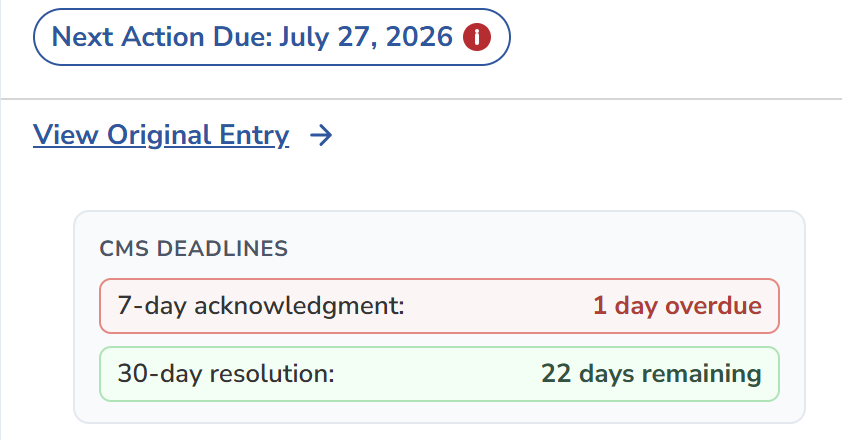
The CMS Deadlines panel tracks two clocks on every grievance: an acknowledgment clock and a resolution clock, each counting down the days remaining or flagging red the moment it's overdue. The example shown here uses a 7-day acknowledgment window and a 30-day resolution window; CMS guidance calls for grievances to be resolved within a reasonable time frame and has referenced roughly 7 days as generally appropriate, but sets no universal deadline, so the windows that actually fire are configured to match your hospital's own grievance policy in My Policy and any state rule that applies.

The CMS Deadlines widget on its own: a Next Action Due date and a View Original Entry link above a CMS Deadlines panel showing a 7-day acknowledgment clock marked overdue and a 30-day resolution clock showing days remaining.

Frequently asked questions

What does CMS require for a hospital patient grievance process?

Hospitals that participate in Medicare and Medicaid must maintain a patient grievance process under the Patient Rights Condition of Participation, 42 CFR §482.13. The hospital's governing body is responsible for the process, and CMS expects each grievance to be reviewed, investigated, and resolved, with written notice of the hospital's decision provided to the patient or their representative.

How quickly does a patient grievance have to be resolved?

The Condition of Participation sets no fixed number of days. CMS interpretive guidance (State Operations Manual, Appendix A) calls for resolution within a reasonable time frame and has referenced roughly 7 days as generally appropriate. When a grievance needs longer, the hospital has to tell the complainant it is still working on it and provide a written response by a stated date. There is no universal CMS 30-day resolution mandate; the specific windows come from your own grievance policy and any state rule that applies.

What is the difference between a patient complaint and a grievance?

CMS treats them differently. A concern that staff present can resolve promptly is generally a complaint, not a formal grievance. A written complaint, a concern that cannot be resolved at the time it is raised, or one that alleges a quality or safety problem, abuse, or neglect is handled as a grievance under the formal process. In Medlaunch, staff classify a complaint as a grievance, and at that point the acknowledgment and resolution clocks and the formal workflow apply.

See every complaint on the clock.

Book a demo and we will walk through how a patient complaint becomes a tracked grievance ticket, with acknowledgment and resolution deadlines matched to your own policy.

Book a Demo