Learn
What Is a Quality Management System?
Every hospital has some way of managing quality, a handful of binders, a shared drive full of policies, or a dedicated software platform. The question is whether that system actually works: whether it catches problems, closes the loop on corrective actions, and produces evidence a surveyor (or your own leadership) can trust. This page explains what a quality management system (QMS) is, what it's made of in a hospital setting, and what separates a functional QMS from one that just exists on paper.

Key takeaways
- A QMS is the whole system a hospital uses to manage quality, not one department, and not one piece of software.
- Eight components carry it: document control, audits and rounds, incident reporting, CAPA, risk, KPIs, vendor oversight, and training.
- Every CMS-participating hospital already runs one. QAPI under 42 CFR §482.21 is the floor, not an upgrade.
- Accreditors differ in survey method, not in building blocks, DNV NIAHO, The Joint Commission, and CMS check the same components.
- The gap between a paper QMS and a software QMS is whether evidence stays current or gets reconstructed under deadline.
What Is a QMS?
A quality management system is the coordinated set of processes, documentation, roles, and tools an organization uses to consistently meet quality objectives, regulatory requirements, and the needs of the people it serves, and to identify and correct problems when it doesn't. The concept originates in general quality standards like ISO 9001, but every accredited healthcare organization runs some version of a QMS, whether or not it's formally labeled that way.
In a hospital, a QMS isn't a single piece of software or a single department's responsibility. It's the connective tissue between policy, practice, measurement, and improvement, spanning infection prevention, nursing, environment of care, pharmacy, and every other function subject to internal or external oversight.
Core Components of a Healthcare QMS
A mature hospital QMS typically includes the following building blocks, each covering a different part of the quality lifecycle:
- Document control, policies, procedures, and forms need a single source of truth: a defined owner, version history, a review cycle, and proof staff have read and attested to the current version. Uncontrolled documents commonly lead to outdated policies still in circulation, a frequent survey finding on its own.
- Audits and rounds, internal audits and leadership/environment-of-care rounds are how a hospital checks its own compliance before a regulator does, using tracer methodology, unit-based rounding, and condition-specific audits (infection control, medication management, life safety), each generating findings that must be tracked to resolution.
- Incident and safety event reporting, a structured way for staff to report incidents, near misses, and safety events, and for that data to reach the people who can act on it. This connects directly to the hospital Condition of Participation for Quality Assessment and Performance Improvement (QAPI, 42 CFR §482.21), which expects hospitals to track adverse events and use data to drive improvement (eCFR: 42 CFR 482.21).
- CAPA (corrective and preventive action), findings from audits, incidents, or complaints only matter if they lead to documented action: a clear owner, root cause, action plan, due date, and verification the fix worked. A CAPA process that loses track of open items is one of the most common gaps surveyors identify, and it's central to the ISO 9001 principles built into DNV's NIAHO accreditation program.
- Risk management, a forward-looking risk registry that proactively identifies risks across clinical, operational, life safety, and cybersecurity domains, scores them, and tracks mitigation, so incident data, audit findings, and external intelligence (recalls, advisories) converge into one prioritized view.
- KPI monitoring, defined key performance indicators (readmission rates, hand hygiene compliance, fall rates, medication error rates) tracked over time, benchmarked, and visible to the people accountable for them, not buried in a static quarterly report.
- Vendor and third-party oversight, hospitals rely on outside vendors for everything from sterile processing to IT systems, and CMS and accreditors increasingly expect documented oversight, contracts, credentialing, performance monitoring, and risk assessment of vendors touching patient care or protected data.
- Training and competency, a way to assign, track, and document training and competency validation, and to tie training gaps back to incidents or audit findings when they occur.
Paper/Spreadsheet QMS vs. Software QMS
Many of the components above can technically be run manually, and for a long time most hospitals did exactly that, with policy binders, Excel-based CAPA logs, and rounding checklists on clipboards. The limitations show up predictably: no single source of truth for which policy version staff are actually using, CAPAs that quietly go untracked once the person who opened them gets busy, KPI trends leadership only sees after someone manually compiles a report, survey prep that becomes a scramble instead of a constant state, and no reliable audit trail proving when something was reviewed or who attested to training.
A software QMS addresses these gaps by centralizing document control, audit findings, incident data, CAPA, risk, and KPIs in one connected system, so evidence is current by default rather than reconstructed under deadline pressure, and leadership can see quality performance in real time rather than after the fact.
See it on your open findings.
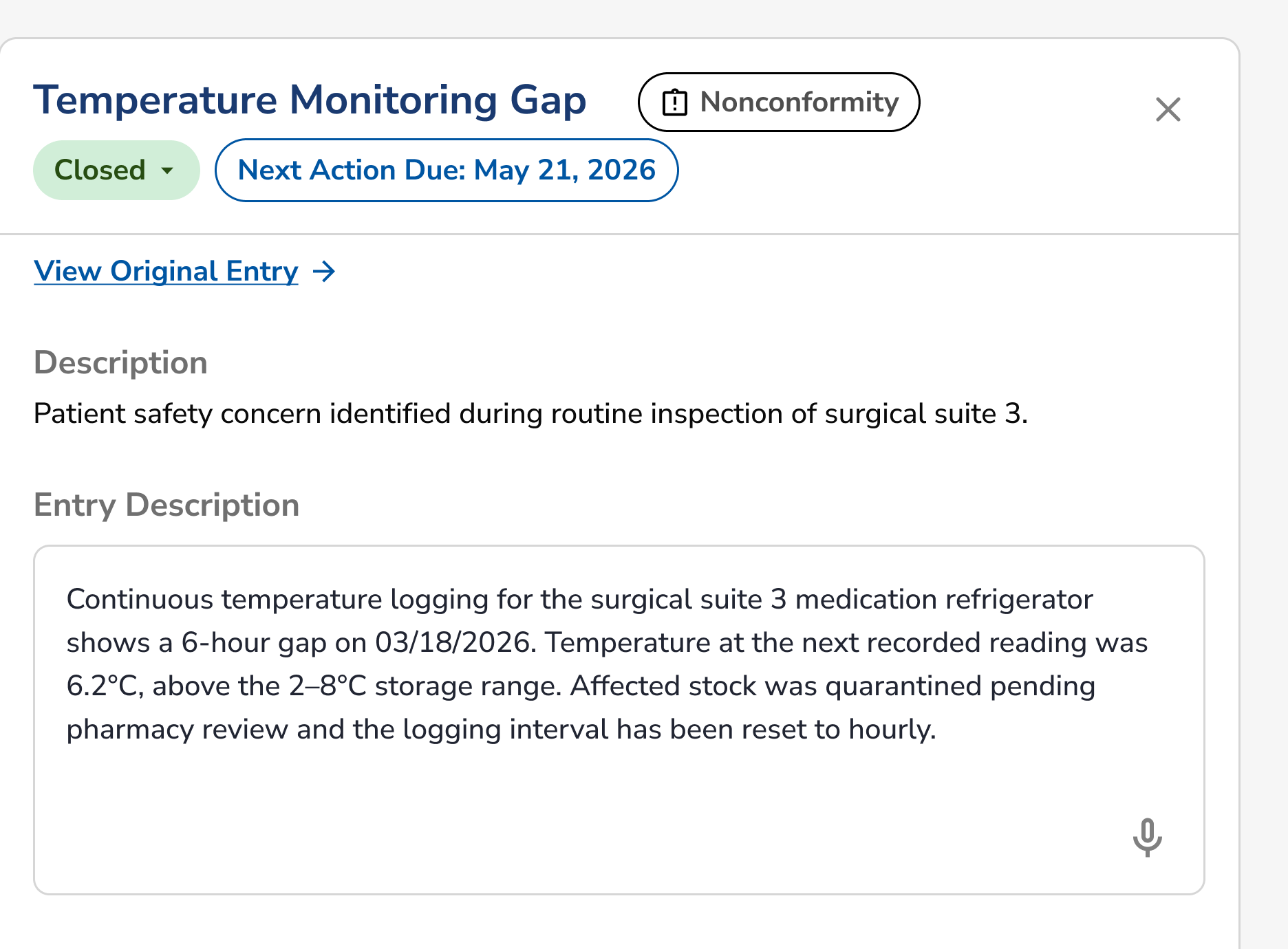
A demo takes a nonconformity you have open right now and walks it through to a closed corrective action, the entry it came from, the similar findings it matches, and the effectiveness check that closes it.
How a QMS Maps to Accreditation and Regulatory Requirements
A well-designed QMS isn't built for any single accreditor, it's built to reflect how hospitals should actually operate, which happens to be what CMS and accreditors are checking for. The CMS Conditions of Participation (42 CFR Part 482) require hospitals to maintain an ongoing, hospital-wide QAPI program that tracks performance and drives corrective action, the regulatory backbone any hospital QMS has to support, regardless of accreditor. DNV NIAHO accreditation integrates those Conditions of Participation with ISO 9001 quality management principles into a single set of standards, meaning DNV-accredited hospitals need a QMS that demonstrably supports document control, internal audits, risk-based thinking, and continual improvement (DNV: Hospital accreditation, NIAHO and DIAS programs). The Joint Commission surveys against its own accreditation standards and National Patient Safety Goals, using ongoing data collection and performance-improvement expectations that map to the same QMS components, audits, incident reporting, CAPA, and competency tracking.
What "Good" Looks Like
A strong hospital QMS generally shares a few traits: policies are version-controlled and reviewed on schedule with tracked (not assumed) staff attestation; audit and rounding findings automatically generate trackable action items instead of living in a separate document; every CAPA has an owner, a due date, and documented root-cause analysis, with overdue items visible to leadership; risk registries are living documents updated as new risks emerge rather than static year-end exercises; KPIs are monitored continuously and trigger action when they trend the wrong way; and evidence for all of it is available on demand, because survey readiness is a constant state, not a project.
Mapping QMS Components to the Medlaunch Platform
Because these components are standard across hospitals regardless of accreditor, Medlaunch Concepts built its platform around them directly rather than as one monolithic tool: MyPolicy handles document control; Quality Core runs internal audits, rounds, and the CAPA lifecycle from finding to verified closure; Risk Management maintains the risk registry and connects it to incident and safety event data; Vendor Management centralizes vendor oversight and risk assessment; and Relevance BI provides the ongoing KPI monitoring that keeps quality performance visible between surveys, not just before them. Clara, Medlaunch's AI agent, works across the platform to help surface overdue CAPAs, outdated policies, or emerging risk patterns before they become findings. The goal isn't to replace a hospital's quality program, but to give it the connective infrastructure to run as one continuous system instead of disconnected efforts.
Frequently asked questions
References
- eCFR: 42 CFR 482.21, Condition of participation: Quality assessment and performance improvement program
- eCFR: 42 CFR Part 482, Conditions of Participation for Hospitals
- DNV: Hospital accreditation, NIAHO and DIAS programs
- DNV: NIAHO accreditation for acute care hospitals
- CMS: Hospitals, Conditions for Coverage & Conditions of Participation
Keep reading
Related from Medlaunch
NIAHO Standards
The DNV program that folds ISO 9001 quality management into the Medicare Conditions of Participation.
Read more →What Are CMS Tags?
The citation codes surveyors write findings under, and how to track policies and CAPAs against them.
Read more →What Is ISO 9001 in Healthcare?
The management-system standard behind the QMS discipline, and where DNV makes it a requirement.
Read more →