Clara gives your team superpowers.
Clara streamlines everything from dashboards and forms to documentation and risk detection. Just tell her what you need and she builds in seconds. With voice-powered input, smart autofill, and system-wide insights, Clara helps your team move faster, stay compliant, and focus on what matters.
Connect Everything.
Simplify Anything.
Use Clara voice-
typing to update
QMS and Forms
3x faster than before.
What Clara AI Does For Your Team
Clara AI gives hospitals back time and accuracy by turning clinical conversations into structured, compliant documentation instantly. The result? Faster workflows, reduced documentation burden, and more time to focus on patient care.
Clara Speech
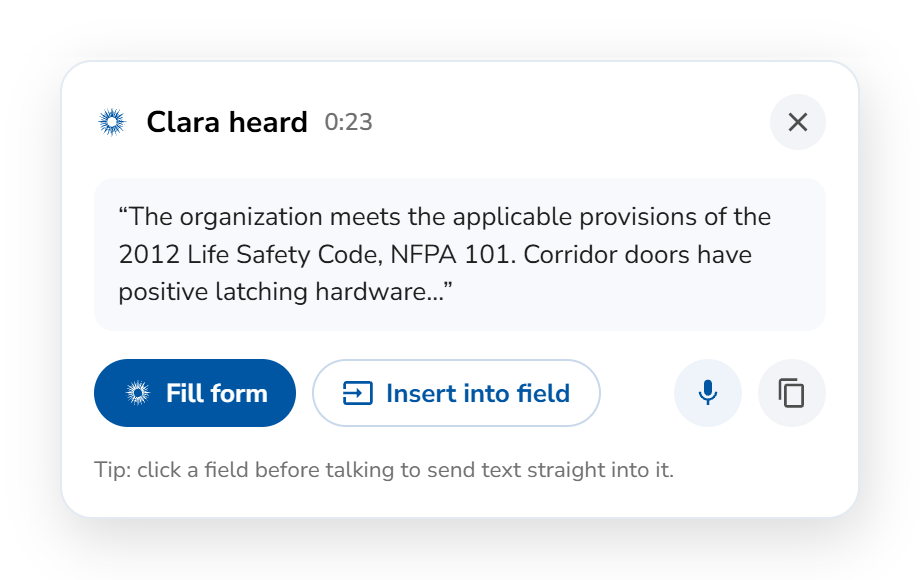
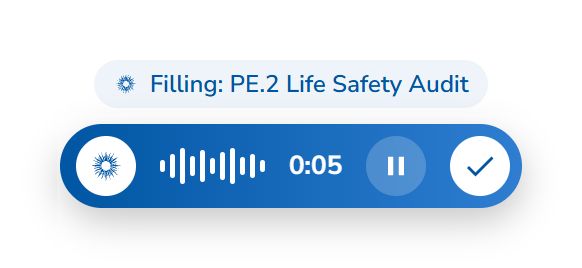
Document 3x faster with voice text. Clara refines and recognizes medical terminology on auto.


Risk Management
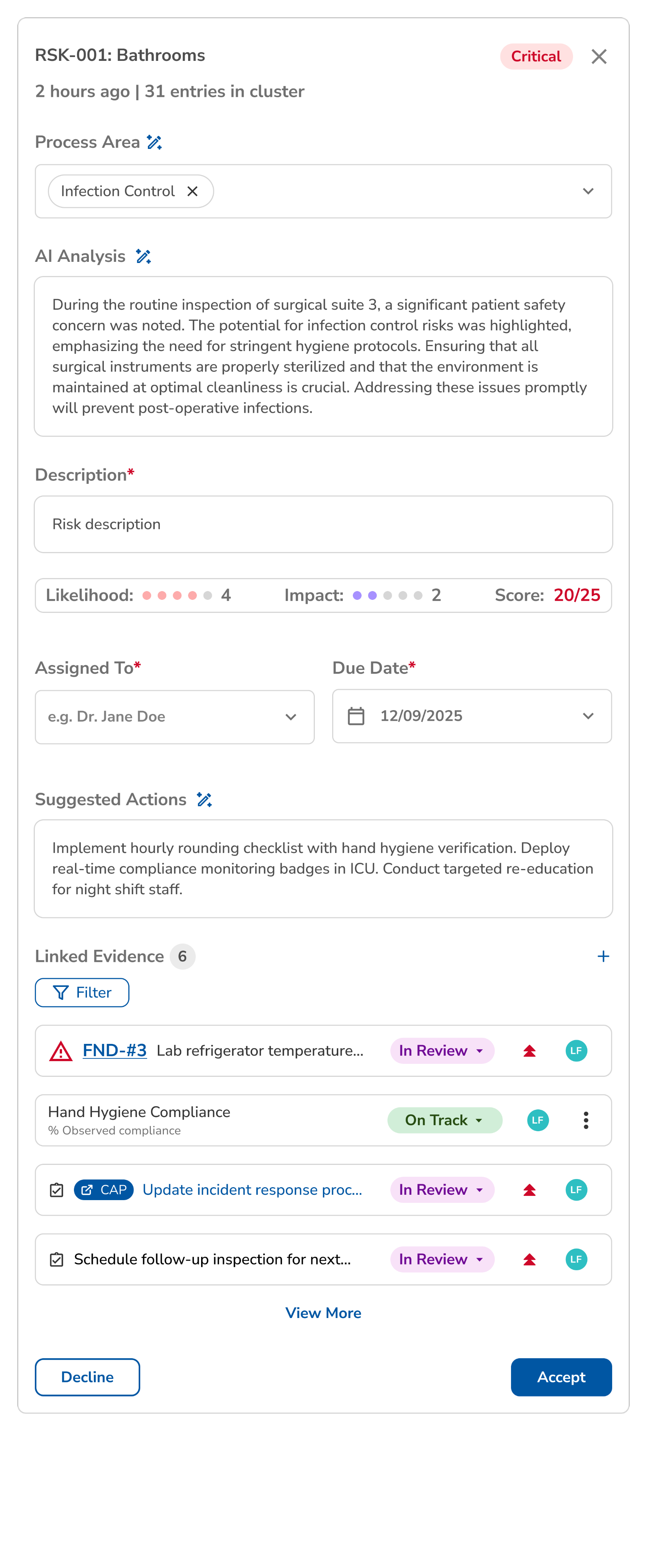
Spot risks early; Clara detects patterns and flags issues before they escalate.
Refrigerator temperature log missing entries from every day last week: Monday, Tuesday, Wednesday, Thursday and Friday.
Smart Prefill
Save time with smart autofill. Enter a description once, and Clara completes the rest for you.
Dashboard Creation
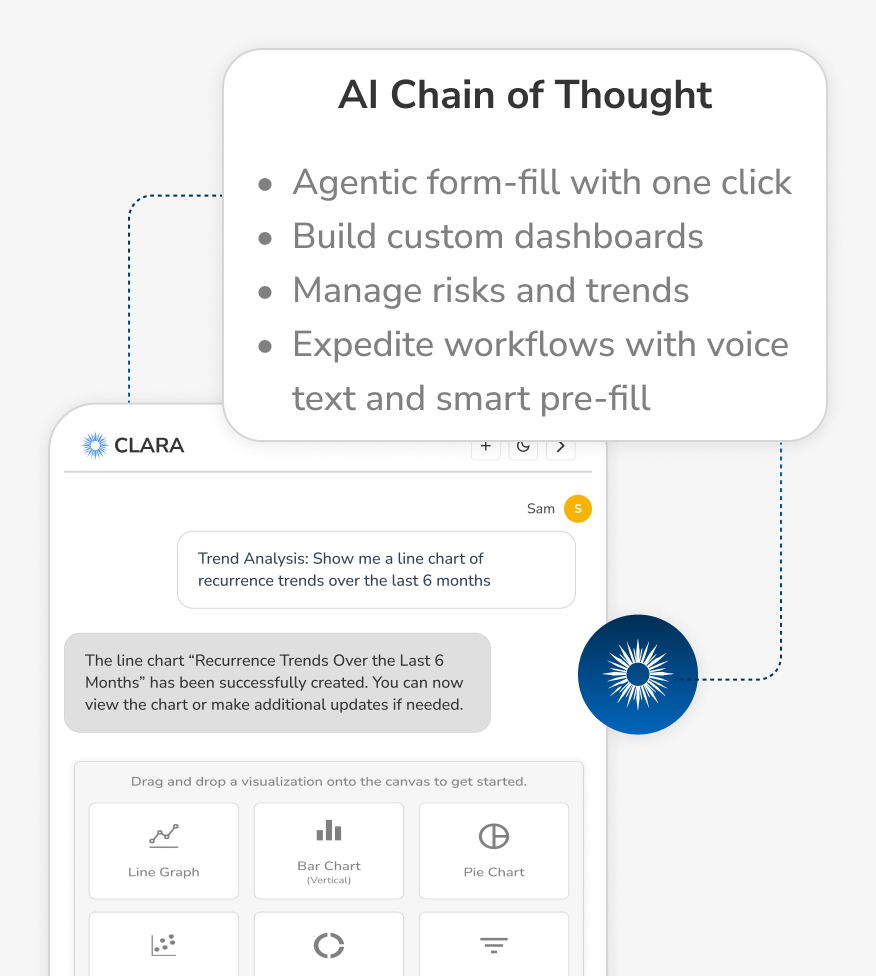
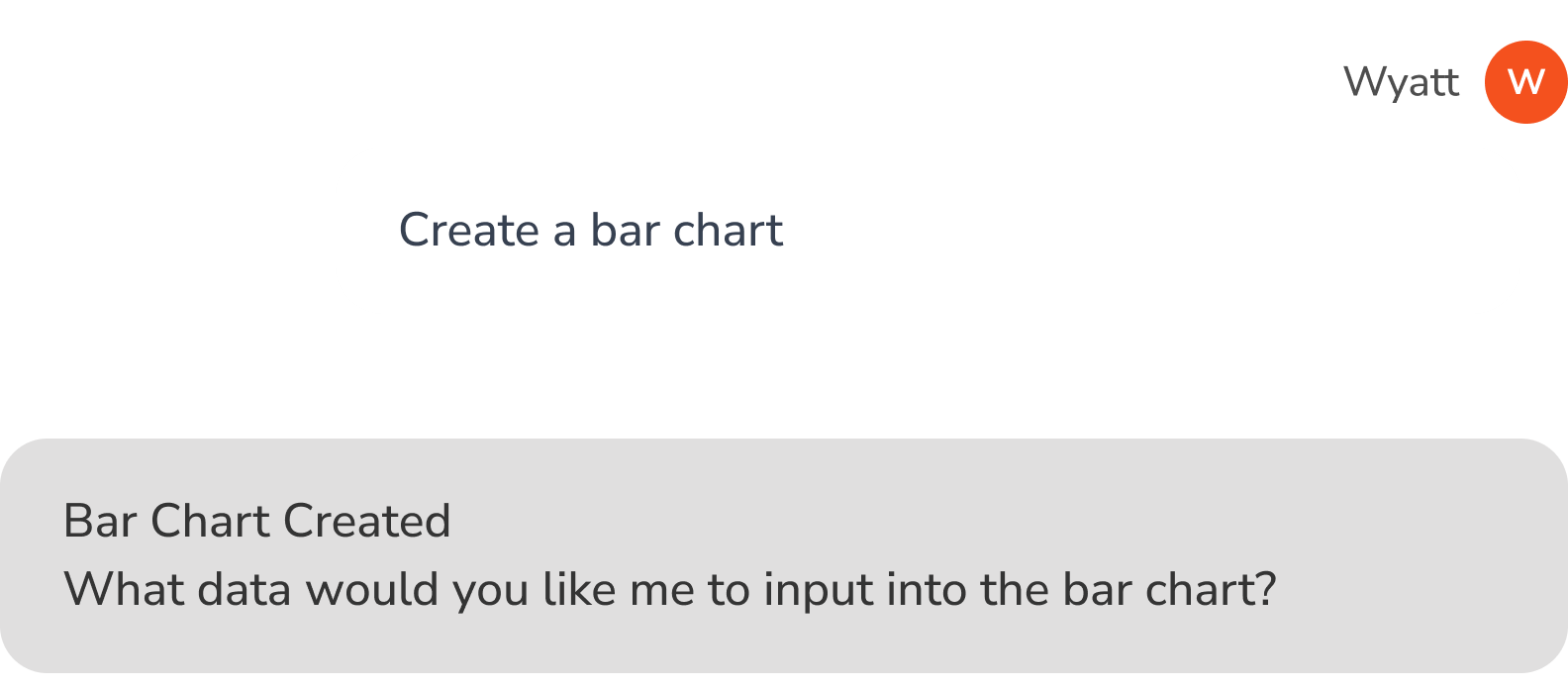
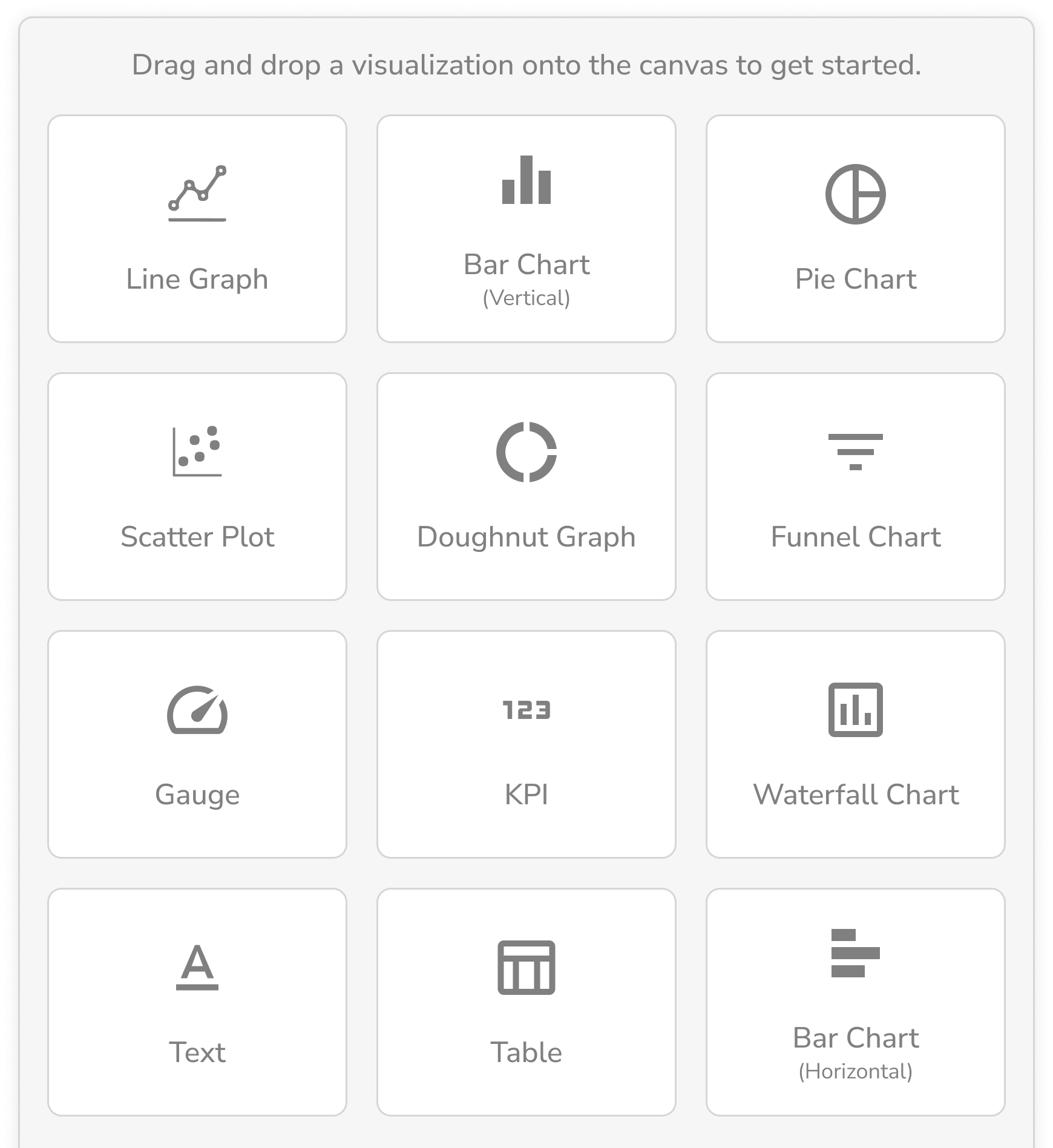
Build custom dashboards in seconds: just describe what you need, and Clara does the rest.
Agentic Form Fill
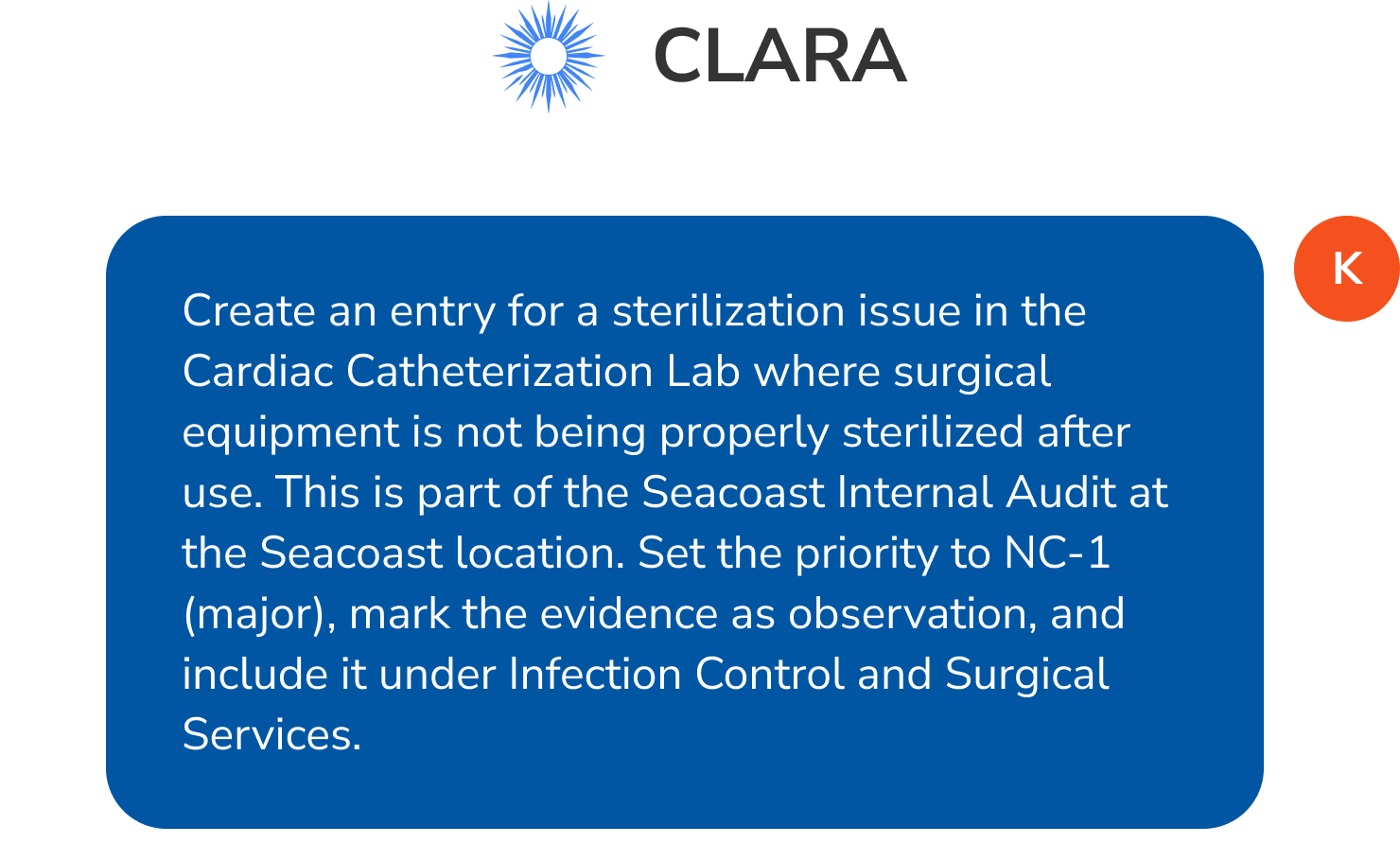
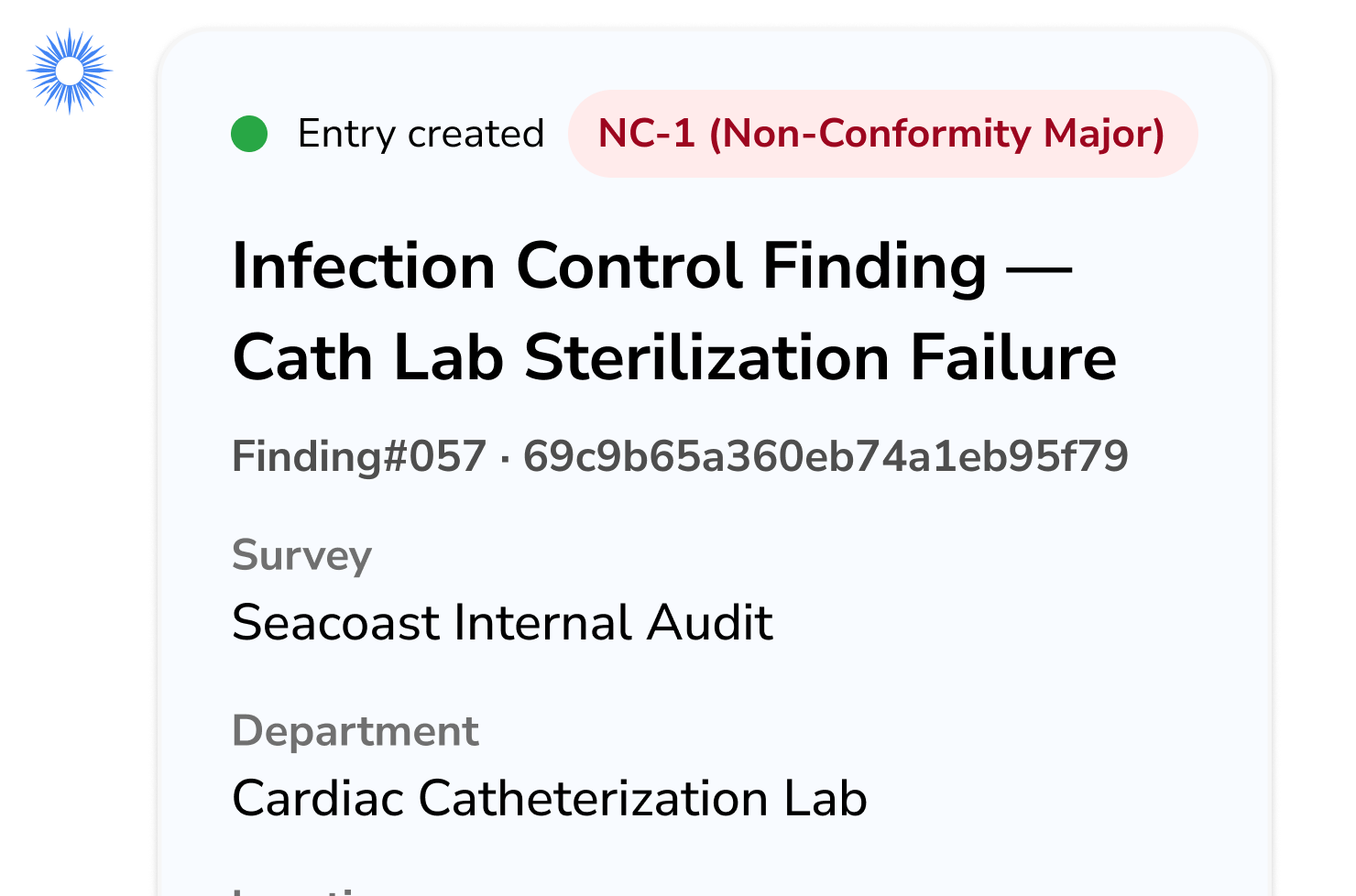
Create forms instantly by telling Clara what you want and what data to capture.


Clara Speech
Document 3x faster with voice text. Clara refines and recognizes medical terminology on auto.
Learn More

Risk Management
Spot risks early; Clara detects patterns and flags issues before they escalate.
Refrigerator temperature log missing entries from every day last week: Monday, Tuesday, Wednesday, Thursday and Friday.
Smart Prefill
Save time with smart autofill. Enter a description once, and Clara completes the rest for you.


Dashboard Creation
Build custom dashboards in seconds: just describe what you need, and Clara does the rest.


Agentic Form Fill
Create forms instantly by telling Clara what you want and what data to capture.


Clara Speech
Document 3x faster with voice text. Clara refines and recognizes medical terminology on auto.


Risk Management
Spot risks early; Clara detects patterns and flags issues before they escalate.
Refrigerator temperature log missing entries from every day last week: Monday, Tuesday, Wednesday, Thursday and Friday.
Smart Prefill
Save time with smart autofill. Enter a description once, and Clara completes the rest for you.


Dashboard Creation
Build custom dashboards in seconds: just describe what you need, and Clara does the rest.


Agentic Form Fill
Create forms instantly by telling Clara what you want and what data to capture.
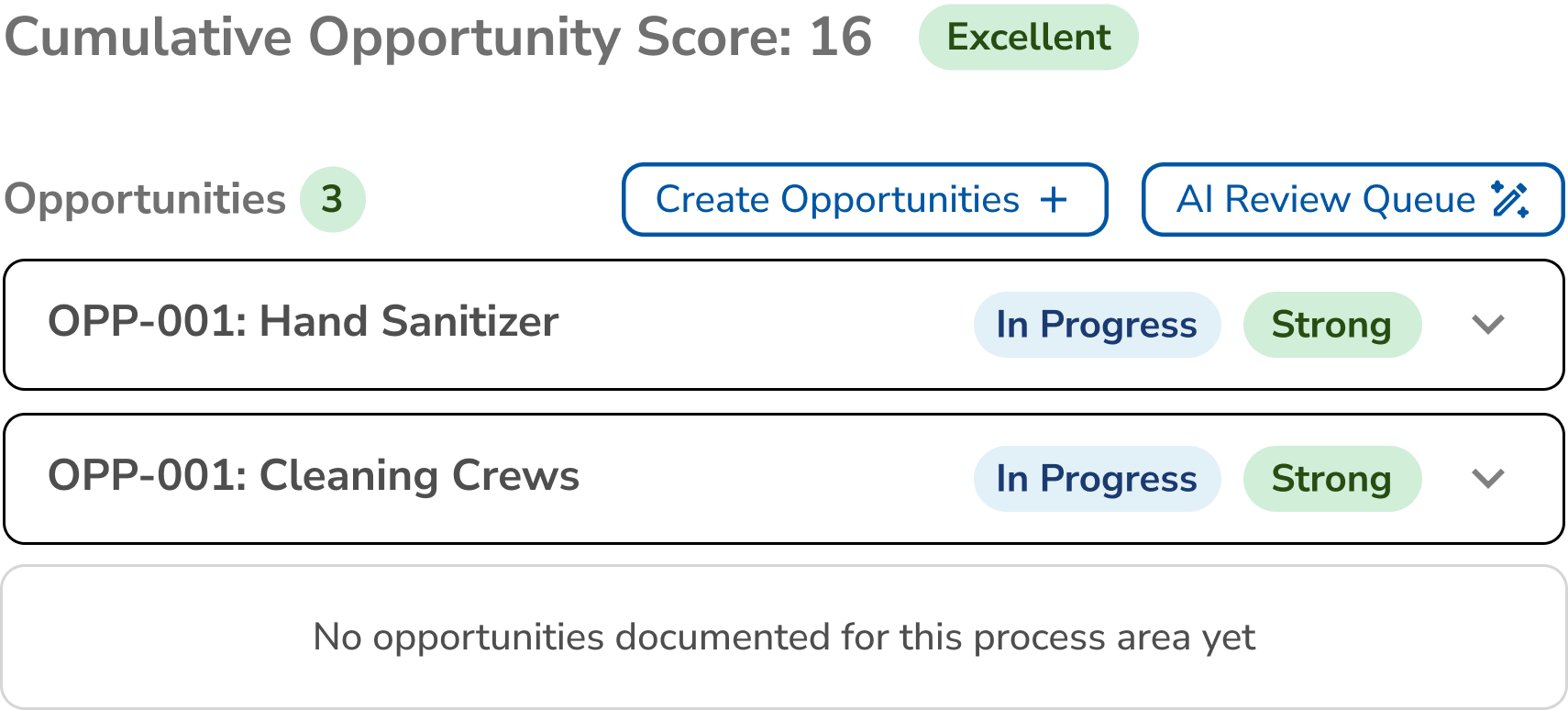
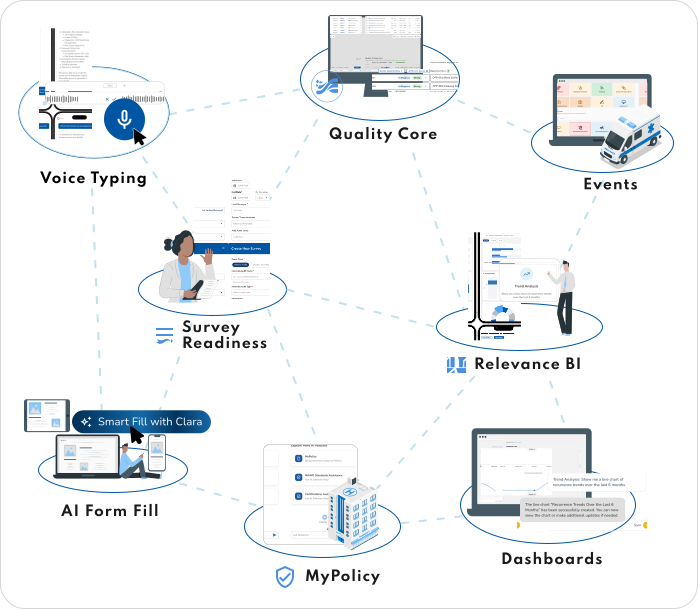
Your Risk Register, Connected to Everything
Every signal in your organization. One intelligent risk register.
Meet Clara Speech
Less time documenting. More time caring.
Clara Speech is built for medical vocabulary, not generic dictation.
Smart Pre-Fill
Skip the typing, keep the insight.
- •Smart Pre-Fill removes the burden of manual data entry in event and quality documentation.
- •Clara instantly analyzes typing to populate key fields: event type, severity, contributing factors, time, and even applicable standards.
- •What used to take 8–12 minutes now takes under 3 minutes, saving teams up to 30% on documentation time.
- •Built-in context memory and form-agnostic design, Smart Pre-Fill works across any workflow.
Manual Entry
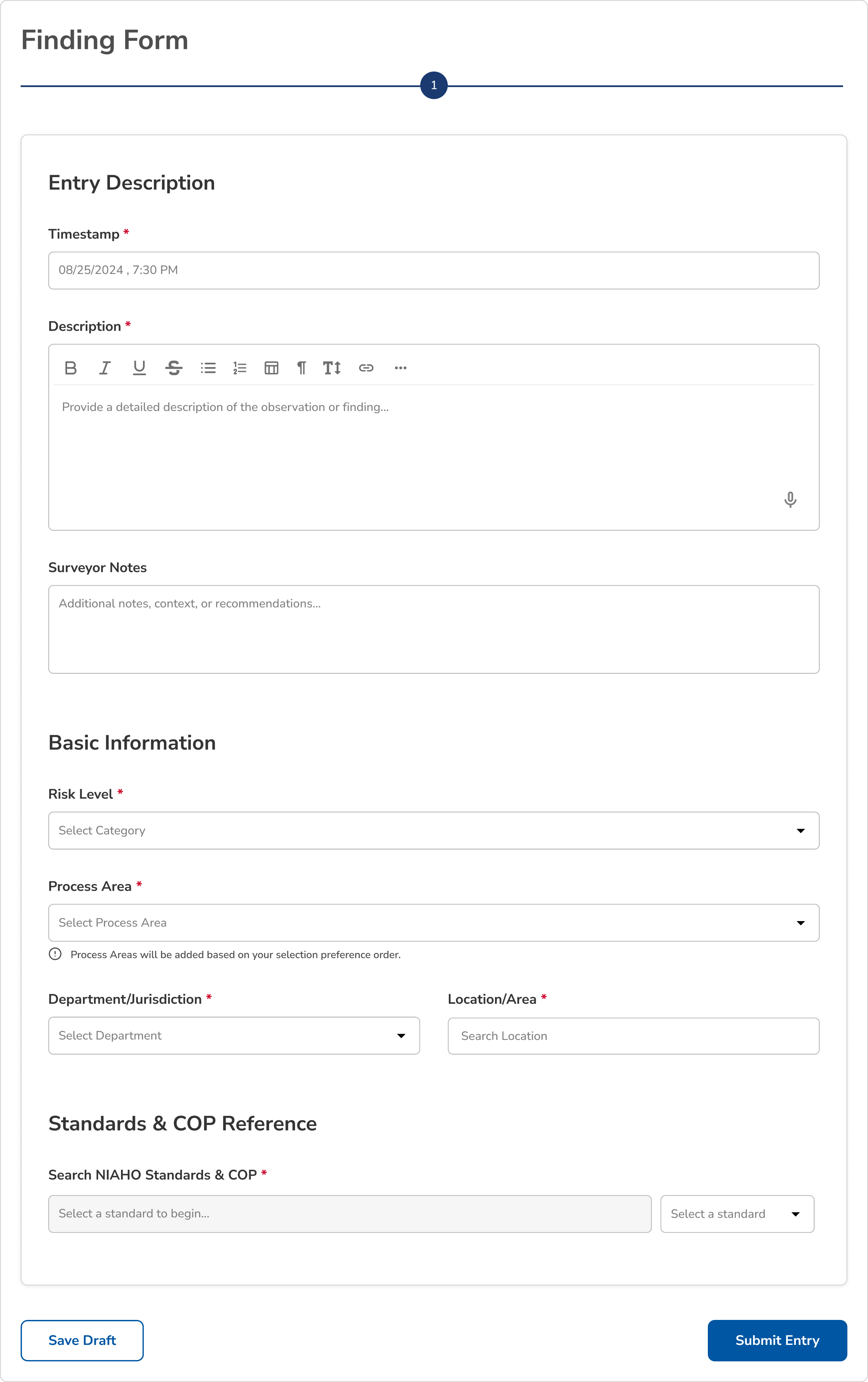
Pre-Fill
See Clara AI in Action
Book a demo to experience how Clara transforms documentation into a faster, smarter, and more compliant workflows. In just minutes, you'll see how your team can save time, reduce risk, and refocus on what matters most—patient care.


Clara FAQs
What is Clara?
Clara is Medlaunch's AI agent built specifically for hospital quality management and compliance. She lives inside the Medlaunch platform and works alongside your quality team — helping them complete tasks faster, surface insights they'd otherwise miss, and interact with the entire system through natural conversation.
Clara isn't a generic chatbot bolted onto a quality management system. She understands hospital quality workflows, CMS Conditions of Participation, DNV NIAHO standards, OSHA, NFPA, ISO 9001, and state-specific regulations at a deep level. When your team talks to Clara, she's operating with full context of your organization's data — your events, your CAPAs, your policies, your dashboards — not giving generic answers from a knowledge base.
How is Clara different than any other AI?
Most AI tools in healthcare are either general-purpose assistants that know nothing about your organization, or narrow automation scripts that handle one specific task. Clara is neither.
Clara is purpose-built for hospital quality management, which means she understands the domain — not just the words, but the workflows, the regulatory context, and the relationships between different parts of your quality program. When you ask Clara about a recurring finding, she doesn't just search for similar text. She traverses the connections between your events, action plans, policies, standards, and audit results to give you an answer grounded in your organization's actual data.
The other difference is scope. Clara isn't limited to answering questions. She can create event reports, draft corrective action plans, build dashboards in Relevance BI, analyze trends across your quality data, generate reports, detect recurrence patterns, and map findings to applicable standards. She even works on mobile through Clara Voice — your team can speak findings out loud during an audit walkthrough, and Clara handles the documentation, department tagging, and standards attachment in real time. She's a working member of your quality team, not a search bar.
And because Clara operates inside a platform built for hospital compliance, every interaction respects your organization's role-based access controls, data boundaries, and audit requirements. She's not a third-party AI tool with access to your data — she's a native part of the system your data already lives in.
How can Clara help my hospital?
Clara helps hospital quality teams work faster and catch more by handling the time-consuming tasks that slow down quality improvement. Here's what that looks like day to day:
- Event reporting in seconds — Staff can describe what happened in natural language, and Clara pre-fills the structured event report form, cutting submission time from minutes to under a minute
- Voice-powered auditing on mobile — During an audit or survey walkthrough, your team can use Clara Voice on their phone to describe a finding out loud. Clara creates the description, selects the department you're in, finds the relevant standards, and attaches the finding to the survey you're currently conducting — all without typing a word or leaving the floor
- Corrective action plan drafting — Clara can generate a draft CAPA based on the finding, including suggested root causes, action items, responsible parties, and timelines — your team reviews and refines rather than starting from scratch
- Recurrence detection — Clara automatically identifies when similar findings have occurred before, connecting patterns across departments, timeframes, and event types that manual review would miss
- Instant answers from your data — Instead of running reports or digging through records, ask Clara: "How many falls did we have in the ICU last quarter?" or "What CAPAs are overdue in surgery?" and get an immediate, accurate answer
- Dashboard and report generation — Tell Clara what you want to see, and she builds it in Relevance BI — charts, scorecards, trend lines, and comparison tables without any technical skills required
- Standards mapping — Clara connects findings, policies, and action items to the applicable CMS, DNV, OSHA, NFPA, ISO, and state standards, keeping your regulatory links current without manual cross-referencing
Who is Clara for?
Clara is designed for every role that interacts with hospital quality data — and she adapts to how each person needs to work.
Frontline staff use Clara to submit event reports quickly by describing what happened in plain language, removing the friction that causes underreporting. Quality directors and patient safety officers use Clara as an analytical partner — asking questions about trends, recurrence, and program performance that would otherwise require hours of manual data review. Compliance officers use Clara to check standards mapping, verify regulatory linkages, and stay current on requirements. Executives and leadership use Clara to get quick answers about organizational quality performance without logging into operational tools.
If you work in or around hospital quality management, Clara is built to make your specific workflows faster and more informed.
Do I need technical experience to use it?
Not at all. Clara is designed to be the easiest way to interact with the Medlaunch platform — especially for people who don't have time to learn new software.
You talk to Clara the same way you'd talk to a colleague. "What's on my plate today?" "Create a finding for the medication error in 3 West." "Show me how our fall rates compare across facilities." Clara understands the intent behind your request, accesses the right data, and either gives you an answer or completes the task.
There's no query language to learn, no menu navigation to memorize, and no training required. Clara is specifically built so that the people who are busiest — frontline staff, department heads, quality managers juggling dozens of open items — can get things done without any learning curve.
How does Clara integrate with my hospital's existing systems?
Clara operates as a native part of the Medlaunch platform, so there's no separate integration required for any Medlaunch module. She has direct access to your quality data, policies, dashboards, and standards — all within the same system.
For connecting to systems outside of Medlaunch, Clara supports the Model Context Protocol (MCP), an open standard for AI agent connectivity. This means if your hospital is already using other AI tools, automation platforms, or internal systems that support MCP, Clara can communicate with them directly. Your existing AI investments don't become obsolete — they gain a quality management expert they can talk to.
Clara also benefits from the platform-level integrations that Quality Core supports, including SSO for seamless authentication, API access for custom workflows, and data imports that bring external information into the environment Clara can work with.
How does Clara interact with hospital data?
Clara interacts with your hospital's quality data directly — not through exports, snapshots, or copies. She reads from and writes to the same live data your team works with every day inside the Medlaunch platform.
When Clara answers a question about your CAPA closure rates, she's querying your actual corrective action records in real time. When she creates an event report, it's written directly into Quality Core with full audit trail documentation. When she builds a dashboard, it pulls from live operational data that updates as your team works.
This direct interaction means Clara's answers are always current, always traceable, and always consistent with what your team sees in the platform. There's no synchronization delay, no stale data, and no discrepancy between what Clara tells you and what the system shows.
How does Clara work with MyPolicy, Relevance BI, and Quality Core?
Clara is the connective tissue across the entire Medlaunch platform. She doesn't just work within one module — she operates across all of them simultaneously, which is what makes her fundamentally different from a module-specific assistant.
- Quality Core — Clara helps create event reports, draft corrective action plans, detect recurrence across findings, track effectiveness of interventions, and map findings to standards. She can tell you what's overdue, what needs attention, and what patterns are emerging
- Relevance BI — Clara builds dashboards and reports from natural language requests. Ask her for a visualization, a trend analysis, or a comparison across facilities, and she generates it directly in Relevance BI without your team touching a dashboard builder
- MyPolicy — Clara can search across your hospital's policy library, identify which policies are linked to specific standards or findings, and flag when quality events may indicate a policy gap. When policies are updated, Clara understands the downstream implications for active quality items
The power is in the connections. Clara can trace a thread from a single event report through the corrective action it triggered, the policy it relates to, the standard it maps to, and the dashboard where the trend appears — all in one conversation.
Can Clara generate reports and dashboards?
Yes — this is one of Clara's most valuable capabilities. Instead of building reports manually or requesting them from a data team, your quality staff can ask Clara to create exactly what they need.
"Build a monthly event summary broken down by department and event type." "Show me a scorecard of CAPA closure rates for Q1 versus Q2." "Create a chart comparing complaint volumes across our facilities." Clara translates these requests into live dashboards and reports inside Relevance BI that your team can save, customize, and share.
Clara can also generate formatted reports for specific audiences — board-ready quality summaries, department-level trend reports, and accreditation evidence documentation — without anyone on your team spending hours in spreadsheets or presentation software.
Does Clara use data safely and accurately?
Yes. Data safety and accuracy are foundational to how Clara is built, not afterthoughts.
Safety and privacy: Clara operates entirely within the Medlaunch platform's security architecture. Your data never leaves your environment to be processed by a third-party AI service. Clara respects your organization's role-based access controls — she only shows users the data they're authorized to see, and every interaction is logged for audit purposes. The Medlaunch platform maintains SOC 2 Type 2 and HIPAA compliance, and Clara operates within those same controls.
Accuracy: Clara works with your organization's actual structured data, not unverified internet sources or general training data. When she provides a number, it comes from your quality records. When she identifies a trend, it's based on your event history. Clara is also designed to be transparent about uncertainty — if she doesn't have enough data to answer a question confidently, she tells you rather than guessing.
What tasks does Clara automate?
Clara automates the repetitive, time-consuming work that slows down hospital quality teams — while keeping humans in control of decisions that matter.
- Event report creation — Describe what happened in natural language, and Clara pre-fills the structured form fields, classification, and severity. Submission goes from minutes to seconds
- Mobile audit documentation — Use Clara Voice during survey walkthroughs to speak findings directly into the platform. Clara transcribes your description, identifies your department, attaches relevant standards, and links the finding to your active survey — hands-free, from the floor
- CAPA drafting — Clara generates draft corrective action plans with suggested root causes, action items, owners, and timelines based on the finding and your organization's historical patterns
- Recurrence detection — Clara continuously monitors for patterns across your event history, flagging when similar findings reappear across departments, shifts, or timeframes
- Effectiveness monitoring — Clara tracks whether completed corrective actions are actually preventing recurrence, alerting your team when interventions aren't holding
- Standards mapping — Clara automatically links findings, policies, and action items to applicable CMS, DNV, OSHA, NFPA, ISO, and state standards
- Dashboard and report generation — Clara builds visualizations, trend reports, and scorecards in Relevance BI from conversational requests
- Data retrieval and analysis — Instead of running queries or pulling spreadsheets, Clara answers questions about your quality data instantly: volumes, rates, comparisons, timelines, and overdue items
Clara handles the data work so your team can focus on the improvement work.
How is AI changing hospital accreditation?
AI is beginning to reshape how hospitals prepare for and maintain accreditation — shifting the process from periodic sprints to continuous readiness.
Traditionally, accreditation preparation has been a manual, resource-intensive process. Quality teams spend weeks or months before a survey pulling together evidence, closing documentation gaps, cross-referencing standards, and assembling binders that demonstrate compliance. The work is repetitive, high-stakes, and often duplicated across survey cycles because the underlying systems don't retain the connections between quality activities and the standards they satisfy.
AI changes this by maintaining those connections continuously. An AI-powered quality management platform can map findings to standards as they're created, detect when a corrective action addresses a regulatory requirement, and flag gaps in real time rather than during a pre-survey review. The evidence doesn't need to be assembled — it's been building itself all along.
For accreditation bodies that use process-oriented, data-driven audit methodologies — like DNV's ISO 9001-based approach — this is especially significant. Surveyors increasingly expect hospitals to demonstrate active, systematic quality management, not just documentation assembled for the visit. AI makes that kind of continuous, data-driven quality program achievable even for teams with limited resources.
How can AI improve my hospital?
AI's value in a hospital extends beyond automating tasks — it fundamentally changes how quality teams see and respond to what's happening across their organization.
The most immediate impact is visibility. Hospital quality programs generate enormous volumes of data — event reports, audit findings, complaints, action items, policy updates — but connecting the dots across all of that data has historically required experienced professionals spending hours in manual review. AI can process those connections continuously, surfacing patterns, recurrence, and risk signals that would otherwise go unnoticed until a surveyor or a serious event brings them to light.
The second impact is speed. When creating a finding, investigating a complaint, or drafting a corrective action plan takes less time, more of it actually gets done. Hospitals that reduce the friction of quality work see higher reporting rates, faster resolution times, and more complete documentation — all of which translate directly into better patient outcomes and stronger accreditation performance.
The third impact is consistency. AI doesn't have a bad week, doesn't forget to check for recurrence, and doesn't skip the standards mapping step because it's Friday afternoon. It applies the same rigor to every event, every action item, and every review — giving quality teams a reliable foundation they can build on rather than constantly backfilling gaps.
The hospitals that adopt AI for quality management aren't replacing their quality professionals. They're giving them the analytical leverage to manage a quality program at the level accreditation bodies expect — without burning out the team in the process.