Answer the Question, Not the Room
A surveyor does not ask whether you have a policy. They ask which version was in force, what changed, who approved it, and who read it. MyPolicy keeps all four answers attached to the document, timestamped, and one click apart.
What the Surveyor Asks. What MyPolicy Shows.
Six questions come up in almost every policy review. Each one has an artifact behind it, not a search you run under pressure, but a record the system has been keeping since the first draft was saved.
Version Control
"Is this the current policy?" Every policy has exactly one active version. Superseded versions stay in the record but cannot be mistaken for live guidance, and staff searching the library only ever land on the approved one.
Historical Tracking
"Was this the policy in effect in March?" Open the library as of any date and see the version that was live then, with its effective date and the approval that put it there. You answer about the past without reconstructing it.
Version Differences
"What changed, and why?" Compare any two versions side by side and see exactly which language was added, removed, or reworded, with the reviewer's comment attached to the change that prompted it.
Change Log and Access
"Who else touched this document?" Every edit, comment, rejection, approval, and republish is logged with the user and the timestamp, in an immutable record, and the list of who could have touched it is controlled and logged too. Nothing is edited out, including the things you would rather explain in person.
Approval Record
"Who approved this, and when?" The approval chain for each version stays attached to it: every step, every named approver, every decision date, including the rounds that were rejected and sent back.
Attestation Record
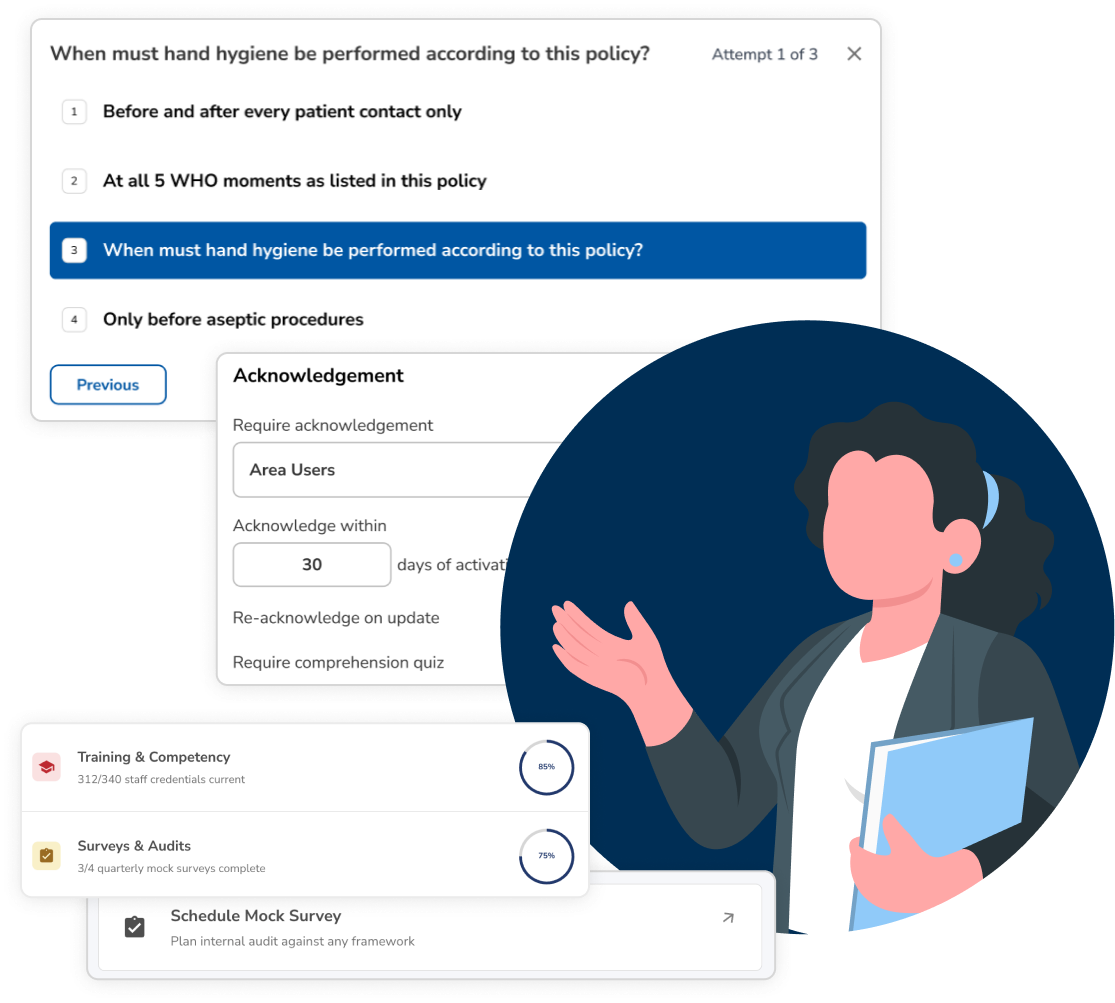
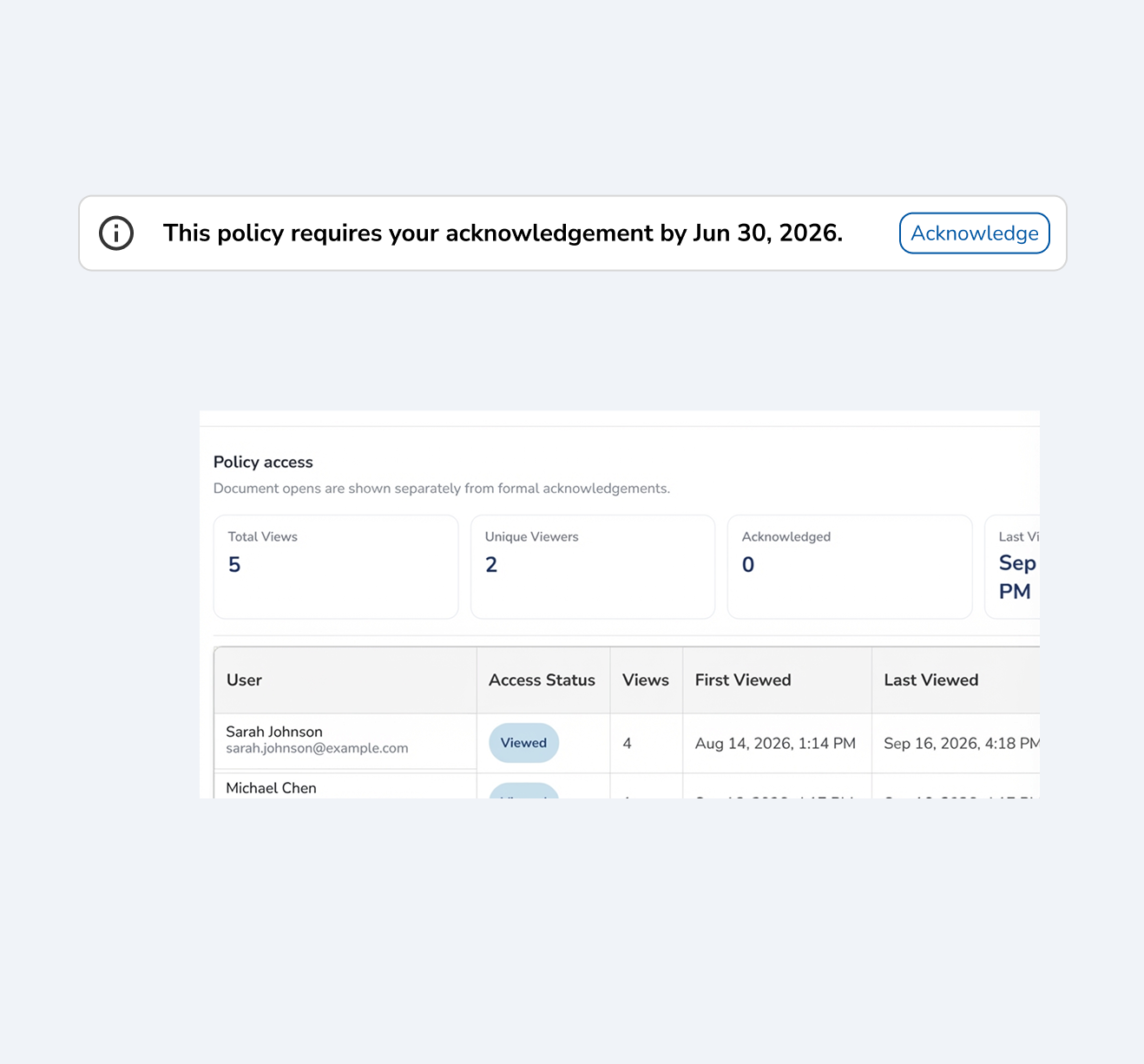
"How do you know your staff read it?" Each acknowledgement is tied to the exact version the person read, with the date and, where a comprehension quiz was required, the result. Not a sign-in sheet: a per-version roster. The section below shows how that roster gets built.
Scheduled Review
"When was this last reviewed?" Every document carries a review interval and a next-review date, and the owner is prompted before it lapses rather than after. A policy that has quietly gone four years without a look is the finding nobody sees coming; this is the item that keeps it from happening.
Attestation That Ensures Staff Accountability
Track Acknowledgment with Confidence
Close the Communication Loop
Acknowledgement Quizzes streamline how organizations assign, monitor, and document policy review. With clear visibility into completion status and historical records, teams stay prepared for internal oversight and external surveys.
Digital Acknowledgment
Staff electronically confirm they have reviewed and understood a policy. Each acknowledgment is recorded with a timestamp and tied to a specific document version.
Version Verification
Every quiz is tied to the exact version of the policy it covers. This ensures you can prove which guidance staff were tested on and confirmed they understood.
Completion Tracking
Monitor acknowledgment status across departments in real time. Quickly identify overdue attestations and follow up before they become compliance gaps.
Comprehension Quizzes
After reading a policy, staff are tested with a quiz drawn from the policy text, with limited attempts, retry paths, and clear pass or fail states. Once they pass, the policy moves from read to acknowledged.
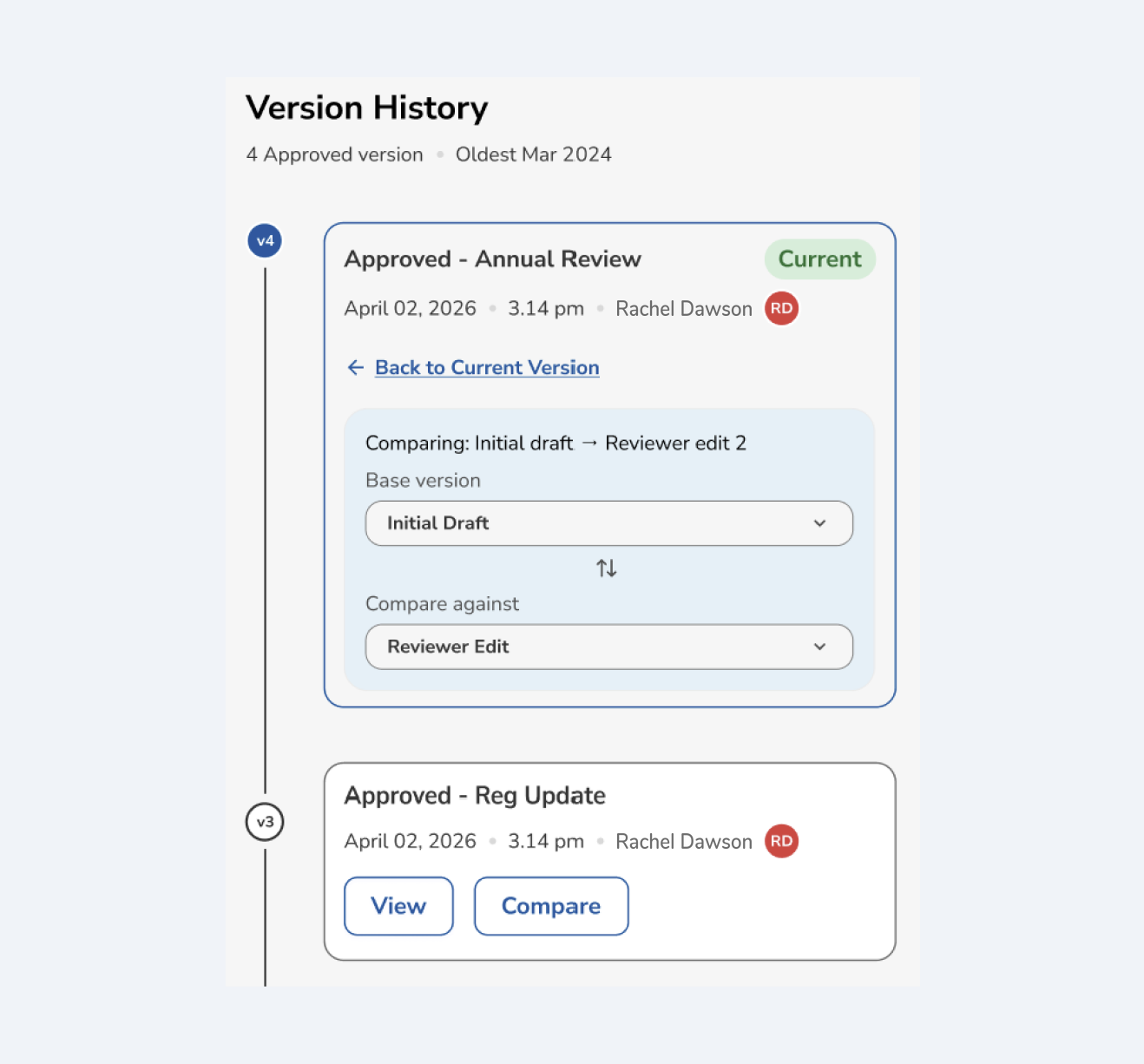
One version is live. The rest are history.
A numbered list of every version with its effective dates, its approver, and a single active badge. This answers which one. It does not tell you what changed inside it.
The record starts at the first save. See how a policy gets written.
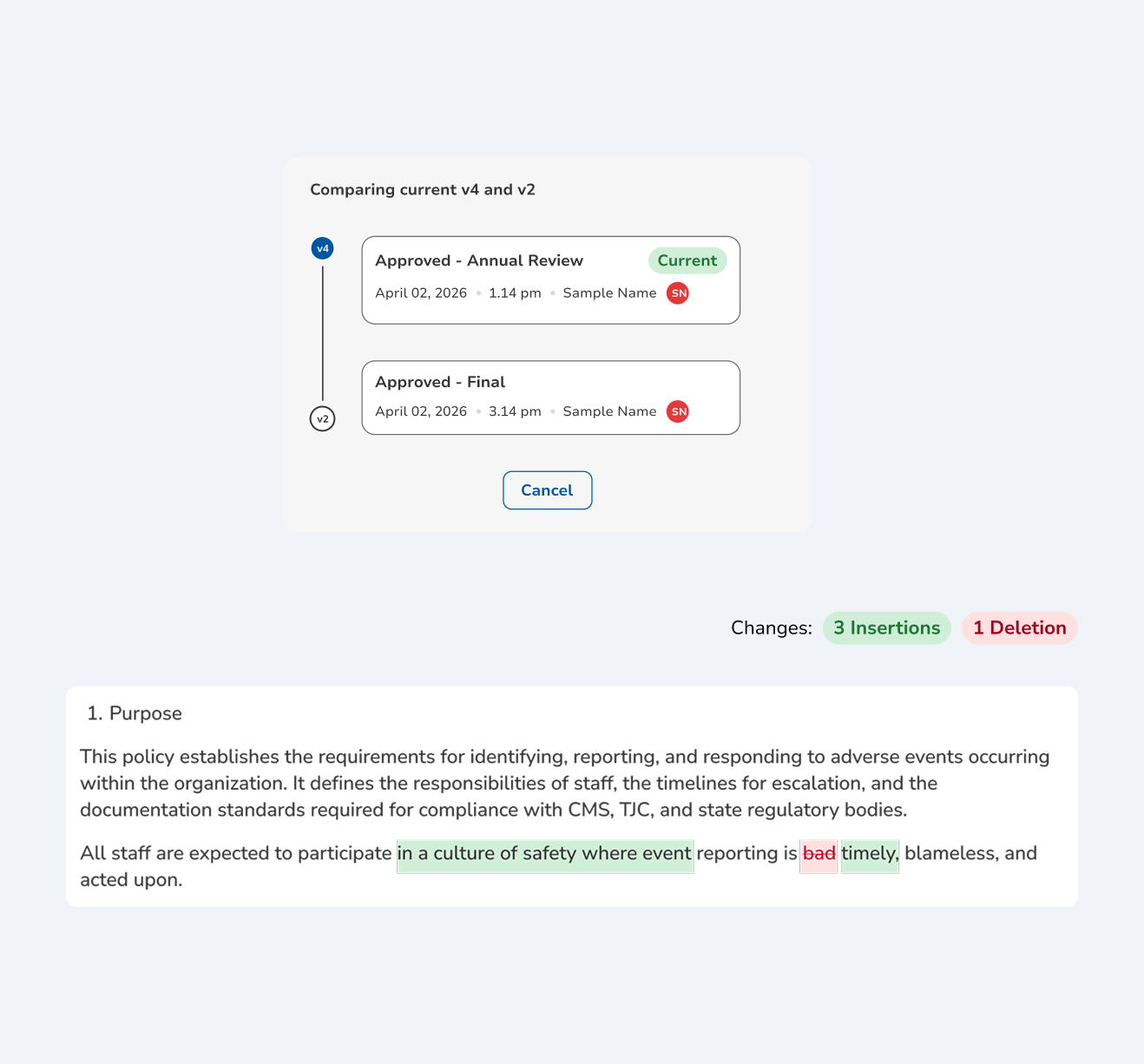
See the change, not just the version number
An inline redline between two versions with added and removed language marked. This answers what changed. Version 4.2 becoming 4.3 tells a surveyor nothing; this tells them everything.
Surveyors also ask which standard a policy answers, that map is its own view.
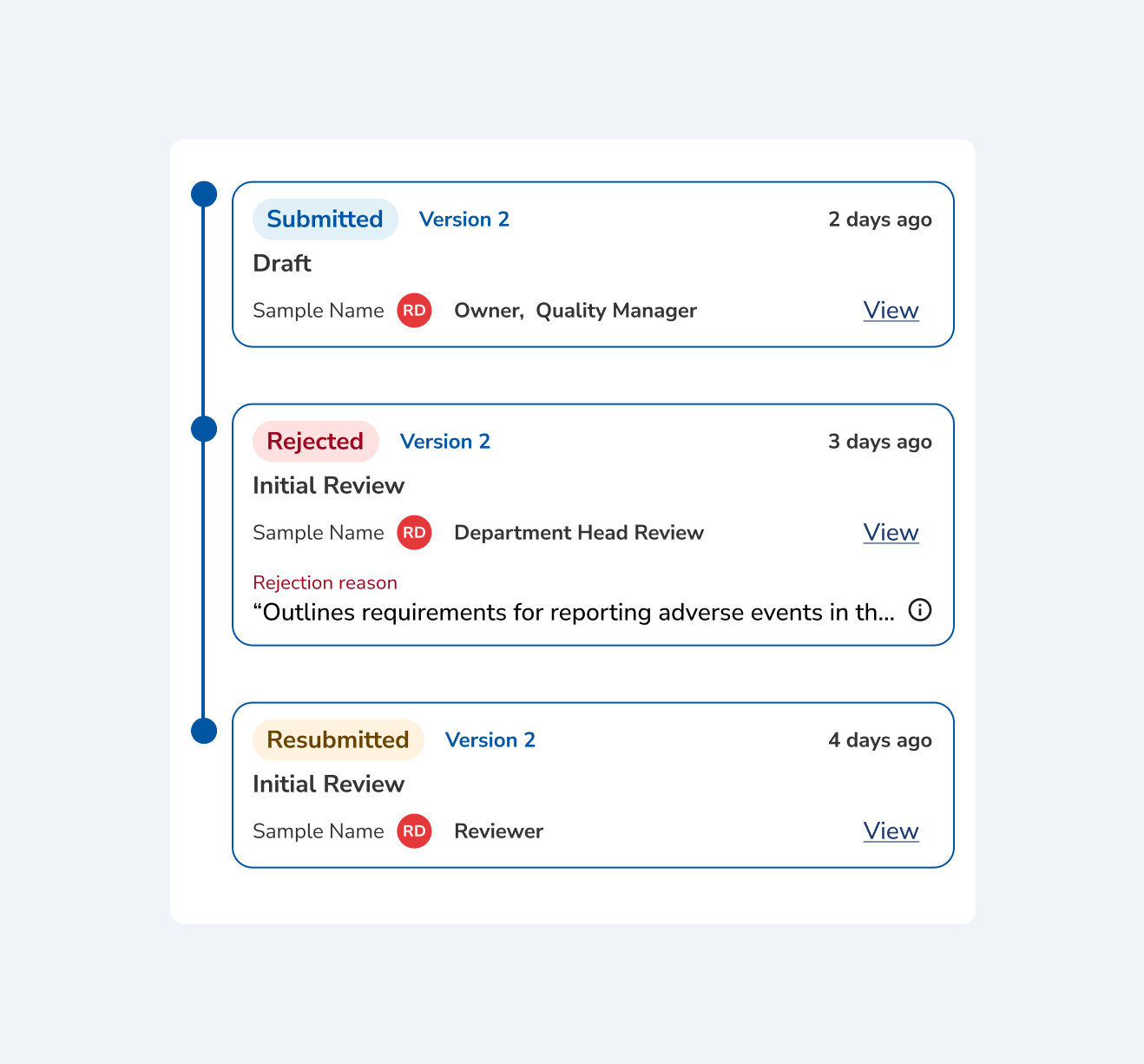
Every action, permanently logged
A chronological record of who did what and when, edits, comments, rejections, approvals, publications, acknowledgements. This answers who, and it is the only one of the three that cannot be edited by anyone, including an administrator.
The approval chain stays attached to the version. See how those chains are built and routed.
Revised policy, fresh acknowledgement
When a policy is republished, everyone it applies to is asked again, with a summary of what changed, so re-acknowledging is informed rather than reflexive. Signing the 2023 version no longer counts as reading the 2026 one.
Need attestation completion rates or approval cycle times across the whole system? Relevance BI builds the report.
Related
How Clara AI Enhances Survey Readiness
The record is complete whether or not you use Clara, she just gets you to the right part of it faster. Ask for a policy as of a date, or for what changed since the last approval, and verify what comes back before it leaves the room.

CLARA
Clarity in complianceClara reads
Clara proposes
You confirm every version, roster and quiz question before it reaches a surveyor or a staff member.