Blog
The Ontology Layer: Why Medlaunch Is Building the Infrastructure Underneath Healthcare Quality Management
Quality management software in healthcare has spent two decades solving the wrong problem. Vendors built better forms. Better dashboards. Better places to store a policy PDF or log an audit finding. What nobody built was the thing underneath all of it, a structure that actually understands how a standard, a policy, an audit, a finding, and a corrective action relate to each other.

Key takeaways
- An ontology layer models standards, clauses, policies, audits, findings, CAPAs, incidents, vendors, and KPIs as typed entities with real relationships, not as rows in separate systems that a human has to cross-reference by ID.
- The problem with today's hospital quality stack is architectural, not cosmetic: every "integration" between point tools is an API call stitching together data that should have been one graph from the start.
- Modeling a quality standard as an ontology is proven prior art in automotive (ISO/TS 16949) and software engineering (CMMI-DEV and PMBOK, with ISO 9001:2015 as the motivating standard), it has simply never been built for ISO 9001 in healthcare.
- Healthcare is where the approach matters most, because ISO 9001 has to interlock with DNV NIAHO accreditation, CMS Conditions of Participation, NFPA, OSHA, and state regulations at the same time.
- Clara is useful because of what it stands on: it traverses the graph from clause to policy to audit to finding to CAPA to KPI, so every answer carries a citation trail instead of a confident guess.
The Category Problem: Point Tools Bolted Onto Document Silos
That's the gap Medlaunch is closing. Not with another module. With an ontology layer, a connected, machine-readable model of how healthcare quality actually works, and we believe it's the first one purpose-built for ISO 9001 in healthcare. This is a category call, not a feature announcement: Medlaunch isn't positioning itself as a better point in the QMS stack. We're positioning ourselves as the infrastructure the entire stack runs on.
Look at how most hospital quality software actually works today. Policies live in one system. Audit checklists live in another. Incidents get logged in a third. Risk registries sit in a spreadsheet. Vendor documentation sits in a shared drive. Each tool can search within itself. None of them can tell you that CMS tag A-0700, the policy written to satisfy it, the environment-of-care round that tested it, and the open CAPA from a failed finding are the same thread pulled through four different systems.
That's not a UX problem you fix with a nicer dashboard. It's an architecture problem. The data underneath these tools is relational in name only, rows in tables, linked by IDs a human has to remember to cross-reference, not by any real semantic relationship the system understands. Every "integration" between quality tools is an API call stitching together things that should have been the same graph from the start.
What an Ontology Layer Actually Is
Strip away the jargon and an ontology is simple: it's a model where the things that matter (standards, clauses, policies, audits, findings, CAPAs, incidents, vendors, KPIs) are defined as typed entities with explicit, real relationships to each other, not as disconnected rows waiting to be joined.
In an ontology layer, "ISO 9001 Clause 8.5.1" isn't a string in a compliance matrix. It's a node. It has a defined relationship to the policy that implements it, the audit that tests it, the finding that surfaced a gap, the CAPA that closed the gap, and the KPI that shows whether the fix actually held. Ask the system "show me everything downstream of this clause" and it can answer, not because someone built a custom report, but because the relationship was modeled as structure, not inferred after the fact from separate databases.
This is the difference between a filing cabinet and a nervous system. One stores things. The other connects them.
This Isn't a New Idea, It's Proven Prior Art, Just Never Built for Healthcare
We didn't invent the idea of modeling a quality standard as an ontology. Researchers have been proving this approach works in other industries for over a decade.
In 2013, researchers Francisco-Edgar Castillo-Barrera, Héctor A. Durán-Limón, Carolina Medina-Ramírez, and Beatriz Rodríguez-Rocha published "A method for building ontology-based electronic document management systems for quality standards" in Applied Intelligence (Springer), using the automotive industry's ISO/TS 16949 standard, the ISO 9001-based quality standard for automotive suppliers, as their case study. Their system, OntoDocMan, modeled the standard's requirements as an ontology built in Protégé, demonstrating that a quality standard can be formalized as a queryable, machine-readable model rather than a document set, with the relationships between requirements and evidence made explicit rather than left as tribal knowledge.
A decade later, the same idea resurfaced in software engineering. In 2023, Nemury Silega and coauthors published "An Ontology-Based Approach to Support the Knowledge Management of Software Quality Standards" in Enfoque UTE, building an ontology for software quality standards, motivated by ISO 9001:2015 and populated with CMMI-DEV and PMBOK, and showing the model could automatically answer questions about compliance and flag organizations needing corrective action. Even work that stopped short of a full ontology, like Andrés-Jiménez et al.'s 2020 Sustainability paper building a rule-based compliance framework on the ISO 9001:2015 process map, framed a structured, graph-like knowledge model as the logical next step for the field.
The pattern: formalize a quality standard as a connected model instead of a document, and you get automated conformance checking and answers a keyword search could never produce. That's proven. What's never been done is building that layer for ISO 9001 in healthcare, where DNV NIAHO hospital accreditation requires ISO 9001 conformance as its backbone, and where ISO 9001 has to interlock with CMS Conditions of Participation, NFPA life safety code, OSHA, and state regulations simultaneously. Healthcare is the industry where this approach matters most, and the industry nobody had built it for. Until now.
See it on your open findings.
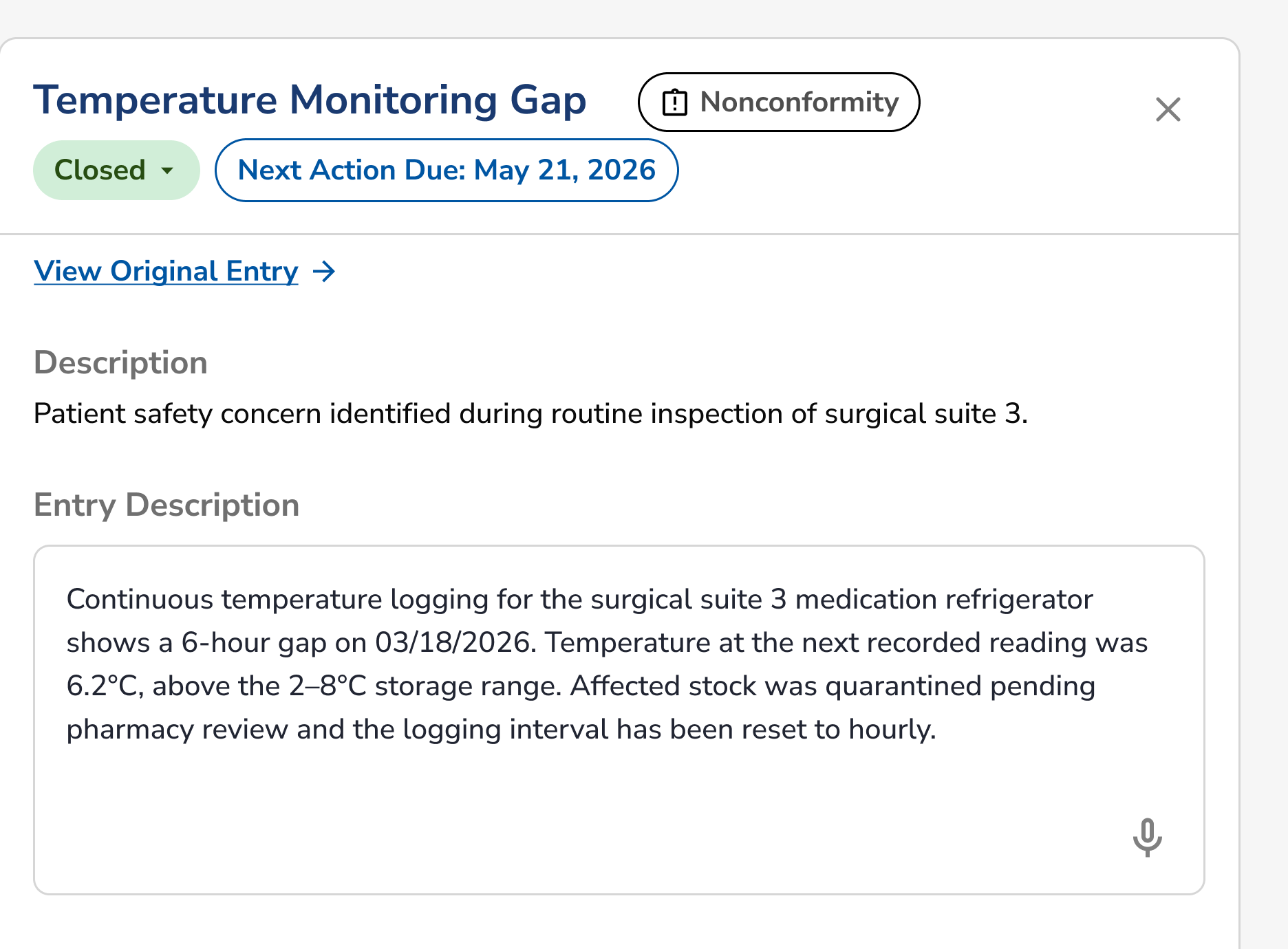
A demo takes a nonconformity you have open right now and walks it through to a closed corrective action, the entry it came from, the similar findings it matches, and the effectiveness check that closes it.
The AI Agent Connection: Agents Are Only as Good as What They Stand On
Every vendor in every category is currently telling you they have an AI agent. Most of that is a chat window bolted onto a database that was never designed to be reasoned over. Ask a generic AI tool to trace a clause through your quality system and it either guesses across unstructured PDFs or admits it can't.
The research on this is direct: a 2024 NAACL survey by Agrawal, Kumarage, Alghamdi, and Liu, "Can Knowledge Graphs Reduce Hallucinations in LLMs?: A Survey", reviews the evidence that grounding language models in knowledge graphs produces more reliable outputs than relying on the model's internal knowledge alone. And the whole emerging discipline of "context engineering", building the structured context an agent reasons over, rather than reaching for a bigger model, exists because the field has worked out where the real constraint sits. The direction of the field isn't ambiguous: agents need a substrate, and unstructured documents were never going to be it.
This is exactly why the ontology layer matters more than the agent sitting on top of it. Clara, Medlaunch's AI agent, isn't smart because of a bigger model, it's useful because of what it's standing on. Ask Clara to explain a finding, and it doesn't retrieve a document and summarize it. It traverses the graph: from the standard clause, to the policy that implements it, to the audit that tested it, to the finding that flagged the gap, to the CAPA that closed it, to the KPI showing whether it stayed closed. Every hop is a real, typed relationship, not a guess, and every answer carries a citation trail back through the graph, because the graph is the citation trail. That's the difference between an agent that sounds confident and one that's actually auditable.
Whoever Owns the Ontology Owns the Layer
Here's the strategic bet underneath this post. As every quality and compliance vendor races to bolt an AI agent onto their product, the agent isn't going to be the differentiator for long, every vendor will have one within a couple of product cycles. The differentiator is what the agent runs on. A chatbot wired into disconnected tables will always be guessing. An agent wired into an ontology will always be reasoning.
Medlaunch built Quality Core, Risk Management, MyPolicy, Vendor Management, and Relevance BI on that shared semantic foundation from the start, which is why Clara can move across all five without losing context. That's not an accident of good engineering. It's the point. Whoever holds the ontology holds the layer every future AI tool in healthcare quality will eventually need to build on top of. We intend to be that layer.
Want to see the ontology layer, and Clara operating on top of it, for your organization? Book a demo with our team.
References
- Castillo-Barrera, F.-E., Durán-Limón, H. A., Medina-Ramírez, C., & Rodríguez-Rocha, B. (2013). "A method for building ontology-based electronic document management systems for quality standards, the case study of the ISO/TS 16949:2002 automotive standard." Applied Intelligence, 38(1), 99–113.
- Silega, N., Castro Aguilar, G. F., Martillo Alcívar, I., Faggioni, K. M., Rogozov, Yu. I., & Lapshin, V. S. (2023). "An Ontology-Based Approach to Support the Knowledge Management of Software Quality Standards." Enfoque UTE, 14(3), 49–56.
- Andrés-Jiménez, J., Medina-Merodio, J.-A., Fernández-Sanz, L., Martínez-Herráiz, J.-J., & Ruiz-Pardo, E. (2020). "An Intelligent Framework for the Evaluation of Compliance with the Requirements of ISO 9001:2015." Sustainability, 12(13), 5471.
- Agrawal, G., Kumarage, T., Alghamdi, Z., & Liu, H. (2024). "Can Knowledge Graphs Reduce Hallucinations in LLMs?: A Survey." Proceedings of NAACL 2024, 3947–3960.
Keep reading
Related from Medlaunch
AI in Hospital Compliance: Why Governance Matters More Than Speed
What has to be true about an AI agent before a surveyor will accept what it tells you.
Read more →What Is ISO 9001 in Healthcare?
The standard this ontology models, and why DNV NIAHO puts it at the center of accreditation.
Read more →How Quality Core Closes the Loop: From Finding to Proven Fix
The clause-to-CAPA-to-KPI path this post describes, running as an actual product workflow.
Read more →