All frameworks

Regulatory

Conditions for Coverage (CfCs): Requirements for ASCs, ESRD Facilities, and Other Suppliers

Conditions for Coverage (CfCs) are CMS's equivalent of the Conditions of Participation, but written for supplier-type organizations rather than hospitals: the terminology CMS uses differs by provider category, even though both function as mandatory Medicare/Medicaid participation standards (CMS: Conditions for Coverage (CfCs) & Conditions of Participation (CoPs)).

Part 416Ambulatory Surgical Centers (ASCs), regulated under 42 CFR Part 416.eCFR: 42 CFR Part 416
Part 494End-Stage Renal Disease (ESRD) facilities, outpatient dialysis centers, regulated under 42 CFR Part 494.eCFR: 42 CFR Part 494
Subpart CWhere the ASC conditions sit, from governance and surgical services through infection control and emergency preparedness.eCFR: 42 CFR Part 416; Foster Garvey
§494.40Water and dialysate quality, testing records dialysis facilities must maintain and be able to produce on an ongoing basis.eCFR: 42 CFR Part 494

What Conditions for Coverage Are

The two provider types where CfCs come up most for Medlaunch's hospital and health-system customers are Ambulatory Surgical Centers (ASCs), regulated under 42 CFR Part 416, and End-Stage Renal Disease (ESRD) facilities (outpatient dialysis centers), regulated under 42 CFR Part 494, both frequently owned or affiliated with hospital systems even though they're surveyed against their own distinct standards. CMS also applies "Conditions for Coverage" language to a handful of other supplier types, including organ procurement organizations and portable X-ray suppliers.

What Each CfC Set Covers

For ASCs, 42 CFR Part 416 Subpart C sets out specific conditions covering areas such as governance, surgical services, quality assessment and performance improvement, environmental safety, staffing, medical records, pharmaceutical services, laboratory services, patient rights, infection control, and emergency preparedness (Foster Garvey: ASC Conditions for Coverage Checklists; eCFR: 42 CFR Part 416). For ESRD facilities, 42 CFR Part 494 sets out conditions including compliance with laws, infection control, water and dialysate quality, reuse of hemodialyzers and bloodlines, physical environment, emergency preparedness, patients' rights, patient assessment, plan of care, home dialysis (care at home), quality assessment and performance improvement, laboratory services, personnel qualifications, medical director responsibilities, medical records, and governance (eCFR: 42 CFR Part 494).

Reporting Requirements

OngoingWater and dialysate testing records under §494.40 are evidence CMS surveyors expect to see generated continuously, not assembled right before a survey.eCFR: 42 CFR Part 494

Like CoPs, CfCs are enforced primarily through survey and Plan of Correction, but individual conditions carry their own standing documentation and reporting expectations. A concrete example: the ESRD Conditions for Coverage require dialysis facilities to maintain and be able to produce water and dialysate quality testing records on an ongoing basis under §494.40, to address any out-of-range result with a corrective action plan, and, under §494.40(d), to maintain active surveillance of patient reactions and, when clinically indicated, obtain blood and dialysate cultures, evaluate the water purification system, and take corrective action. This is evidence CMS surveyors expect to see generated continuously, not assembled right before a survey. ASCs, similarly, must be able to document QAPI activity and infection-control surveillance data on a standing basis under Subpart C, and any condition-level deficiency triggers the same Plan of Correction obligation used for hospitals.

Manage Every Site-Specific Requirement in One System

See how Medlaunch keeps ASC, ESRD, and hospital-specific requirements organized without duplicating your compliance program per location. Request a walkthrough.

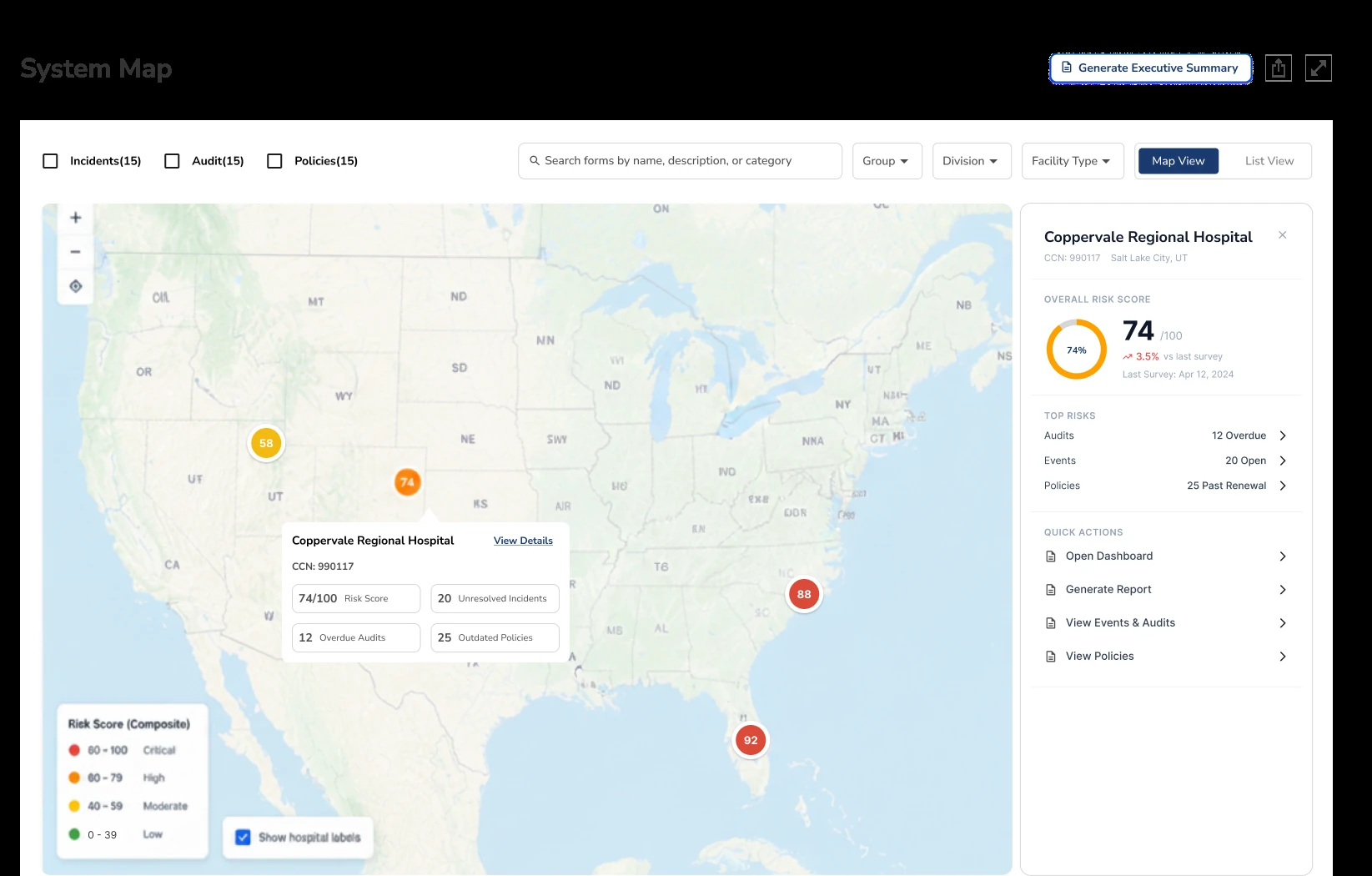
Dark-chrome system map: hospital sites plotted on a US map by composite risk score, with one facility's detail panel open (risk score, overdue audits, open events, outdated policies) and a risk-score legend.

In the platform

How Medlaunch handles it

Every claim below is a screen you can open in a demo.

01

Location-level rules built on the applicable CfC

Medlaunch's rule builder lets ASC- and ESRD-affiliated locations encode their applicable CfCs, alongside the organization's own internal policies, as active rules. For instance, a rule can flag any water/dialysate testing result outside range under an ESRD facility's §494.40 requirement and automatically open a corrective action plan with a due date, assign it to the responsible clinical or facilities owner, and escalate if the deadline is missed.
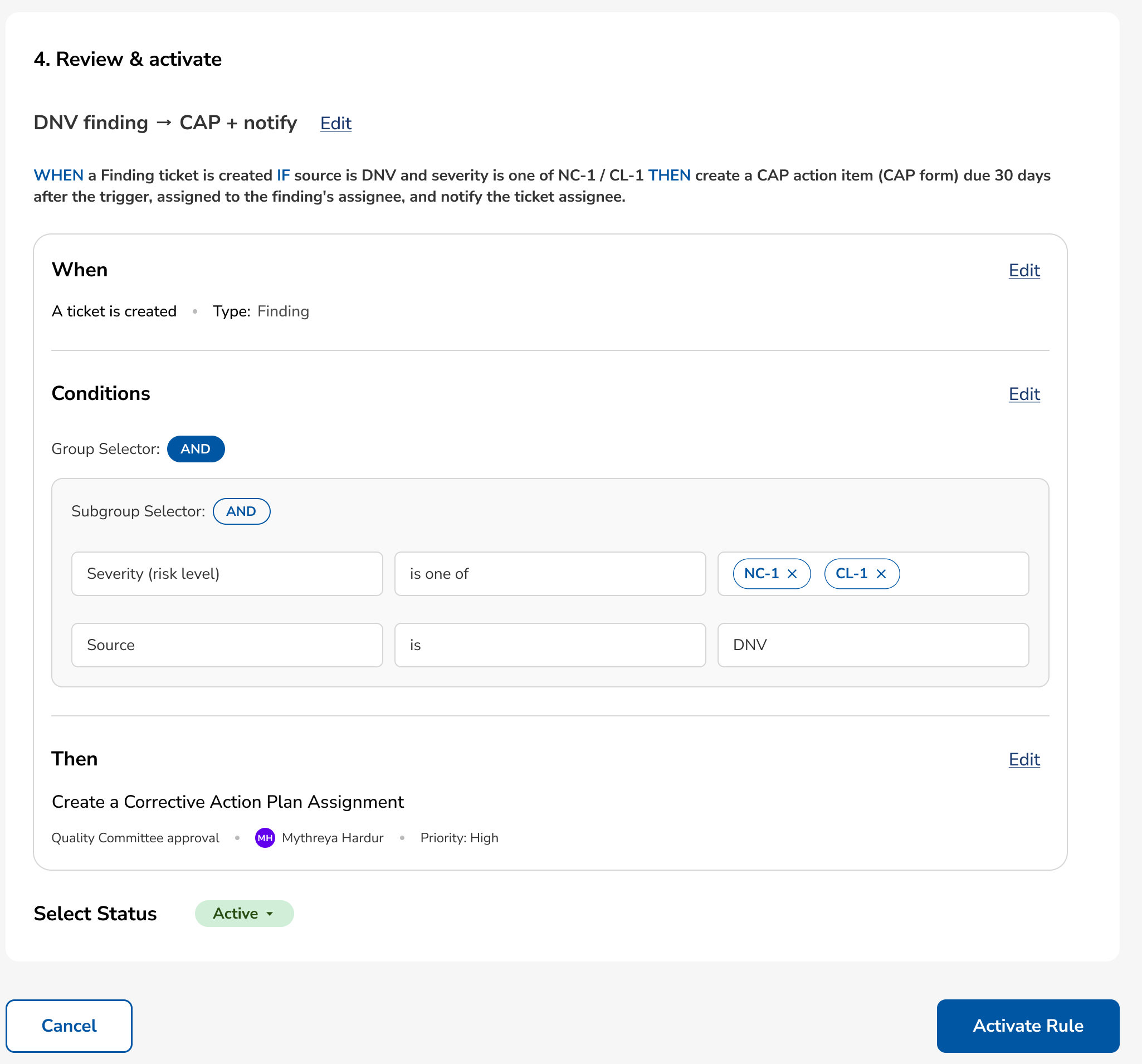
Light rule builder "Review & activate" step: an example rule ("DNV finding → CAP + notify") showing When/Conditions/Then logic and an auto-generated Corrective Action Plan assignment due 30 days after the trigger.

02

Clara rolls findings up across every affiliated site

Clara can summarize CfC-related findings across affiliated ASCs or dialysis units system-wide, help draft the correction-plan narrative from the underlying event data, and flag emerging patterns (for example, a specific ASC location generating repeat infection-control findings).

03

Safety events and vendor issues on the same workflow

Risk Management and Vendor Management modules route safety events and contracted-service issues at these locations into the same rule-driven workflow.

04

ASC and ESRD requirements in one dynamically mapped library

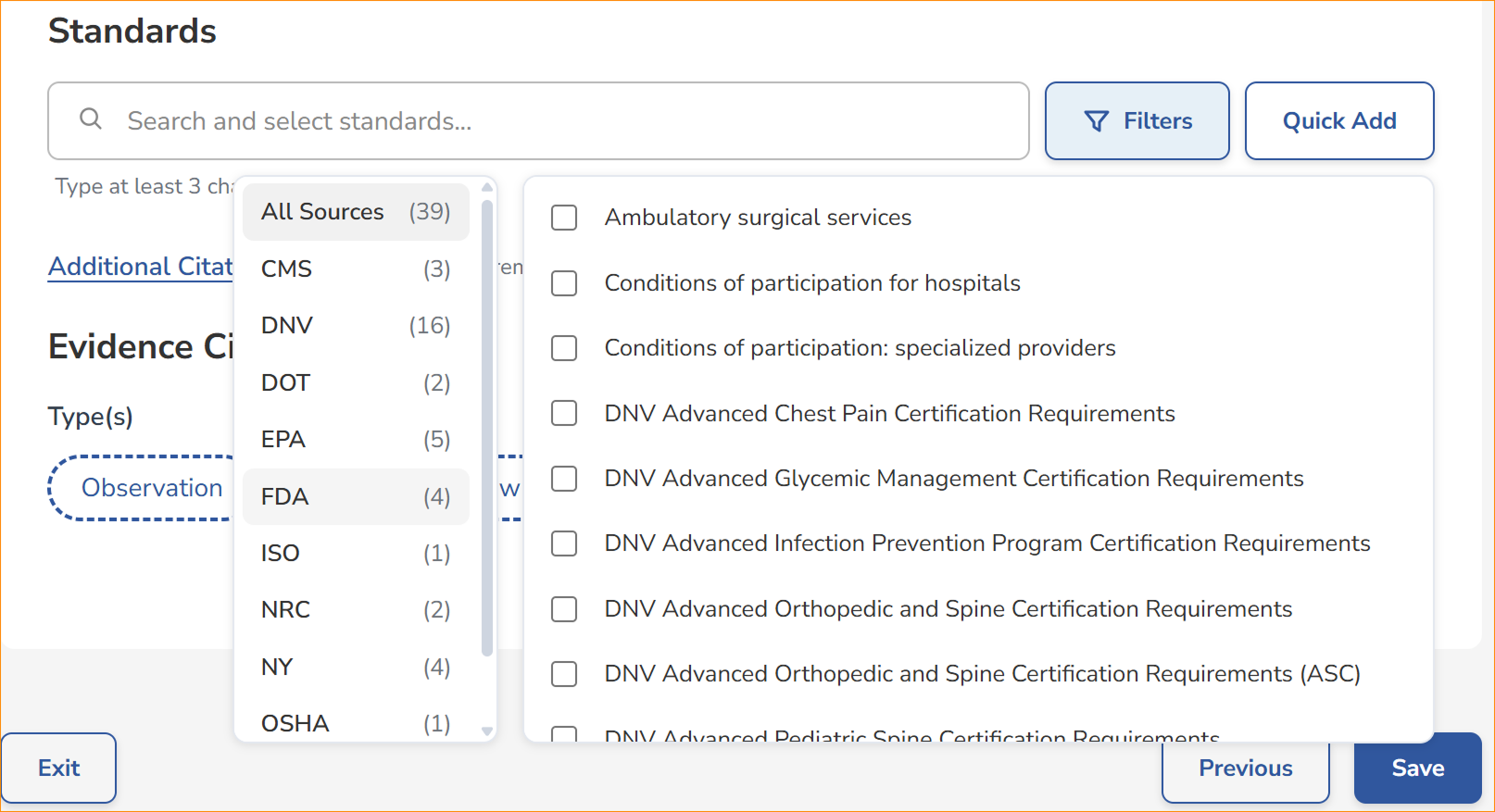
Quality Core keeps the ASC (42 CFR 416) and ESRD (42 CFR 494) condition sets in a dynamically mapped library of standards, distinct from the hospital CoP library, with similarity search, keyword search, and the ability to search across all standards at the same time, so audit tools and rounding checklists at these locations stay built against the correct requirement set.

Light standards picker: a source filter (All Sources, 39, including CMS, DNV, DOT, EPA, FDA, ISO, NRC, NY, OSHA) beside a checkbox list of individual standards to select.

05

Readiness reported per location and per condition

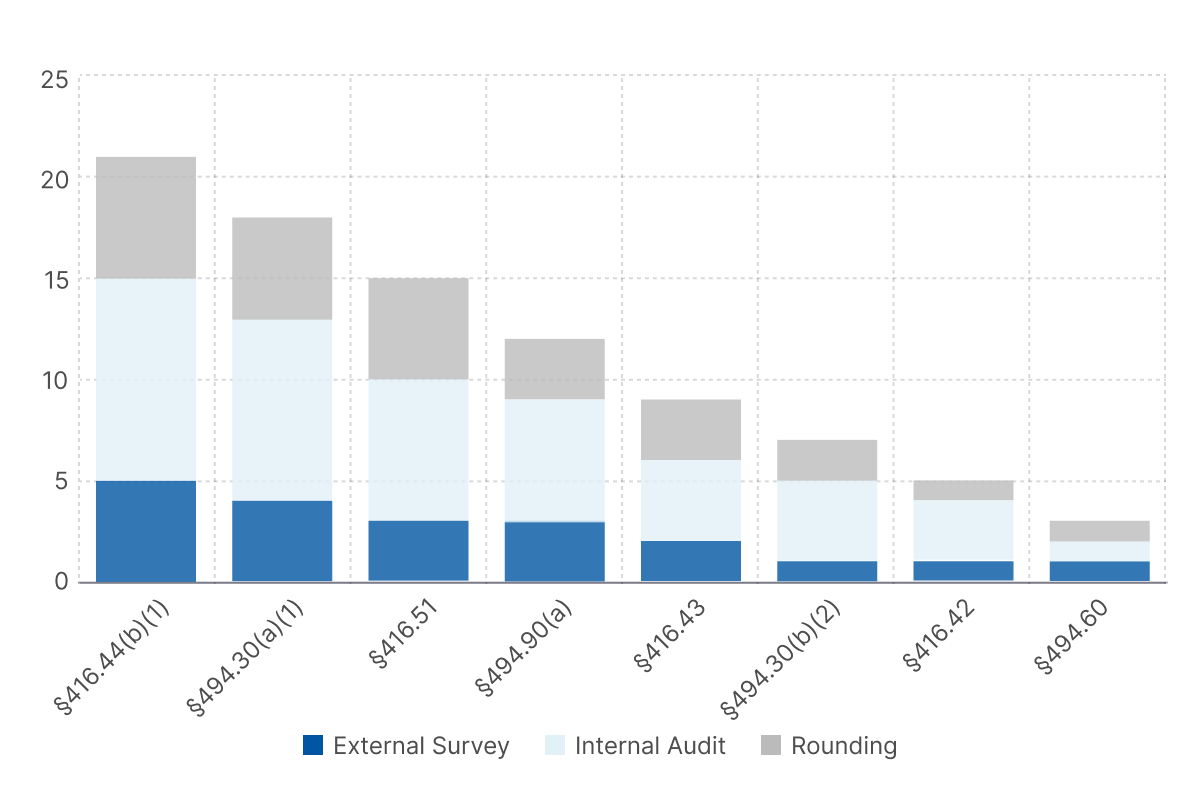
Findings are tagged to the specific CfC condition, letting Relevance BI report readiness and deficiency trends per location and per condition, and My Policy maps location-specific policies to the CfCs they satisfy so any requirement traces instantly to its governing document, with alerts triggered whenever CMS updates a condition so mapped materials stay current.

Light stacked-bar chart: findings by 42 CFR §416/§494 citation (ASC and ESRD requirements), §416.44(b)(1) highest at 21, down to §494.60 at 3, each bar segmented by source: External Survey, Internal Audit, and Rounding.

See it running on your standards.

Book a demo and we will walk through Medlaunch against the frameworks you are surveyed on and the facilities you actually run.

Book a Demo