Blog
How to Build a Hospital Quality Management System on the Medlaunch Stack
Most hospitals don't lack quality processes. They lack a system that connects them. Policies live in a shared drive, audit findings in a spreadsheet, incidents with one team, risk with another, vendor contracts in a folder nobody opens until renewal. When survey season hits, someone spends six weeks stitching it all into evidence.

Key takeaways
- A QMS is not one tool. It is a sequence of connected components, and the order you build them in decides whether they ever connect.
- Start with document control in MyPolicy, every audit finding, CAPA, and survey question eventually traces back to a policy and proof staff read it.
- Then layer the evidence engine (Quality Core), risk registries and incident intake (Risk Management), continuous monitoring (Relevance BI), and vendor oversight (Vendor Management).
- CAPA is the connective loop: a finding becomes a ticket, the ticket becomes a corrective action plan, and Relevance BI checks whether the fix held.
- Built in this order, survey readiness stops being a project you start. It is a report you run.
Step 1: Get Your Documents Under Control First (MyPolicy)
A real quality management system (QMS) isn't a single tool, it's a sequence of connected components, each feeding the next. Below is a practical build order for standing one up on the Medlaunch stack, module by module, so that by the end, survey readiness isn't a project you scramble to start, it's a report you run.
Everything downstream in a QMS (audits, training, incident response, CAPA) refers back to a policy, procedure, or protocol. If that foundation is unstable, nothing built on top of it is reliable.
In MyPolicy, you're establishing:
- A single source of truth for every policy, procedure, and controlled template, replacing the shared drives and department binders where outdated versions survive.
- Version control and approval workflows, so a revision goes through defined reviewers and sign-off before going live, and you can always produce the version in effect on any given date.
- Controlled templates for documents teams generate repeatedly (consent forms, protocols, checklists), so nobody is working off a stale copy.
- Attestation tracking, so you can show not just that a policy exists, but that the right staff reviewed and acknowledged it.
Every audit finding, every CAPA, and every survey question eventually traces back to "what does policy say, and can you prove staff knew it." Get this right first.
Step 2: Build Your Evidence Engine (Quality Core)
With documents under control, the next step is generating evidence that you're actually operating according to those documents. That's the job of Quality Core, where internal audits and routine rounds happen across three domains most hospitals need to track continuously:
- Physical environment rounds, life safety, environment of care, infection control walkthroughs.
- Clinical rounds and audits, chart reviews, medication management, clinical documentation checks.
- General operations audits, departmental compliance checks, competency verification, process audits.
Rather than one-off exercises before a survey, Quality Core is built for a cadence: scheduled rounds, standardized checklists tied to accreditation standards, findings logged in real time, and every finding automatically feeding into a ticket for follow-up.
This is where your QMS stops being "documents on a shelf" and starts producing a living evidence trail. Every completed round, every closed finding, every corrected deficiency becomes part of the record you'll eventually hand a surveyor, accumulated as a byproduct of doing the work, not scrambled together after the fact.
Step 3: Stand Up Risk Registries and Incident Management (Risk Management)
Audits catch what you go looking for. Risk Management catches what comes to you, incidents, near-misses, and safety events. In this module, you're building two connected pieces:
- Risk registries, a structured inventory of risks across clinical, operational, financial, and safety domains, each with a likelihood/severity assessment, an owner, and a mitigation plan.
- Incident and safety event management, standardized intake for reporting, investigating, and closing out safety events, adverse events, and near-misses, with the ability to trend them over time and roll significant findings into the registry.
An incident shouldn't just be logged and closed. A pattern of similar incidents should surface as a risk in the registry, and a risk that materializes should link back to the incident that proved it. Handled together, risk and incident data don't just tell you what happened, they tell you what's likely to happen next.
Step 4: Put Continuous Monitoring on Top (Relevance BI)
Audits, rounds, and incident logs generate a lot of data. Without a layer that turns it into trends, that data sits there until someone builds a manual report before survey week, exactly the scramble a real QMS is supposed to eliminate.
Relevance BI is where that data becomes a monitoring system rather than an archive:
- KPI tracking against metrics leadership and accreditation bodies care about, audit completion rates, finding closure times, incident trends by unit, CAPA overdue rates.
- Continuous monitoring that surfaces drift before it becomes a finding, declining round scores, a rising CAPA overdue rate, a policy area generating repeat incidents.
- Leadership-ready reporting, so committee and board reporting draws from the same live data frontline teams generate, not a separately assembled deck.
This is the step that turns your QMS from reactive to proactive: instead of finding out about a negative trend during a survey, you're seeing it months earlier on a dashboard.
Step 5: Bring Vendors Into the System (Vendor Management)
Accreditation standards and payer contracts increasingly expect hospitals to demonstrate oversight of vendors and business associates that touch patient care, data, or facilities. That's the role of Vendor Management, which covers both halves of the vendor lifecycle:
- Vendor evaluations, structured assessments before a vendor is engaged, covering compliance, security, and performance criteria relevant to what they'll be doing in your environment.
- Post-signature operations, ongoing tracking after the contract is signed: renewal dates, required documentation (insurance, BAAs, licensure), performance monitoring, and re-evaluation cadence.
Left in a contracts folder, vendor oversight is invisible until something goes wrong. Built into the QMS, it's another category of evidence you can produce on demand, proof that vendor risk is actively managed, not just contractually assumed.
See it on your open findings.
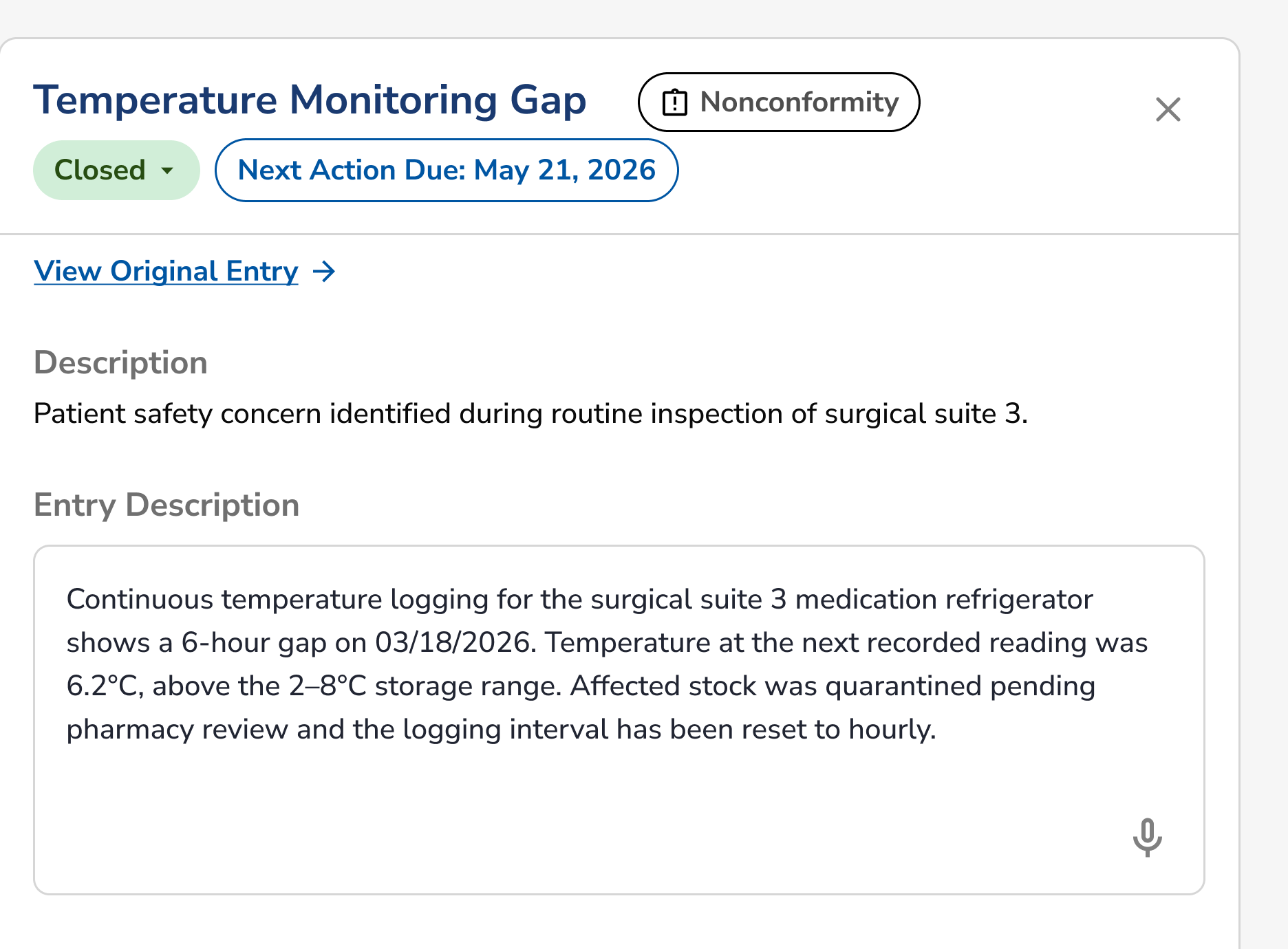
A demo takes a nonconformity you have open right now and walks it through to a closed corrective action, the entry it came from, the similar findings it matches, and the effectiveness check that closes it.
Step 6: Connect It All Through CAPA
Every component above generates findings, an audit finding, a risk needing mitigation, an incident needing a root-cause fix, a vendor gap needing remediation. The corrective and preventive action (CAPA) workflow turns those findings into resolved problems, and it's what ties the whole stack together:
- Finding identified, in a Quality Core audit, a Risk Management incident, or a Vendor Management evaluation.
- Finding becomes a ticket, assigned to an owner, with a due date and defined scope.
- Ticket becomes a corrective action plan, root cause identified, corrective steps defined, and where relevant, a preventive action to stop recurrence elsewhere.
- Effectiveness gets monitored, Relevance BI tracks whether the underlying metric actually improved, so a CAPA that "closed" but didn't fix the problem doesn't fall off the radar.
This loop is what separates a QMS from a compliance checklist. A checklist tells you something was wrong once. A CAPA loop, run consistently across every module, tells you the organization got better at the thing that was wrong.
Step 7: Let Survey Readiness Become a Byproduct, Not a Project
Here's the payoff of building the stack in this order: survey readiness stops being something you prepare for and becomes something you already have.
Because MyPolicy has tracked versioned, approved documents all year, Quality Core has generated dated evidence from routine rounds, Risk Management has an active registry with real mitigation history, Relevance BI has tracked KPI trends month over month, and Vendor Management has documentation on file for every active vendor, the evidence a surveyor asks for isn't something your team reconstructs. It's something the system has been quietly accumulating all along. The difference shows up the week before a survey: instead of a scramble to pull together binders, your team runs a report.
Clara: The Connective Layer Across the Whole Stack
Each module above is powerful on its own, but the real leverage comes from how they connect, and that's where Clara, Medlaunch's AI agent, operates. Clara works across the entire stack end-to-end, not inside a single module in isolation. It can pull the policy context behind an audit finding, surface the incident history behind a risk registry entry, draft a CAPA plan informed by how similar findings were resolved elsewhere in the organization, and flag when a KPI trend in Relevance BI ties back to an open finding in Quality Core.
Because Clara has visibility across policies, standards, audits, incidents, risks, vendors, and KPIs simultaneously, it can connect a finding in one part of the system to relevant context in another, in seconds, without a human manually cross-referencing five different screens, all inside your existing role-based permissions and approval workflows, so speed doesn't come at the cost of control.
Building in This Order Pays Off
You don't need to build all six components simultaneously. Documents first, then audits and rounds, then risk and incident management, then continuous monitoring, then vendors, tied together with a consistent CAPA loop. Each step makes the next one more valuable, and by the time it's all connected, survey readiness has quietly become a permanent state rather than a periodic fire drill.
Ready to see the Medlaunch stack, and Clara, in action for your organization? Book a demo with our team.
Keep reading
Related from Medlaunch
AI in Hospital Compliance: Why Governance Matters More Than Speed
What has to be true about Clara before AI-assisted speed is safe to rely on.
Read more →How Quality Core Closes the Loop
Step 2 and Step 6 in practice: a finding tracked from the round that caught it to the proven fix.
Read more →What Is a Quality Management System?
The plain-language version of the components this build order stands up, module by module.
Read more →