Your Data Already Has the Answer.
It's just written in a sentence instead of a field. "The crash cart was expired" is not a dropdown, so no tool can count it. Relevance BI reads those descriptions and turns what they contain into things you can filter, trend and compare.
A Filing Cabinet Stores Things. This Connects Them.
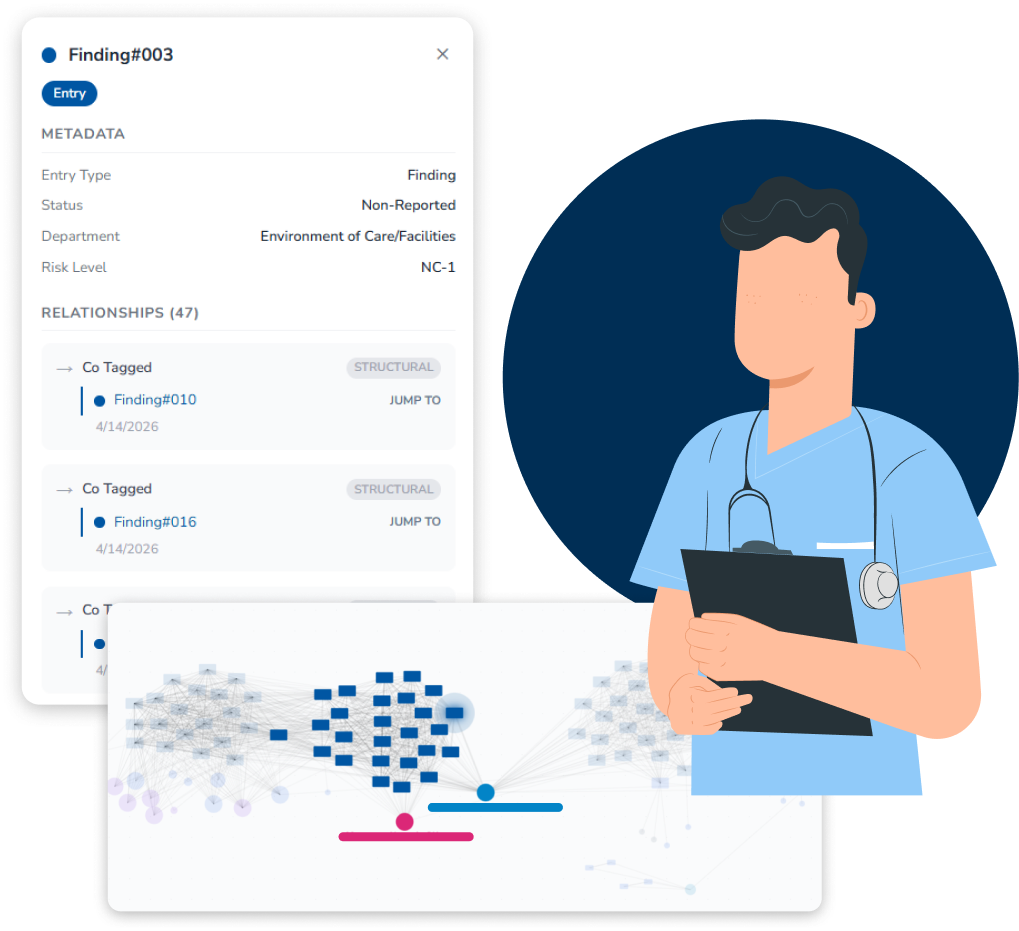
Standards, clauses, policies, audits, findings, CAPs, incidents, vendors and KPIs are modeled as typed entities with real relationships between them, not as rows in separate tables that a person has to join by remembering an ID.
One Requirement, Three Codes
DNV writes it as MM.3.SR.2. Joint Commission writes it as MM.03.01.01. CMS writes it as 482.25(b)(6). They are the same requirement about medication storage. The crosswalk makes them one thing, so a finding from any source lands in the same place.
The Concept in the Sentence
The information that matters most lives in free text, because nobody built a dropdown for "the item was expired" or "the crash cart was involved". Those descriptions are read and turned into concepts you can filter and count.
Equipment and Clinical Concepts
Once expiration is a concept and a crash cart is an entity, you can slice your data by the thing that actually failed, not only by the standard number a surveyor happened to cite it under.
Clause to Policy to CAP to KPI
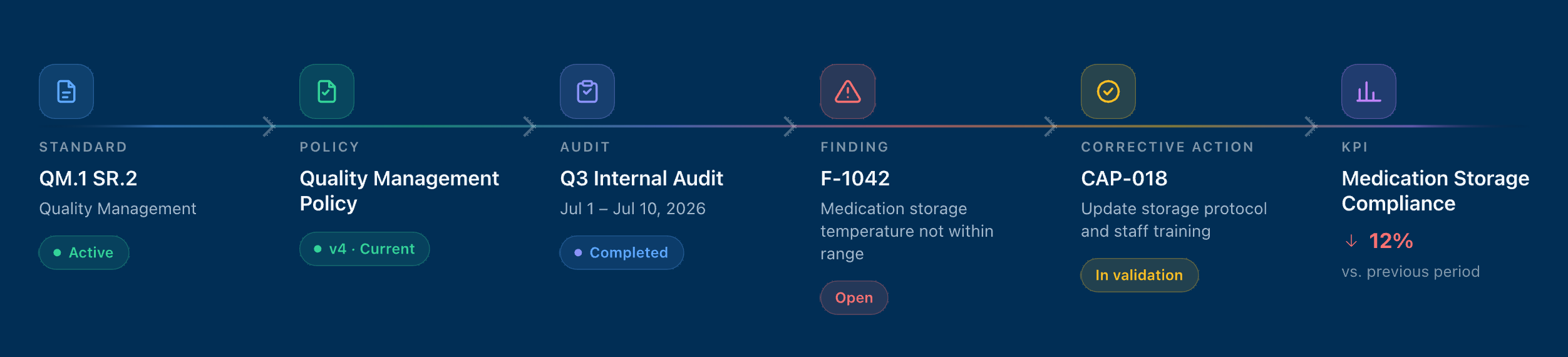
A clause connects to the policy that implements it, the audit that tested it, the finding that flagged the gap, the CAP that closed it, and the KPI showing whether it stayed closed. Ask for everything downstream of a clause and there is an answer.
The Same Failure, Cited Three Ways
Two surveyors can cite the same real-world failure under different standards, which makes it invisible to any analysis based on citation codes. Recognizing the underlying event is what makes cross-facility patterns, and cross-organization benchmarking, possible.
Bring Your Own Data
Data from outside the platform comes in through CSV and Excel upload, external survey results, HR metrics, anything your team needs beside its quality data, and can be trended and cross-referenced alongside it.
Related
An agent is only as good as what it stands on.
Every vendor in this category will tell you they have an AI agent. Most of it is a chat window over a database that was never designed to be reasoned across. Ask a general-purpose tool to trace a clause through your quality system and it either guesses across unstructured PDFs or tells you it can't.
Clara is useful because of what she is standing on. Asked to explain a finding, she doesn't retrieve a document and summarize it; she moves along real relationships, from the standard to the policy to the audit to the finding to the CAP to the KPI. Every hop is a modeled relationship, so every answer arrives with a trail you can check. That is also what makes risk worth scoring: a risk register can only rank what it can see connected.
How Clara AI Uses the
Ontology Layer
Clara reads the connections rather than the documents. That is what lets her answer a question crossing four modules, and cite what she crossed to get there. Every answer shows its trail, so your team can check the reasoning instead of trusting the tone.

CLARA
Clarity in complianceClara reads
Clara proposes
Every connection Clara draws shows the path it traveled, so your team can open any link and judge it.
Related
- Quality CoreFindings, audits and CAPs are created here, then become connected records.
- MyPolicyA policy links to the standards it satisfies, so a change to one shows on the other.
- Vendor ManagementA vendor's contract sits beside the CAPs raised against them.
- Risk RegisterA register can only rank what it can see connected.
- ClaraHow Clara's agentic workflows, voice and pre-fill work.
- The Ontology Layer, the long versionThe full argument, with the academic prior art.
- What Is ISO 9001 in Healthcare?The standard this model is built around.