Closed Isn't Fixed.
Define what "effective" means for each corrective action, set the window, and let the platform watch. A repeat finding, a failed audit tool score, or the same standard cited again reopens the plan instead of quietly starting a new one.
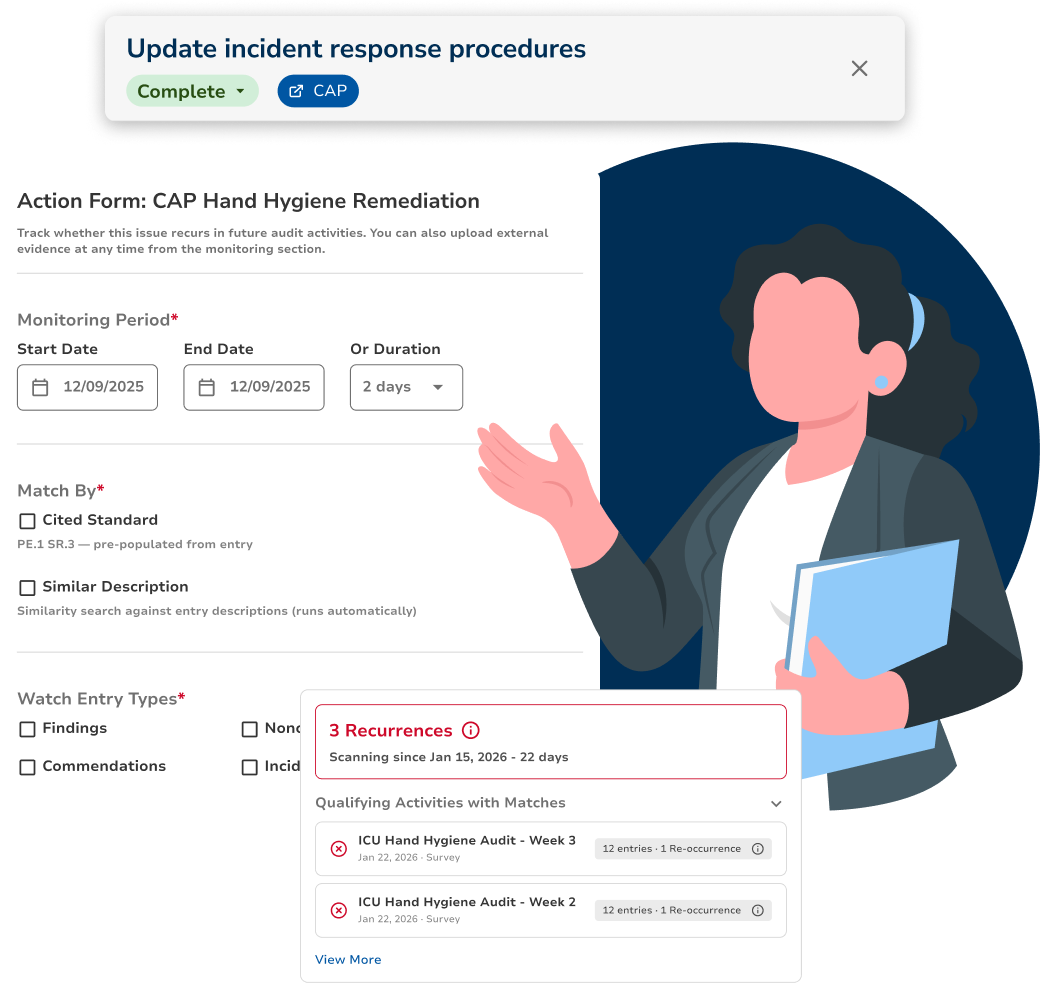
You Decide What Effective Means
Effectiveness is not a universal setting. What proves a corrective action worked in a 25-bed critical access hospital is not what proves it across a twelve-site system. Both definitions live in the platform, and both are yours to write.
Define the Criterion
Write the test the corrective action has to pass: zero repeat findings on this standard across two audit cycles, an audit tool score at or above your threshold on three consecutive rounds, no repeat citation at the next survey. Different findings can carry different criteria.
Set the Scope
Monitor at the site, the department, or the organization as a whole. A CAP written for one unit can be watched across every unit that shares the process, which is how you find out the fix worked in the ICU and never reached the ED.
Watch the Window
Closure starts a clock, not an archive. During the monitoring window the platform checks real activity against your criteria, rounds walked, audits run, findings written, rather than waiting for someone to schedule a review meeting.
Detect the Recurrence
Recurrence matching runs on the standard cited, the process area, the location and the root cause category. When the same problem reappears under a different label, it is still linked to the plan that was supposed to have fixed it.
Detect It by Citation
The sharpest signal is the one an accreditor gives you. When a standard is cited again, at an internal audit or at a survey, the citation links back to the prior corrective action and marks it ineffective, automatically. Repeat citations stop being a surprise.
Reopen, Don't Re-File
An ineffective CAP reopens with its history attached instead of spawning a brand-new plan with no memory. The next analysis starts from what has already been tried and what already failed.
Plan This CAP From the Last Five
An example scenario, not a customer result, the numbers below are illustrative and describe how the record reads, not a Medlaunch outcome.
- Before you write the plan, a Life Safety round finds a rated door on 6 East that will not self-close. Before your team drafts anything, the platform reads every audit and every round across all seven hospitals in the system and pulls each prior finding cited to the same hazardous-area requirement: eleven in four years, on six units at four sites.
- What was tried, six of those closed with "closer replaced, staff educated". Four of those six recurred within two audit cycles, so that approach reads as ineffective across the system. One closed with a change to the renovation change-control procedure. That one has not recurred in nine quarters.
- What that tells you, the CAP that treats the door is the CAP that fails. The CAP that treats the process is the one that holds. Your team writes the second kind, from evidence, on day one.
- The criterion you set, zero rated-door nonconformities across two consecutive quarterly Life Safety rounds at any site, and no repeat citation at the next survey.
- What happens next, the plan closes into that window. Nine months later, when the standard is cited on a different campus, the citation links back to this plan, marks it ineffective at that site, and reopens it with all of the above attached.
Related
- Effectiveness Monitoring for EventsThe same monitoring engine tracks whether a corrective action from a safety event stopped the harm from recurring.
- RCA & CAPsA corrective action plan closes into this window.
- AuditsRecurrence shows up as a repeat citation at your next internal audit or survey.
- AutomationsA failed window can reopen the plan, escalate it and open a risk entry, under a rule you write once.
- Risk RegisterMonitoring results are one of the sources feeding your register.
- Reporting & DashboardsChart effectiveness, recurrence and repeat-finding rates by department or site.
- BenchmarkingRecurrence is the most comparable measure there is. See how you sit against your peer group.
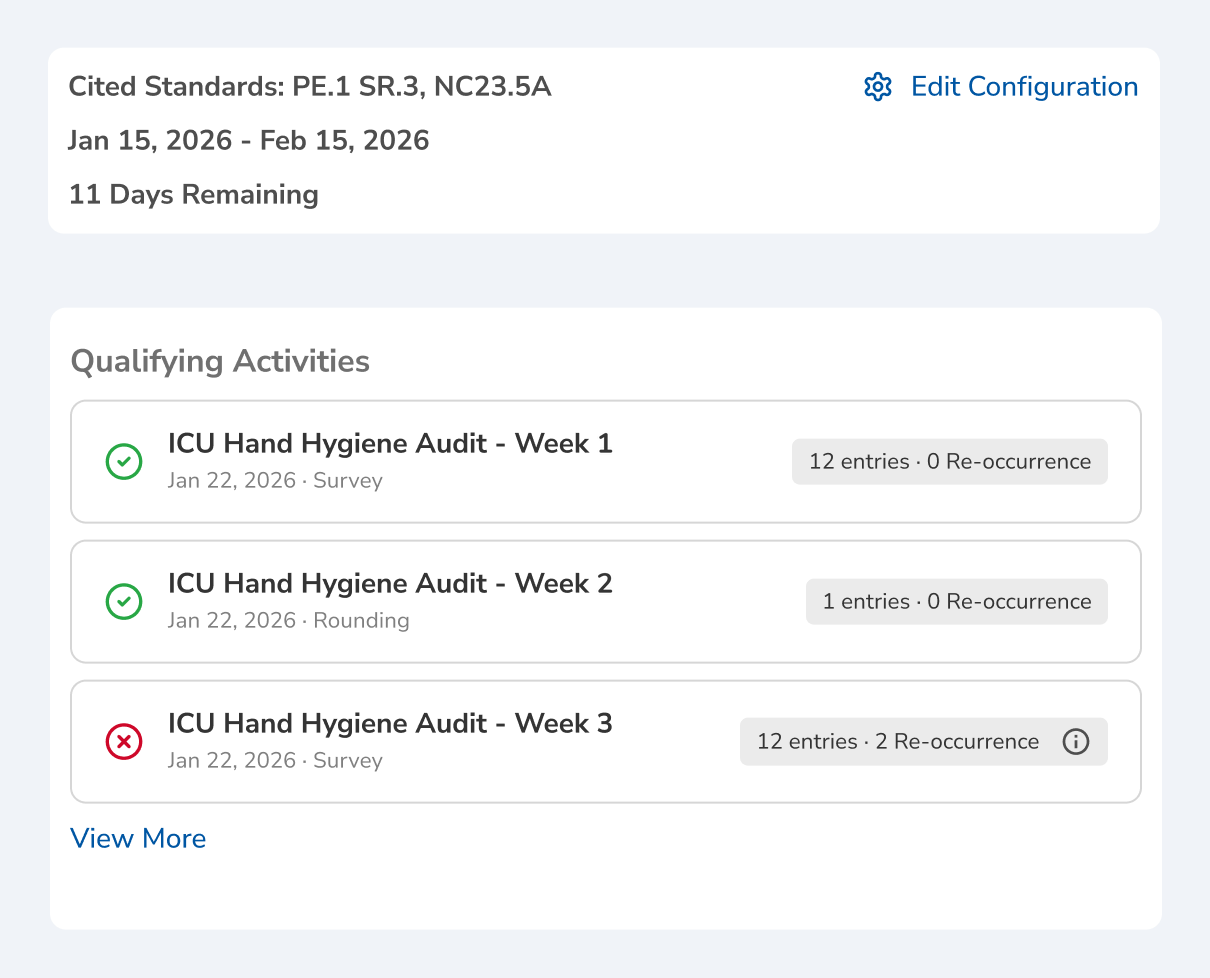
Inside the Monitoring Window
A closed plan goes quiet until someone on your team remembers to check it. This window stays on screen instead: the standards it is matching on, the time left in it, and every audit, round and survey that has run against it since closure, each one marked clean or matched. Whether the fix is holding becomes a glance rather than an investigation.
Rounds qualify the same way audits do, so a window can be watched against the rounds your team already walks.
How Clara AI Enhances
Effectiveness Monitoring
Exact-match rules catch the obvious repeat. Clara catches the one wearing a different label, a finding cited to a different standard with the same underlying cause. She raises the connection and shows her reasoning; your quality team decides whether it counts as a recurrence.

CLARA
Clarity in complianceClara reads
Clara proposes
Clara raises the link and shows her sources. Your quality team confirms or dismisses every recurrence she proposes.