Blog
ISO 9001:2026 Is Here: What the New Standard Means for DNV-Accredited Hospitals—and How Quality Core Keeps You Ahead
If your hospital is accredited through DNV, you already know that DNV's NIAHO® standards are directly anchored in ISO 9001 quality management principles. Throughout your three year accreditation cycle, ISO conformance isn't just an abstract framework; it is the operational benchmark your hospital works toward every day.

Key takeaways
- ISO 9001:2026 was published on 16 September 2026. It splits risks and opportunities into two clauses, with the structural work concentrated in clause 6, which moves the bar for survey readiness at every DNV-accredited hospital.
- The 2026 standard is already loaded in Medlaunch, in the same standards library behind Quality Core, MyPolicy and Risk Management, so your team can cite a 2026 clause on a finding, a policy or a risk today rather than in year three.
- Risks and opportunities now sit in separate clauses (6.1.2 and 6.1.3). Medlaunch has kept them on separate ledgers from the start, and Clara surfaces the ones nobody stopped to write down.
- Clause 6.3 adds communication, effectiveness monitoring and review of results to change management. All three are document control work, and every policy in MyPolicy is already tagged to the standard it implements.
- ISO 9001:2015 asked internal audits for criteria and scope, not a stated objective. In Quality Core the objective is a field on the audit, set when you plan it, not written up afterward, so it is on the record either way.
What Changed in ISO 9001:2026?
ISO 9001:2026 was published on 16 September 2026. With targeted changes across clauses 4 through 10, the bar for survey readiness has officially moved. While there is a standard three year transition window, waiting until the eve of your survey window to overhaul audit trails, forms, and registers is a recipe for stress and findings.
Below, we break down what has fundamentally shifted in ISO 9001:2026 and how Quality Core is purposely built to help hospital quality, accreditation, and leadership maintain effortless, year-round compliance.
The 2026 revision doesn't tear down the High-Level Structure, but it introduces critical accountability requirements that will reshape hospital rounds, leadership reviews, and corrective action workflows:
Quality Culture & Ethical Conduct Are Explicit (Clauses 5.1.1 & 7.3): Leadership can no longer simply issue a policy statement. Surveyors will expect direct evidence that top management actively promotes a culture of quality and ethics, evidenced through leadership rounding, huddles, and staff who understand and articulate these values in their daily workflow.
Risks and Opportunities Get Separate Clauses (6.1.2 & 6.1.3): You can no longer treat opportunities as an empty side column on your risk matrix. Opportunities now require distinct determination, analysis, evaluation, and dedicated management review reporting.
Expanded Change Management (Clause 6.3): The previous four planning considerations are now seven. Whenever clinical pathways, workflows, or QMS policies change, hospitals must specifically document:
- How the change is communicated.
- How its effectiveness is monitored and evaluated.
- How the results are reviewed.
Knowledge Retention & Continuity (Clause 7.1.6): With ongoing healthcare staffing turnover, institutional knowledge must be systematically captured, applied, and shared across departments.
Auditing With Specific Objectives (Clause 9.2.2): ISO 9001:2015 asked only for audit criteria and scope, so an audit whose objective lives in someone's memory has nothing on the record to point at.
Bridging the Gap: Why Traditional QMS Spreadsheets Fall Short
If your hospital relies on disconnected spreadsheets, paper-based rounding binders, and siloed emails to track nonconformities, meeting the 2026 standard will be an uphill battle.
When surveyors ask to see:
- The communication plan and 90-day effectiveness review for a recent change to central line dressing protocols,
- Staff interview documentation proving leadership promotes a culture of quality during floor rounds, or
- A distinct opportunities log tied back to patient safety initiatives...
...the evidence needs to be immediate, traceable, and embedded into daily operations. Two of the 2026 changes map almost exactly onto how the Medlaunch platform is already built, which makes them the easiest place to start.
Risks and opportunities are already on separate ledgers (6.1.2 & 6.1.3). The new clauses ask you to determine, analyze and evaluate opportunities on their own terms and report them into management review, which is a problem if opportunities have only ever been a column on your risk matrix. In Medlaunch they were never the same object. The risk register holds risks. Opportunity Management holds opportunities, each one scored rather than merely listed, each with an owner and a review date, and each linked to the quality objective it serves. The 6.1.3 reporting requirement becomes a view of a ledger you already keep, not a new register to stand up. And because Clara reads across your audits, rounds, events and findings rather than a single module, she surfaces the risks and opportunities nobody stopped to write down: a pattern running through three months of rounding entries comes back as a proposed register entry with a suggested score and owner. Clara proposes, and your quality team decides what gets accepted.
Clause 6.3 is policy work, and it is tagged that way. The three new change-management considerations are document control questions in disguise. How was the change communicated? In MyPolicy, a policy revision carries its own approval workflow and its acknowledgement roster, so who was told and who confirmed they read it is part of the record rather than a reconstruction from someone's sent folder. How is effectiveness monitored, and how are results reviewed? Those attach to the same policy, beside the version history showing what changed and when. Because every policy is tagged to the regulations and standards it implements, a revision made under the new clause 6.3 is filed against 6.3 — so the change, its communication plan and its review sit on one record a surveyor can open, instead of three systems you have to reconcile in the room.
See it on your open findings.
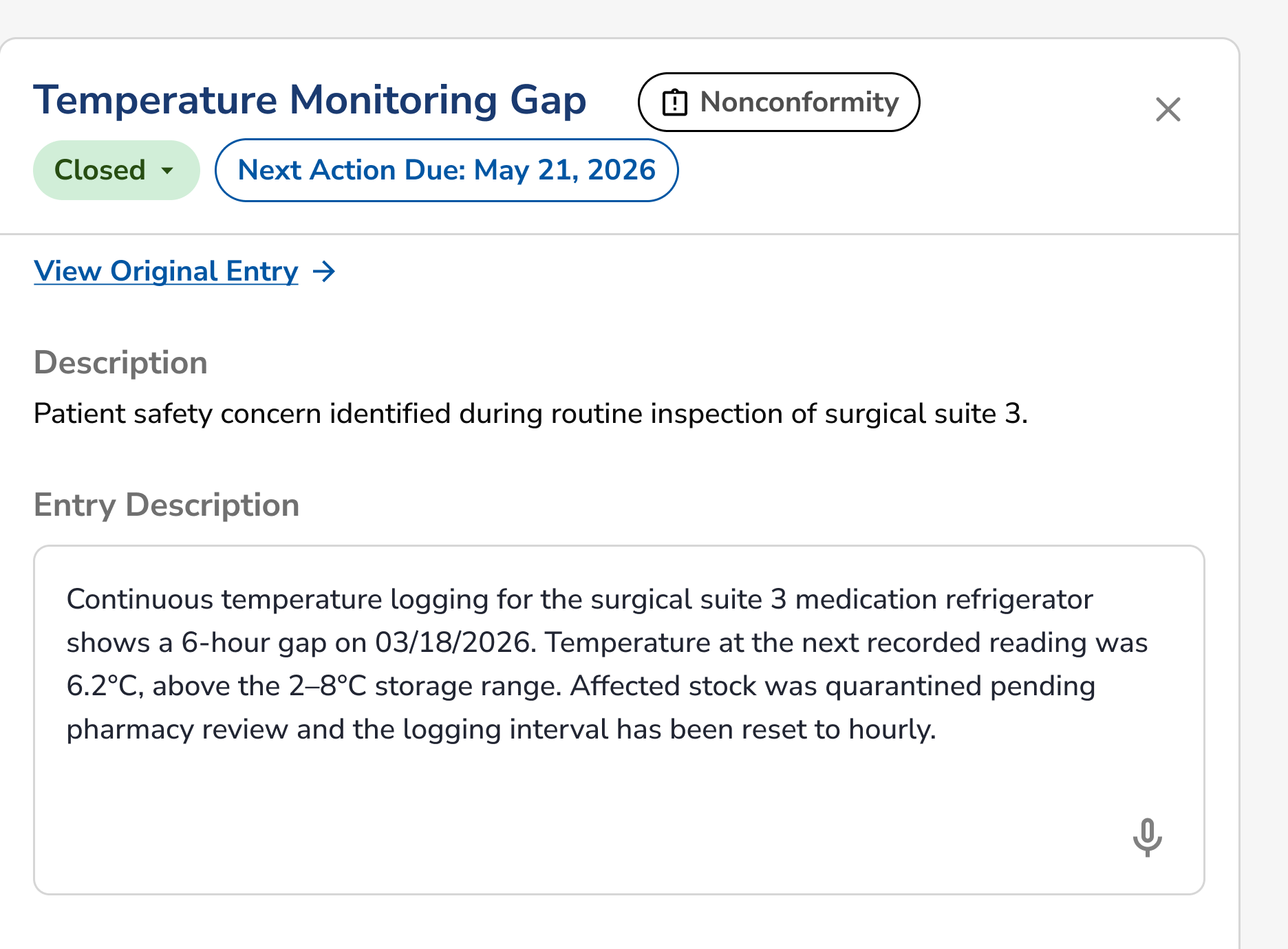
A demo takes a nonconformity you have open right now and walks it through to a closed corrective action, the entry it came from, the similar findings it matches, and the effectiveness check that closes it.
How Quality Core Keeps Your Hospital Survey-Ready Every Day
We built Quality Core specifically around ISO 9001 and DNV hospital accreditation standards. It is designed to turn compliance from an annual scramble into a natural byproduct of your everyday rounding and auditing.
Streamlined Internal Audits & Clinical Rounding. Quality teams, nurse managers, and clinical leaders conduct audits right at the point of care. Whether performing executive leadership rounds to capture quality culture evidence or running departmental tracer audits, Quality Core organizes your findings in real time, complete with photos, notes, and direct staff feedback. Internal audits and routine rounding run off the same record, so an executive round and a tracer are not two separate programs.
Every Audit Carries Its Objective (Clause 9.2.2). ISO 9001:2015 asked only for audit criteria and scope, so stating the objective has been good practice rather than something a surveyor could hold you to. Most quality programs can produce scope and criteria on demand and then reach for the objective after the fact, reconstructing intent from a calendar invite or an email thread.
In Quality Core, the objective is a field on the audit itself, set when the audit is planned. Audit planning is risk-based, so the objective ties back to whatever made you schedule it: a cluster of findings in one department, a corrective action that closed last quarter and needs to hold, a clause your last survey flagged. Scope and criteria sit alongside it. When the audit runs, every entry is cited to the clause it tests, so the finished report shows the objective, the scope, the criteria, the standard each observation was written against, and what the audit concluded about the objective it set out to test. A surveyor asking why you audited this and what you were trying to find out gets the answer off the record, not from memory.
Built-in Standards Library: Instant Citation of Nonconformities. No more thumbing through dense accreditation manuals or memorizing clause numbers. Quality Core includes an integrated ISO 9001 and DNV standards library, with the 2026 clauses already loaded alongside the 2015 text you are transitioning from. When an auditor flags an issue, whether an environmental hazard or a documentation gap, they can instantly link and cite the exact standard requirement, eliminating guesswork and standardizing data across all facilities.
End-to-End CAP Management, Root Cause Analysis & Effectiveness Checks. Closing a finding is only half the battle:
- Root Cause Analysis (RCA): Guide cross-functional teams through structured RCA workflows (such as 5-Whys or Fishbone frameworks) directly within the platform to address true systemic causes rather than superficial symptoms.
- Closed-Loop Corrective Action Plans (CAPs): Assign ownership, set milestone deadlines, and enforce automated accountability.
- Automated Effectiveness Monitoring: ISO 9001:2026 places a heavy emphasis on validating that changes actually worked. Quality Core automates the post-implementation monitoring phase, prompting follow-up evaluations at 30, 60, or 90 days so you have audit-ready proof of sustained improvement.
One Platform Across Departments Is Now Doing Compliance Work (Clause 7.1.6). Organizational knowledge has been clause 7.1.6 since 2015, and the 2026 revision leaves the requirement close to where it was, while recognizing knowledge that lives in digital systems and other media. What has changed is the setting: this lands differently in a hospital that has been through several years of turnover. Think about where institutional knowledge currently sits: rounding in one department's binder, infection prevention on its own tracker, pharmacy in a separate spreadsheet, the emergency department in a tool nobody else logs into. Each is defensible on its own, and together they guarantee that knowledge does not survive the person holding it. The nurse manager who knew why a workflow changed three years ago moves on, and the reasoning leaves with them. Under 7.1.6 that is no longer an operational annoyance; it is a conformance gap.
This is why running rounds, audits, policy and risk in one system across every department has stopped being a procurement preference. When all of it happens in the same place, against the same standards library, the institutional record is a byproduct of normal work rather than a project somebody has to staff. A new quality director opens a clause and sees every policy written against it, every audit that tested it, every finding it produced and every corrective action that held, across all departments, back through every year the platform has been in place. That is what 7.1.6 asks for, and it is very hard to assemble from eight isolated tools after the fact.
Flexible Custom Forms + Pre-Uploaded DNV Templates. Transitioning platforms shouldn't mean abandoning what already works:
- Pre-Built DNV Templates: Hit the ground running with pre-configured DNV compliant audit forms, inspection checklists, and survey tracer templates.
- Custom Form Builder: Have homegrown rounding tools, departmental check-sheets, or specialized environmental rounding forms? Seamlessly import or build them within Quality Core. With the 2026 expansion of Clause 6.3, your team can update change-management forms to include the new communication and review boxes in seconds.
Don't Wait for Year Three of the Transition
The transition window runs from publication on 16 September 2026 to 30 September 2029. Three years is real, and it is also the trap. Treat the far end as the deadline and you will spend year three rebuilding audit trails, forms, and registers under survey pressure, which is exactly the position the window exists to help you avoid. Every hospital that has been through a standards transition knows how year three goes.
There is also an earlier date, and it is the one worth putting on the wall. From 31 March 2028, new and initial accredited certifications may only be issued against ISO 9001:2026. That is roughly eighteen months away, not three years.
You don't have to run it that way, because there is nothing left to wait for. ISO 9001:2026 is already in Medlaunch. The clauses are loaded in the standards library behind Quality Core, MyPolicy, Risk Management and Vendor Management right now. The first finding your auditors cite to a 2026 clause, the first policy tagged to the new 6.3 with its communication and review evidence attached, the first opportunity scored and owned under 6.1.3, the first internal audit that carries its objective as a field rather than an afterthought — all of that can happen this quarter, on an ordinary Tuesday, with no survey on the calendar and nothing riding on it.
That is the whole argument for starting now. Do it inside the transition window and a miss is a lesson. Do it in year three and a miss is a finding. By the time your survey window opens, the 2026 evidence a surveyor asks for is simply the record of how your team has been working for two years, and nobody has to build anything.
ISO 9001:2026 sets a higher standard for healthcare excellence, transparency, and continuous improvement. The hospitals that thrive under the new standard will be those whose clinical and quality teams never had to think about it, because compliance was simple, visible, and collaborative from the first week of the transition rather than the last.
Ready to see how Quality Core simplifies your transition to ISO 9001:2026? Book a demo and we will walk the new clauses through your real workflows, starting with an open finding or a policy you are already revising.
Keep reading
Related from Medlaunch
What Is ISO 9001 in Healthcare?
The standard this revision updates, and why DNV NIAHO puts it at the center of hospital accreditation.
Read more →NIAHO Standards
The DNV accreditation program that carries ISO 9001 conformance as its backbone, chapter by chapter.
Read more →How Quality Core Closes the Loop: From Finding to Proven Fix
The finding-to-CAP-to-effectiveness-check path that clauses 9.2.2 and 6.3 both lean on, as an actual workflow.
Read more →