Score Every Vendor. Defend Every Award.
Most vendor selections are defensible in the room and indefensible six months later. Score every candidate against criteria you set, compare them side by side, and keep the award decision, with its evidence, as a record you can hand a surveyor.
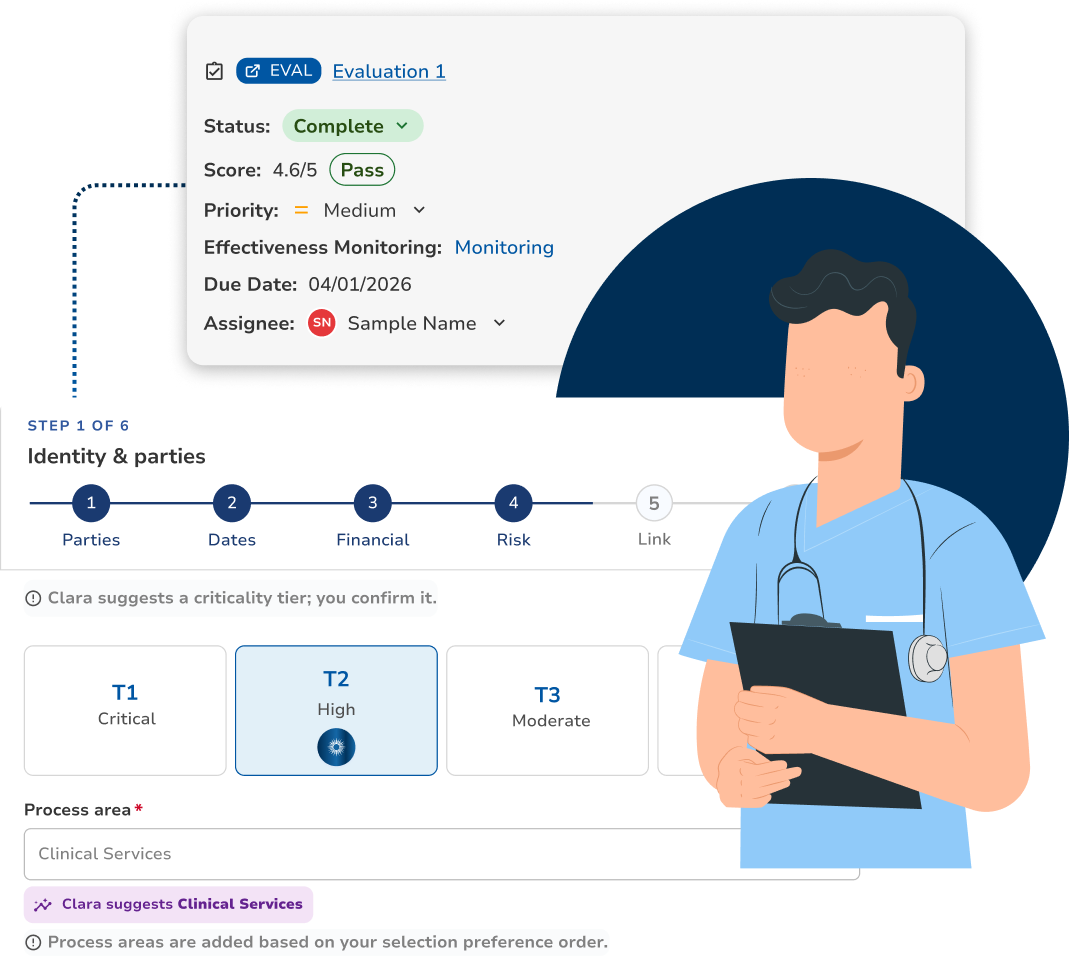
An Evaluation You Can Reconstruct
Define the criteria, score the vendor and compare them side by side in one view. Every weight, score and comment stays attached to the contract record so procurement can trace the benchmark and the reasoning behind it.
Criteria You Define
Build the criteria set before the first bid arrives, clinical fit, security posture, service levels, price, references, implementation burden. Weight each one, and lock the weights so nobody re-weights them after the scores come in.
Independent Scoring
Every reviewer scores in their own form without seeing anyone else’s numbers. Scores are revealed together once the last reviewer submits, so the loudest person in the meeting does not set the anchor for the room.
Evidence On Every Score
Attach what you scored from, the security questionnaire, the reference call notes, the pricing sheet, the sample report. A score with a document behind it survives a challenge. A number on its own does not.
Side-by-Side Comparison
Put every active contract in one view: category performance, total weighted score, price normalized to the same term length, and the gaps. The comparison is the working document your procurement team uses to assess relative vendor performance across current contracts.
Track the Strong Performers
Keep the evaluations that are doing well in one place so you can see what strong performance looks like across vendors. Use those patterns to guide your next scorecard, set better benchmarks, and spot the qualities worth looking for in other contracts.
Criteria Carry Forward
The criteria you scored on become the scorecard you monitor on. Nothing gets re-typed at signature, and the vendor gets measured on the same things you said mattered when you were still choosing.
DNV NIAHO GB.4 SR.2a requires your policy to define criteria for selection, evaluation, monitoring of performance and re-evaluation of external providers: the same four activities ISO 9001:2015 clause 8.4.1 requires you to document. GB.4 SR.2b then requires your governing body to review selected indicators at intervals your organization defines. Set the interval per vendor, score against your own criteria, and let the platform track what is due, what is complete and what has lapsed. The evaluation becomes a record you run, not a project you start.
How the Contract Record Stays Useful
The Evaluation Stays With the Contract
The same criteria, scores and evidence remain attached to the contract as the vendor relationship unfolds. Your benchmark is part of the record procurement uses to track performance, gaps and accountability over time.
Custom Fields Bring Visibility
Pull the terms that matter most into custom contract fields you can upload in bulk from Excel or extract from the document with AI. Once those fields are mapped, the platform shows the contract data you need at a glance instead of burying it in PDFs and spreadsheets.
Dates Become Obligations
Term length, notice period, renewal window, insurance and BAA requirements are pulled off the executed contract into the renewal calendar the moment it is signed.
See Renewal TrackingGaps Stay Visible
When a contract has a weak spot in one area, that gap stays attached to the record as a condition to monitor instead of disappearing once the agreement is signed.
Owners Stay Accountable
The requesting department and the contract owner stay attached to the record, so there is always a clear person to ask when performance slips or a condition needs attention.
Related
- Vendor OversightThe same contract record supports evaluation and ongoing oversight.
- Renewal TrackingThe dates in the agreement become a calendar as soon as it is executed.
- Vendor CAPsWhen a vendor misses what they were scored on, the corrective action starts here.
- Policy-Driven AutomationA failed evaluation criterion can open a corrective action automatically, under a rule you build once.
- Reporting & DashboardsTrend award cycle times and scoring spread, or export a full evaluation packet as a dated extract.
How Clara AI Enhances
Contract Evaluations
Clara reads the paperwork so your committee can spend its time on judgment. She drafts criteria, pulls terms out of long agreements, and flags what a proposal does not say. Every criterion, weight and score is still yours to set, change or reject; Clara never scores a vendor for you.

CLARA
Clarity in complianceClara reads
Clara proposes
You confirm every field Clara fills and set every weight. Clara never scores a vendor; the award decision stays with your committee.