Your Risk Register Should Know as Much as You Do.
Medlaunch's AI Risk Management is the first platform that combines every source of quality data across your organization. Findings, corrective actions, audits, incidents, complaints, outcomes united into one intelligent risk register that your team controls and Clara strengthens.
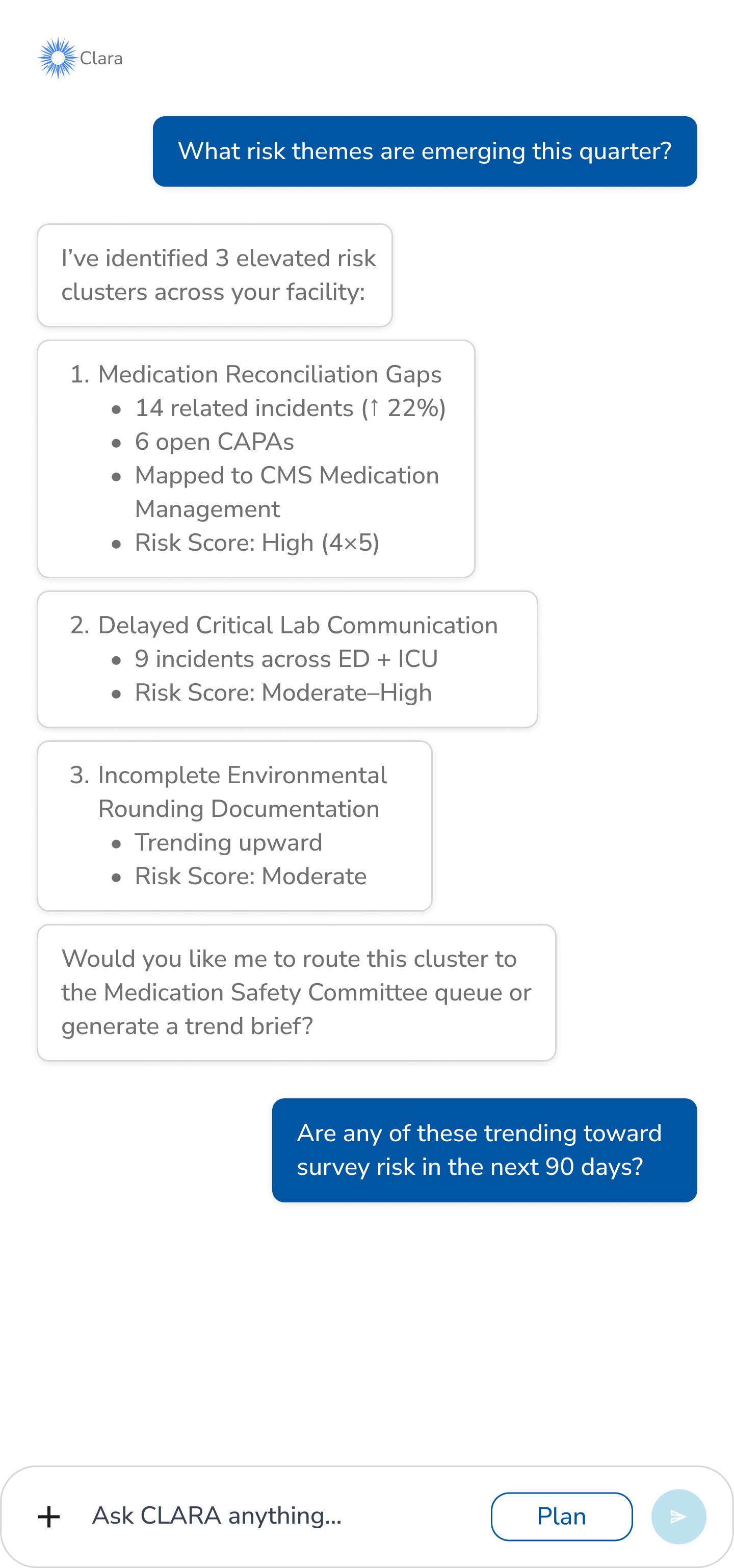
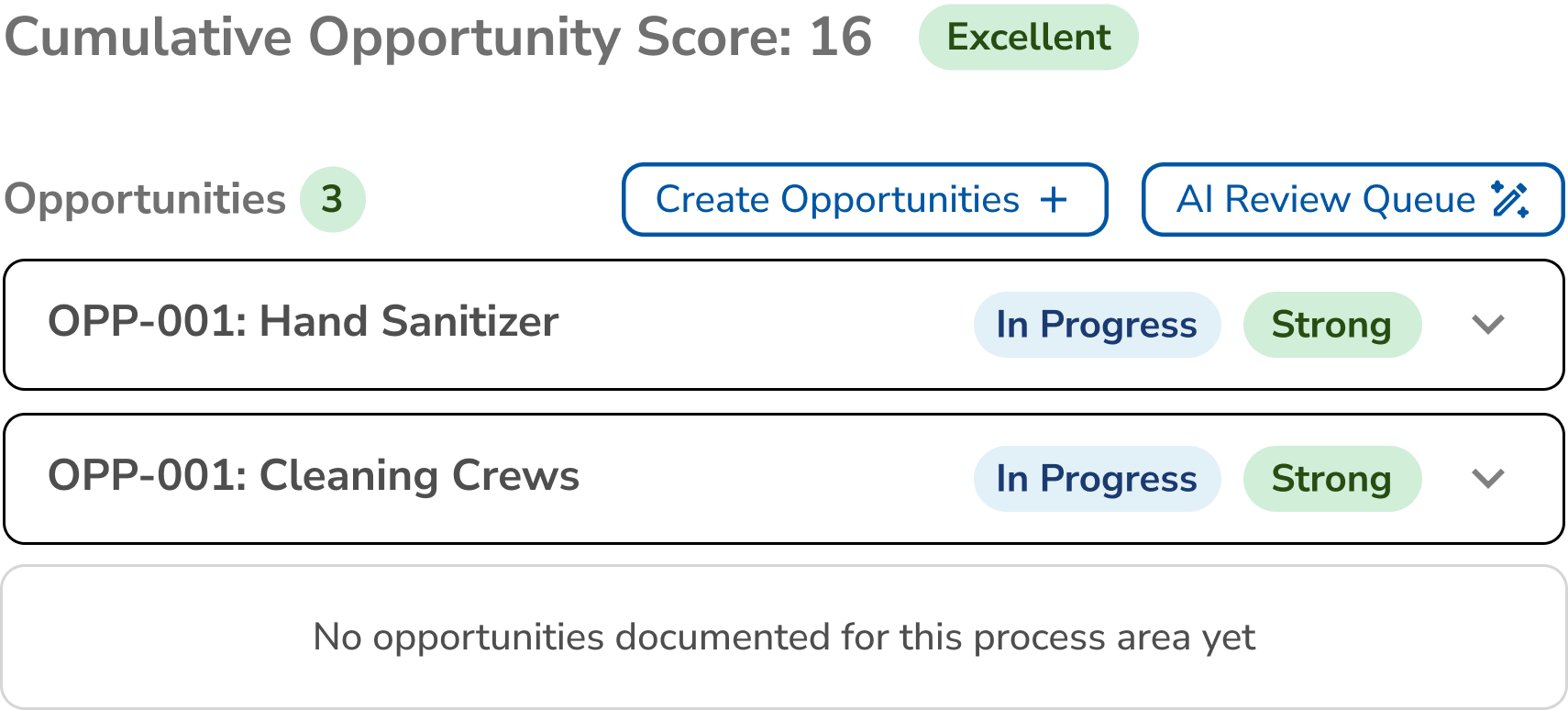
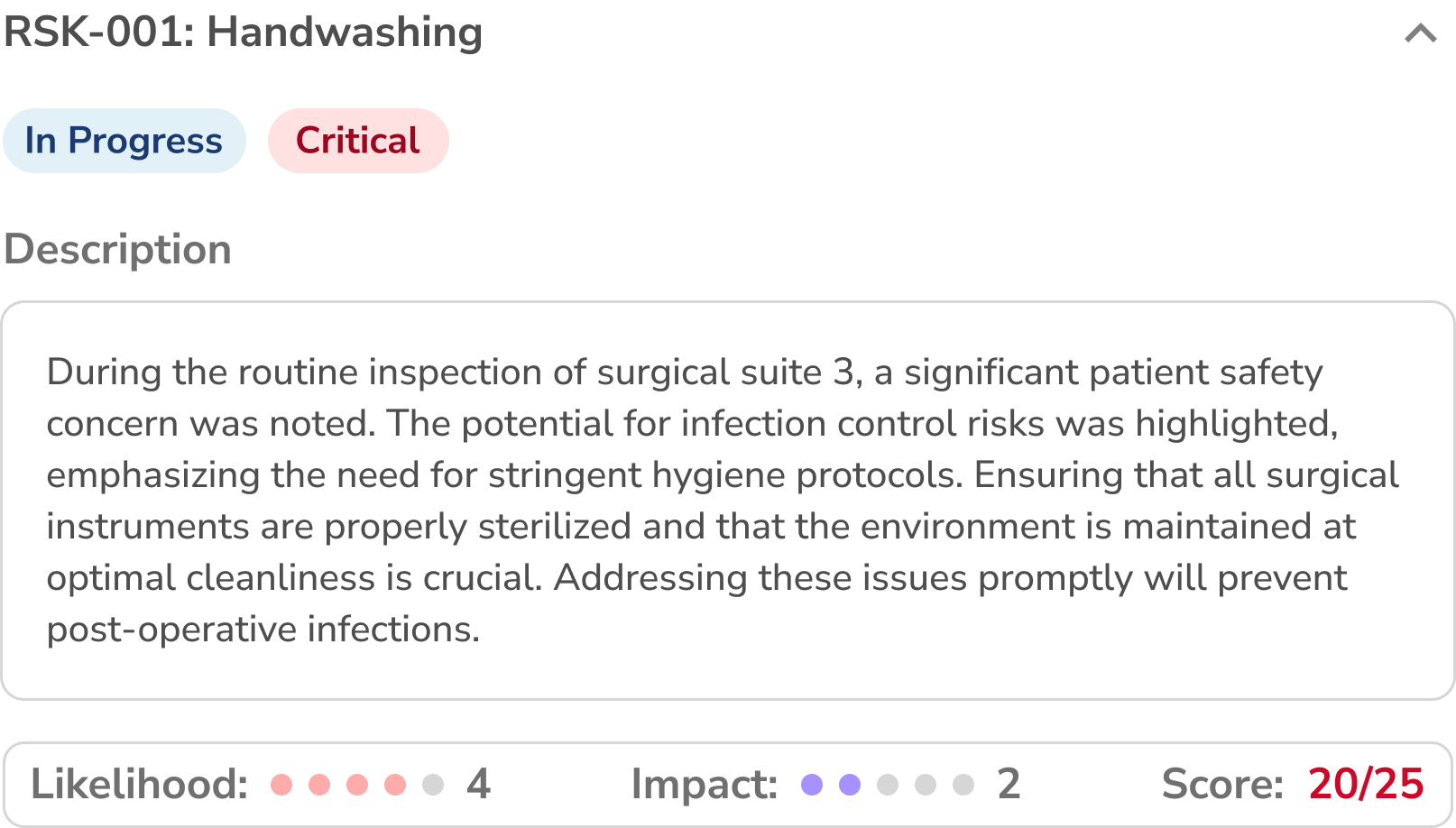
Built to Connect
Most hospitals still manage risk the same way they did a decade ago; a static spreadsheet someone updates before a survey, disconnected from the findings, corrective actions, and outcomes that actually define your risk posture. Findings live in one system. Corrective action plans live in another. Incidents, complaints, audit results, and performance data are scattered across departments. Nobody connects the dots, because no system was ever built to. Until Medlaunch was.
Comprehensive Tracking
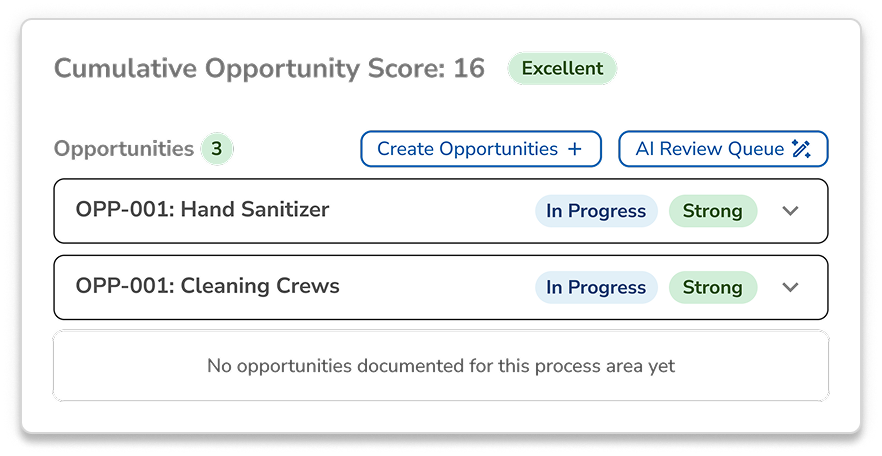
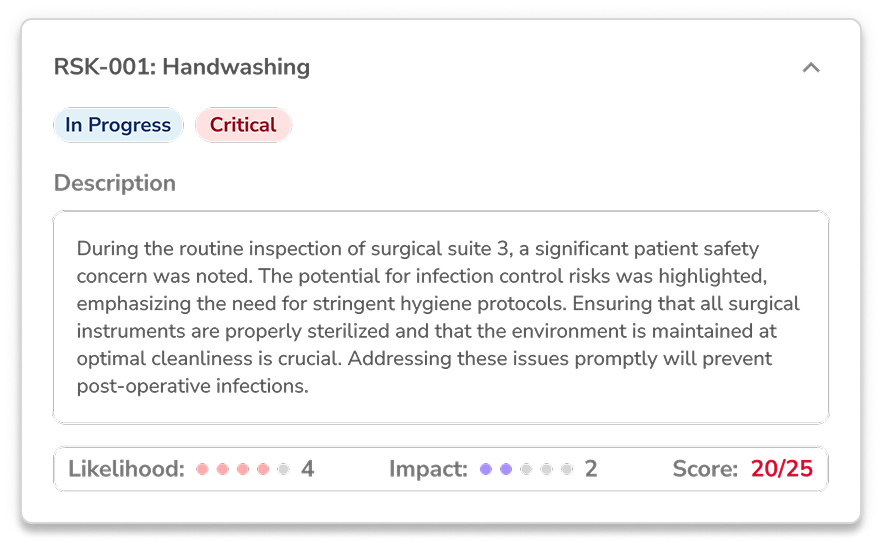
Medlaunch's AI Risk Management gives your quality team the platform to track risks and opportunities with full context linked evidence, structured scoring, escalation workflows, and more.
The Ultimate Teammate
Clara, Medlaunch's AI compliance engine, continuously analyzes everything within your system to surface the risks building silently and the opportunities hiding in your data. You review everything. You decide what enters the register. Clara makes sure nothing gets missed.
NOT a Digital Version of your Spreadsheet
This is an intelligent platform that knows what happened in your ICU last month, what corrective action resolved in the ED last quarter, what CMS is penalizing your peer hospitals for, and what your next surveyor is going to ask about. We connect all of it before you have to.
Your Risk Register, Connected to Everything
Every signal in your organization. One intelligent risk register.
Every Signal in your Organization.
One Intelligent Risk Register.
Medlaunch gives your quality team a structured view of risk and opportunity across every process area: Infection Control, Patient Rights, QAPI, Emergency Preparedness, Nursing Services, Pharmaceutical Services, and more. Organized by CMS Conditions of Participation so the structure maps directly to how surveyors evaluate your hospital.
But the register itself is just the surface. What makes this fundamentally different from any risk tool on the market is what's connected underneath it.
Every piece of quality data your organization generates feeds into the same platform under a shared taxonomy: findings and non-conformities, corrective action plans, root cause analyses, effectiveness monitoring results, internal audits, quality roundings, DNV surveys, incidents, patient complaints, observations, commendations, policies, quality objectives, CMS performance data, and for health systems, cross-site data from every facility.
Thirteen-plus data sources, all connected, all categorized under the same process areas, all available for your team to reference and for Clara to analyze.
When data is connected, invisible patterns become obvious. Medlaunch sees what spreadsheets never will:
Systemic Risk - Infection Control
- A patient complaint about room cleanliness.
- An observation during a quality rounding noting inconsistent terminal cleaning between patients.
- A finding from an internal audit citing gaps in environmental services training documentation.
- An incident report for a hospital-acquired MRSA case on the same unit.
- A commendation from a different unit for their enhanced cleaning protocol that reduced HAIs, meaning the solution already exists internally but hasn't spread.
Five signals, five different sources, five different people who logged them, and none of them know about the others. That's not five isolated issues. That's a systemic infection control risk with a patient safety incident already on the record and a proven fix sitting unused one floor away.
Corrective Action Erosion - Emergency Prep
- A finding from an internal audit noting incomplete emergency operations plan training records.
- An observation during a quality rounding that crash cart checks on two units are being signed off without actually verifying contents.
- An incident report from a code blue where a defibrillator battery was dead.
- A corrective action plan from six months ago that addressed code team response times- closed, but effectiveness monitoring shows response times creeping back up.
- A policy gap analysis showing the emergency management plan doesn't address updated requirements from last year.
None of these triggered an alarm on their own. Together, they tell a clear story. Emergency preparedness compliance is eroding, previous fixes aren't holding, and the next real emergency or the next survey will expose it.
Early Warning - Nursing Services
- An observation during a rounding noting a new-hire nurse unfamiliar with the unit's fall prevention protocol.
- A patient complaint about delayed call light response on night shift.
- A quality objective dashboard showing fall rates ticking up slightly over two quarters.
- A commendation for the med-surg unit's mentorship program that onboards new staff faster.
- An internal audit finding that competency assessments for agency nurses aren't being completed within the required timeframe.
No single red flag here. Each one looks routine in isolation. But the early pattern is forming: staffing competency gaps are starting to show up in outcomes, and a department down the hall already built the program that could fix it.
Systems-Wide Solutions
What you've been trying to do manually for years, now automated.
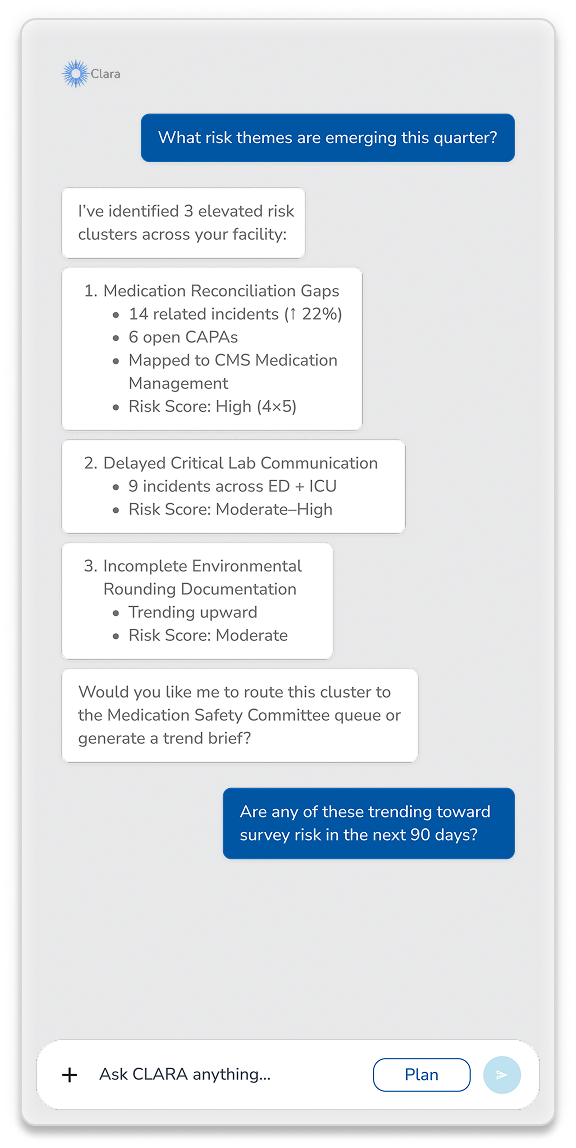
Ask Clara Anything About Your Risk Posture
Beyond the proactive analysis running behind the scenes, Clara is available to your team directly within the Risk Management page. Ask about your organization's risk posture in plain language:
The Risk Register That Works as Hard as Your Quality Team.
Track risks and opportunities with full context and linked evidence. Let Clara continuously analyze your organization's data to catch what's building and surface what's working. Keep your register current without the quarterly scramble.